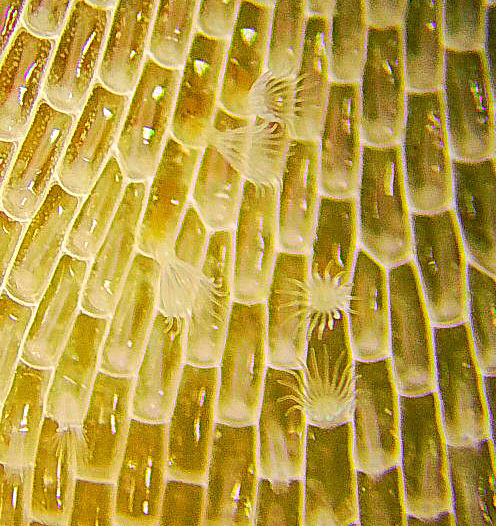
Bryozoans
Bryozoa
The Bryozoa (also known as the Polyzoa, Ectoprocta or commonly as moss animals) are a phylum of simple, aquatic invertebrate animals, nearly all living in sedentary colonies. Typically about 0.5 millimetres (1⁄64 in) long, they have a special feeding structure called a lophophore, a "crown" of tentacles used for filter feeding. The bryozoa are classified as the marine bryozoa (Stenolaemata), freshwater bryozoa (Phylactolaemata), and mostly-marine bryozoa (Gymnolaemata), a few members of which prefer brackish water. Most marine bryozoans live in tropical waters, but a few are found in oceanic trenches and polar waters. 5,869 living species of bryozoa are known. Originally all of the crown group Bryozoa were colonial, but as an adaptation to a mesopsammal (interstitial spaces in marine sand) life or to deep-sea habitats, secondarily solitary forms have since evolved. Five genera are solitary: Aethozooides, Aethozoon, Franzenella, Solella, which together make up the family Aethozoidae, and Monobryozoon, which has a statocyst-like organ with a supposed excretory function.
The terms Polyzoa and Bryozoa were introduced in 1830 and 1831, respectively. Soon after it was named, another group of animals was discovered whose filtering mechanism looked similar, so it was included in Bryozoa until 1869, when the two groups were noted to be very different internally. The new group was given the name "Entoprocta", while the original Bryozoa were called "Ectoprocta". Disagreements about terminology persisted well into the 20th century, but "Bryozoa" is now the generally accepted term.
3 branches of this phylum, most-observed first

Naked Throat Bryozoans
classGymnolaemata
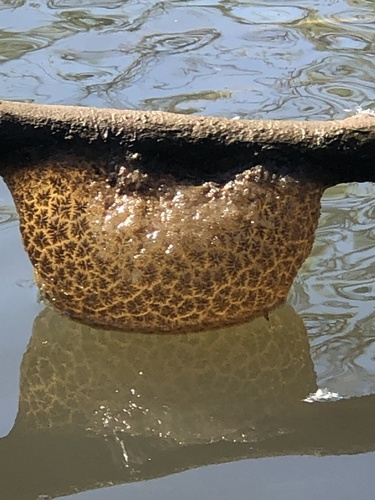
Freshwater bryozoans
classPhylactolaemata
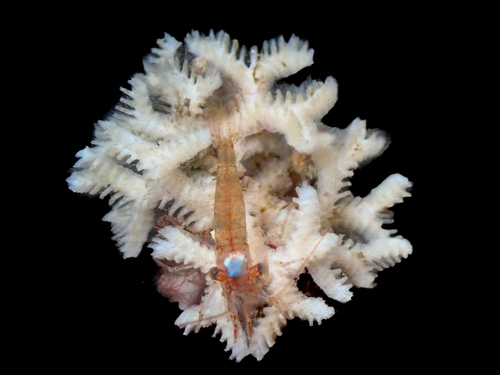
Narrow Throat Bryozoans
classStenolaemata
Where it lives
Recorded sightings
—
geo-referenced records in GBIF, from museums, herbaria and field observers.
Drag the globe to turn it. Dots are where records exist, not a range map; darker means more records.
In the stacks
Searching the stacks…
Every page naming Bryozoa in the Biodiversity Heritage Library →
This page is assembled live from iNaturalist, GBIF, Wikipedia, the Source Library and the Internet Archive. It is not yet part of the hand-edited codex. iNaturalist taxon 68104.