- Animals
- ›Arthropods
- ›Chelicerates
- ›Arachnids
- ›Spiders
- ›Typical Spiders
- ›Entelegyne Spiders
- ›Salticoid Spiders
- ›Jumping Spiders
- ›Typical Jumping Spiders
- ›Chrysillini
- ›Menemerus
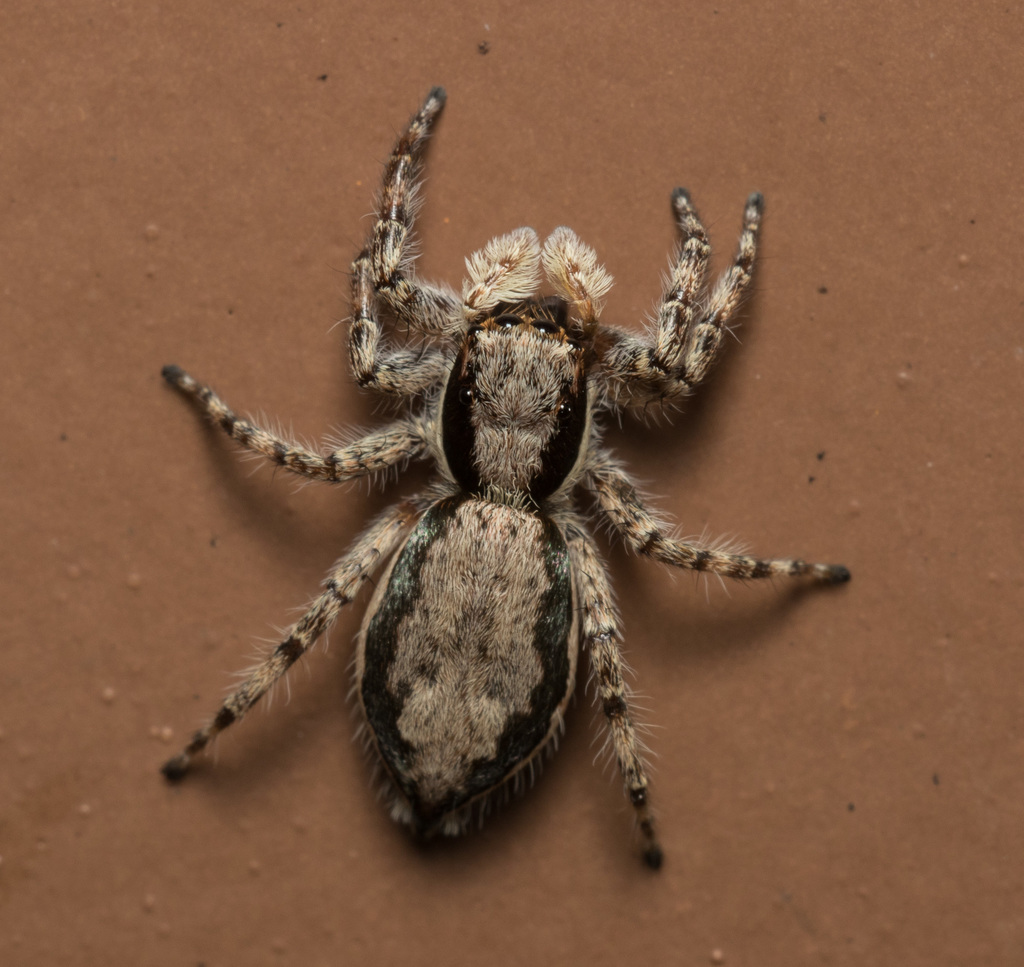
Gray Wall Jumping Spider
Menemerus bivittatus
Menemerus bivittatus is a spider in the Salticidae family commonly known as the gray wall jumper. It is a pantropical species and is usually found on the walls of buildings or on tree trunks where it stalks its prey.
From the article Menemerus bivittatus on Wikipedia (CC BY-SA), quoted section by section
Description
Gray wall jumpers are dorso-ventrally flattened and are covered with short dense, grayish-white hairs. There are tufts of dark brown bristles near the large, forward-facing eyes. The spiders are about nine millimetres long, the male being slightly smaller than the female. The male has a blackish longitudinal dorsal stripe with a brownish-white stripe on either side of the abdomen. The carapace and chelicerae are also black and white and the legs have transverse bandings of the same colours. The female is generally paler and more brown, with a larger carapace and abdomen. Her carapace is edged with two black bands and a thin white stripe and her abdomen is edged with broad black stripes on each side which unite at the posterior end. Her legs are banded but are paler than those of the male. Immature spiders resemble the female.
Range & habitat
Menemerus bivittatus is native to the Sub-Saharan region in Africa with Nigeria, Kenya, DR Congo, South Africa, Senegal, etc. but has been widely introduced, resulting in a cosmopolitan distribution. In America, the species is found in Florida, Texas, and California (USA) and south as far as Paraguay, including some Caribbean islands, Colombia, and Venezuela. It is often seen on the outside of man-made structures.
Wikipedia: “Distribution”
Where it lives
Recorded sightings
—
geo-referenced records in GBIF, from museums, herbaria and field observers.
Drag the globe to turn it. Dots are where records exist, not a range map; darker means more records.
In the stacks
Searching the stacks…
Every page naming Menemerus bivittatus in the Biodiversity Heritage Library →
This page is assembled live from iNaturalist, GBIF, Wikipedia, the Source Library and the Internet Archive. It is not yet part of the hand-edited codex. iNaturalist taxon 68062.