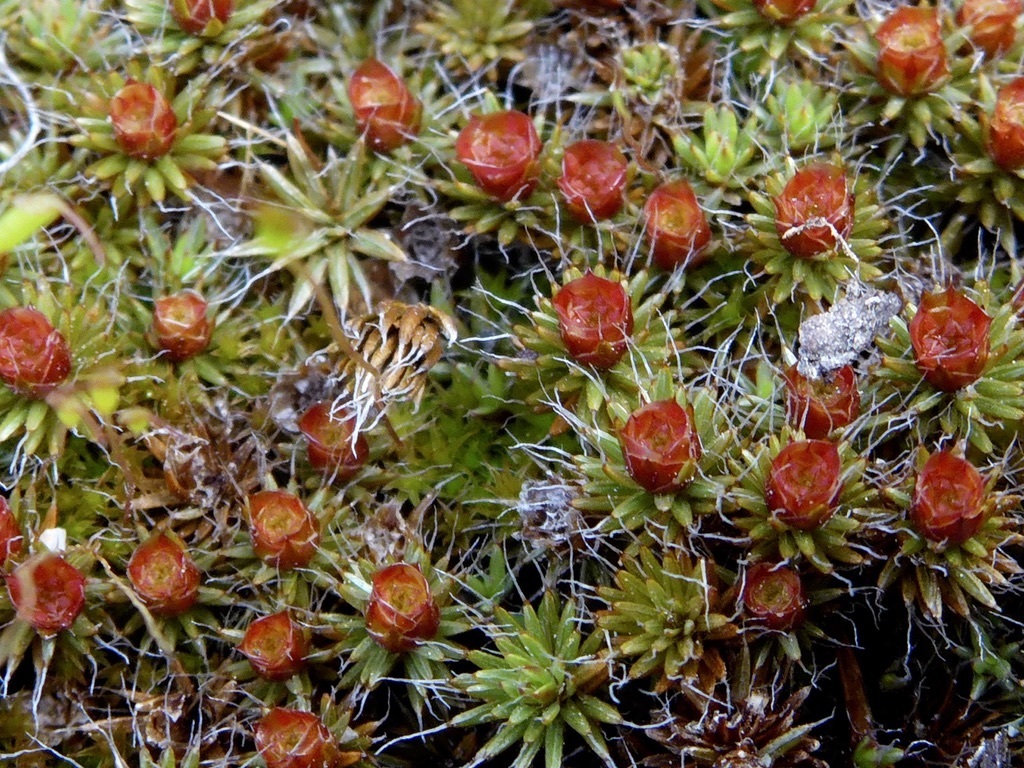
bristly haircap moss
Polytrichum piliferum
Polytrichum piliferum, the bristly haircap, is an evergreen perennial species of moss in the family Polytrichaceae. The bristly haircap moss is small-sized to medium-sized and forms loose tufts with wine-reddish stems. It is an acrocarpous moss that appears bluish-green to grey. This moss grows in clumps on erect shoots and becomes a red-brown colour as it grows older. The most distinguishing feature of P. piliferum is the long, white awn at the tips of the leaves, which also give this moss its grey colour. It is the only species in its genus where the awn is completely hyaline.
From the article Polytrichum piliferum on Wikipedia (CC BY-SA), quoted section by section
Range & habitat
Polytrichum piliferum has a bipolar, cosmopolitan distribution, occurring in suitable habitats on all continents including Antarctica. P. piliferum is less common than Polytrichum juniperinum and it often occurs in association with species of Cladonia. In sandy dry grass lands the species prevents higher plants from growing.
Habitat. It is found in similar habitats to Polytrichum juniperinum, however, P. piliferum prefers more open and exposed areas. P. piliferum also prefers a drier environment and is able to withstand temperatures as high as 90°C to 100°C. P. piliferum can also be frequently found in areas that are acidic and low in nutrients, therefore, they can be an excellent gauge for nutrient levels. The habitat of P. piliferum includes shallow soil over outcrops, exposed sandy soils of banks, gravel cover, and disturbed areas. Other habitats of P. piliferum includes rocks on road banks or pastures. It is also found in shallow and drained sand or gravel, like in ground over rocks and boulders.
Wikipedia: “Distribution”
What it does
P. piliferum is dioicous, meaning that it has separate male and female plants. To sexually reproduce, this moss utilizes the splash-cup mechanism to disperse the sperm it produces from its antheridia. The splash-cup mechanism occurs when raindrops splash onto the antheridia, collect sperm, and are hopefully splashed onto the female plant, where the sperm can swim to the archegonia.
Wikipedia: “Reproduction”
Where it lives
Recorded sightings
—
geo-referenced records in GBIF, from museums, herbaria and field observers.
Drag the globe to turn it. Dots are where records exist, not a range map; darker means more records.
In the stacks
Searching the stacks…
Every page naming Polytrichum piliferum in the Biodiversity Heritage Library →
This page is assembled live from iNaturalist, GBIF, Wikipedia, the Source Library and the Internet Archive. It is not yet part of the hand-edited codex. iNaturalist taxon 67905.