- Animals
- ›Arthropods
- ›Chelicerates
- ›Arachnids
- ›Spiders
- ›Typical Spiders
- ›Entelegyne Spiders
- ›Salticoid Spiders
- ›Jumping Spiders
- ›Typical Jumping Spiders
- ›Chrysillini
- ›Menemerus
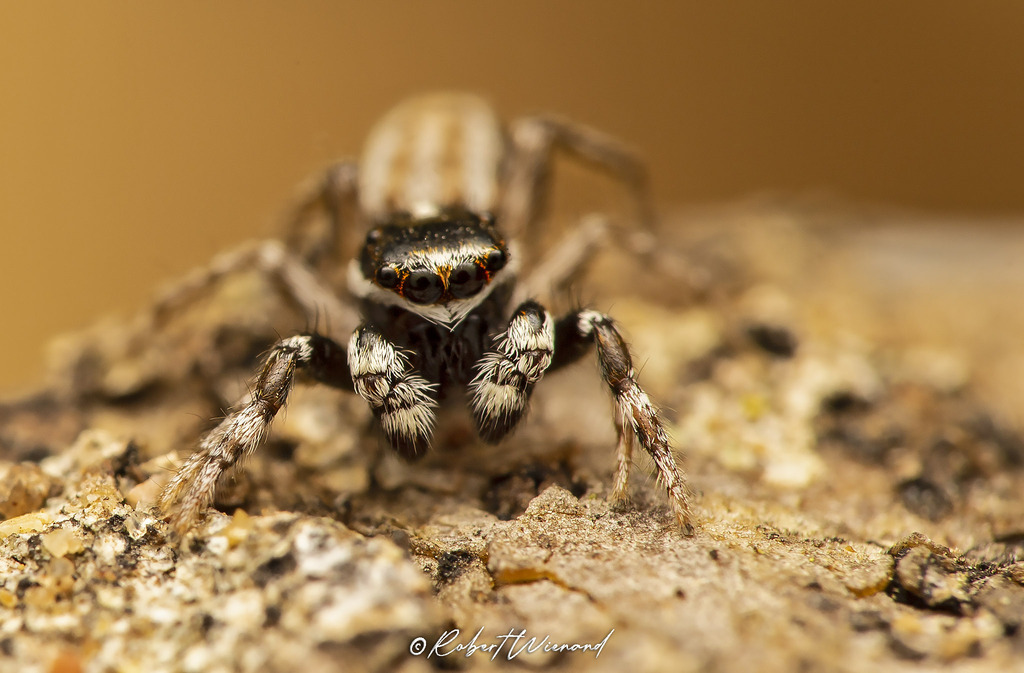
Menemerus minshullae
Menemerus minshullae is a species of jumping spider that lives in South Africa, Malawi and Zimbabwe. A member of the genus Menemerus, it lives on Vachellia xanthophloea trees, using its flattened shape to hide under flakes of bark. It is a small- to medium-sized spider with a forward section, or cephalothorax, that is between 1.9 and 2.2 millimetres (0.075 and 0.087 in) long and, behind that, an abdomen between 2.1 and 3.3 millimetres (0.083 and 0.130 in) long. Its female is larger than the male and lighter in colour, with a dark brown rather than black carapace and lighter brown abdomen. Both have an abdomen that has a large, leaf-shaped, pattern. Its copulatory organs distinguish the species from others in the genus. The male has a very short embolus with a larger accompanying conductor. The female epigyne, the external visible part of its copulatory organs, has two pockets that have strongly sclerotized edges. The species was first described in 1999 by Wanda Wesołowska, one of over 500 descriptions she has completed during her lifetime. She originally identified the male as a different species, named Menemerus manicus, but merged the two in 2007.
From the article Menemerus minshullae on Wikipedia (CC BY-SA), quoted section by section
Description
Menemerus minshullae is a small- to medium-sized spider. The male has a forward section, or cephalothorax, that is between 1.9 and 2.1 millimetres (0.075 and 0.083 in) long while the female cephalothorax is between 2.0 and 2.2 millimetres (0.079 and 0.087 in) long. In both the sexes, it is between 1.5 and 1.6 millimetres (0.059 and 0.063 in) wide. The female has a dark brown carapace, the hard upper side of its cephalothorax, that is between 1.6 and 2.1 millimetres (0.063 and 0.083 in) long and between 1.4 and 1.6 millimetres (0.055 and 0.063 in) wide with white stripes formed of hairs on its edges. In some examples, there are four white patches on the thorax. Its eye field is black, sometime with a metallic sheen, with occasional white hairs amongst the long brown hairs and brown bristles. Its sternum, or underside of the cephalothorax, is dark brown. The part of the spider's face known as its clypeus is low and also has white hairs. Its mouthparts, including its chelicerae and labium, are mainly dark brown; its maxilae are lighter, with white tips. The female has a brownish or light brown abdomen that is between 2.1 and 3.3 millimetres (0.083 and 0.130 in) in length and between 1.5 and 2.4 millimetres (0.059 and 0.094 in) in width. …
Range & habitat
Menemerus spiders are found throughout Africa and Asia, with some species introduced more widely. Menemerus minshullae is endemic to Africa. It has been found in South Africa, Malawi and Zimbabwe. The male holotype was discovered in the Bvumba Mountains near Mutare on border between Mozambique and Zimbabwe and the female nearby in Umtali in 1979. Other examples were found in Bulawayo in 1983 and 1989. It was subsequently also seen in the Sengwa Wildlife Research Area in 2001 and 2002. The first to be found in Malawi was collected in 1976 near Chintheche. The species range was expanded to South Africa when examples were identified in Ndumo Game Reserve between 2005 and 2007. The spider thrives in arboreal environments. It seems to be particularly fond of living on Vachellia xanthophloea, with the flattened shape of its body enabling it to hide under shards of bark that become loosened from the tree.
Wikipedia: “Distribution and habitat”
What it does
Due to their good eyesight, Menemerus spiders are mostly diurnal hunters. They attack using a complex approach to their prey and are generally more proactive in comparison to web-spinning spiders. The spiders will eat a wide range of prey, including nectar. They undertake complex displays and dances during courtship. Some of these will involve two males and a female. The males also undertake aggressive displays between themselves.
Wikipedia: “Behaviour”
In human culture
Menemerus minshullae is a species of jumping spider, a member of the family Salticidae, that was first described by the Polish arachnologist Wanda Wesołowska in 1999. She described two species, one named Menemerus minshullae and the other Menemerus manicus, but further discoveries led to the realisation that the two were simply the female and male respectively of the same species. In consequence, the two were combined under the current name. It is one of over 500 species identified by during her career, making her one of the most prolific in the field. She allocated the spider to the genus Menemerus. The genus was first described in 1868 by the French arachnologist Eugène Simon and contains over 60 species. Menemerus shares some characteristics with the genera Hypaeus and Pellenes. Genetic analysis has shown that the genus is related to the genera Helvetia and Phintella. The genus was placed in the tribe Heliophaninae until that was reconstituted as Chrysillini by Canadian scientist Wayne Maddison in 2015. The tribe is ubiquitous across most of the continents of the world. It is allocated to the subclade Saltafresia in the clade Salticoida. In 2016, Polish arachnologist Jerzy Prószyński created a group of genera named Menemerines after the genus. …
Wikipedia: “Taxonomy and etymology”
Where it lives
Recorded sightings
—
geo-referenced records in GBIF, from museums, herbaria and field observers.
Drag the globe to turn it. Dots are where records exist, not a range map; darker means more records.
In the stacks
Searching the stacks…
Every page naming Menemerus minshullae in the Biodiversity Heritage Library →
This page is assembled live from iNaturalist, GBIF, Wikipedia, the Source Library and the Internet Archive. It is not yet part of the hand-edited codex. iNaturalist taxon 674894.