- Animals
- ›Arthropods
- ›Chelicerates
- ›Arachnids
- ›Spiders
- ›Typical Spiders
- ›Entelegyne Spiders
- ›Orbweavers and Allies
- ›Orbweavers
- ›Mahembea
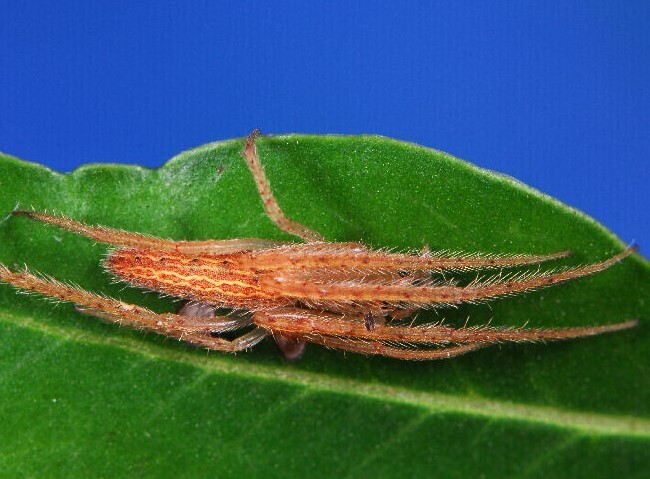
Mahembea hewitti
Mahembea is a genus of African orb-weaver spiders containing the single species, Mahembea hewitti. It was first created by M. Grasshoff in 1970 to separate this species from its original genus, Larinia. It has only been found in Central and East Africa.
From the article Mahembea on Wikipedia (CC BY-SA), quoted section by section
Description
Female and male spiders measure 7-8 mm in total length. The carapace is elongate, straw coloured to yellow orange, with a median longitudinal band. The abdomen is elongate extending past spinnerets with thin paired longitudinal bands. Legs are the same colour as body and bear setae with dark spots at their bases.
Range & habitat
Mahembea hewitti has a distribution from the Democratic Republic of the Congo to South Africa. The species is under-collected and is suspected to occur in more countries. In South Africa, the species is known from five provinces, Gauteng, KwaZulu-Natal, Limpopo, Mpumalanga, and North West. Notable locations include Polokwane Nature Reserve, Legalameetse Nature Reserve, iSimangaliso Wetland Park, and Kgaswane Mountain Reserve.
Wikipedia: “Distribution”
What it does
Mahembea hewitti inhabits Forest, Indian Ocean Coastal Belt, and Savanna biomes at altitudes ranging from 29 to 1,556 m above sea level. The spider makes orb-webs in grass and has been sampled from sugar cane fields.
Wikipedia: “Habitat and ecology”
In human culture
The species is named after John Hewitt, a South African herpetologist and arachnologist who made significant contributions to the study of southern African fauna.
Wikipedia: “Etymology”
Where it lives
Recorded sightings
—
geo-referenced records in GBIF, from museums, herbaria and field observers.
Drag the globe to turn it. Dots are where records exist, not a range map; darker means more records.
In the stacks
Searching the stacks…
Every page naming Mahembea hewitti in the Biodiversity Heritage Library →
This page is assembled live from iNaturalist, GBIF, Wikipedia, the Source Library and the Internet Archive. It is not yet part of the hand-edited codex. iNaturalist taxon 674011.