- Animals
- ›Arthropods
- ›Chelicerates
- ›Arachnids
- ›Spiders
- ›Typical Spiders
- ›Entelegyne Spiders
- ›RTA Clade Spiders
- ›Dionycha clade spiders
- ›Gnaphosoid Spiders
- ›Curly-legged Ground Spiders
- ›Cithaeron
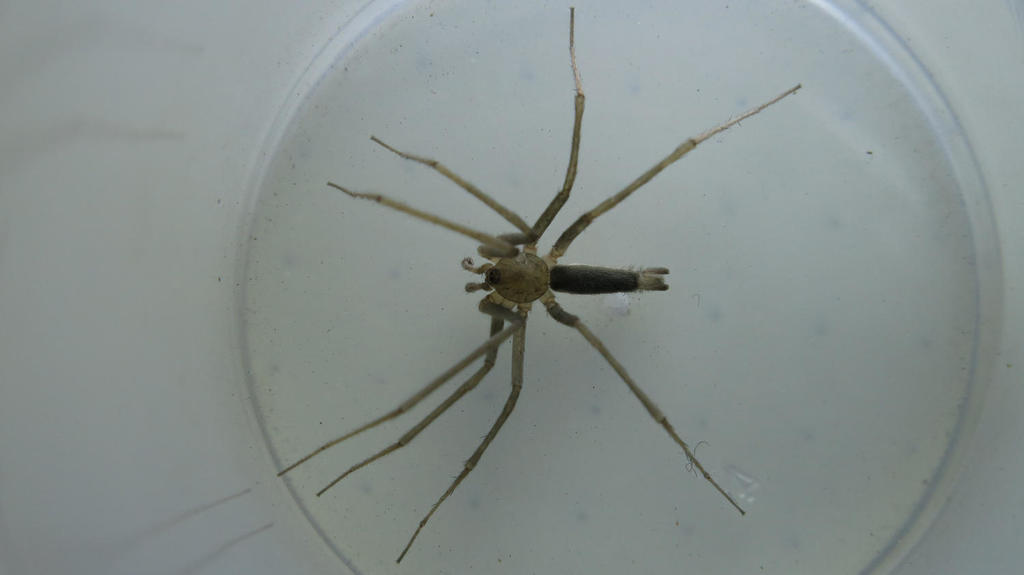
Cithaeron contentum
Cithaeron contentum is a species of spider in the family Cithaeronidae. It is endemic to South Africa.
From the article Cithaeron contentum on Wikipedia (CC BY-SA), quoted section by section
Description
The female has not been formally described. The male holotype has a total length of 6.67 mm. The first leg measures 15.08 mm in total length, while the fourth leg is 16.91 mm. The male pedipalp features an elongate cymbium that tapers towards the tip. The retrolateral tibial apophysis is bifid (split into two branches), with the upper branch pointed and the lower branch rounded at the tip. The embolus is notably elongated, with the distal two-thirds free from the bulb. The median apophysis has two distinct lobes: a ventral lobe that is tongue-shaped and translucent, and a dorsal lobe with a two-pointed notch at the tip. Cithaeron contentum can be distinguished from the closely related C. delimbatus Strand, 1906 by its rigid retrolateral tibial apophysis, elongate embolus that is not held closely to the bulb, and its bilobed median apophysis.
Range & habitat
Cithaeron contentum is known from two provinces in South Africa: Limpopo (Buzzard Mountain, Soutpansberg) and Mpumalanga (Blyde River Canyon Nature Reserve). The type locality is Blyde River Canyon Botanical Reserve in Mpumalanga.
Wikipedia: “Distribution”
In human culture
The specific epithet contentum is derived from the Latin word contentus, meaning "happy".
Wikipedia: “Etymology”
Where it lives
Recorded sightings
—
geo-referenced records in GBIF, from museums, herbaria and field observers.
Drag the globe to turn it. Dots are where records exist, not a range map; darker means more records.
In the stacks
Searching the stacks…
Every page naming Cithaeron contentum in the Biodiversity Heritage Library →
This page is assembled live from iNaturalist, GBIF, Wikipedia, the Source Library and the Internet Archive. It is not yet part of the hand-edited codex. iNaturalist taxon 657898.