- Animals
- ›Arthropods
- ›Crustaceans
- ›Typical Crustaceans
- ›Malacostracans
- ›Decapods, Isopods, and allies
- ›Decapods and Krill
- ›Decapods
- ›Crabs, Lobsters, Shrimps, and Allies
- ›True Crabs
- ›Eubrachyuran Crabs
- ›Heterotrematan Crabs
- ›Rock and Horse Crabs
- ›Rock Crabs
- ›Metacarcinus
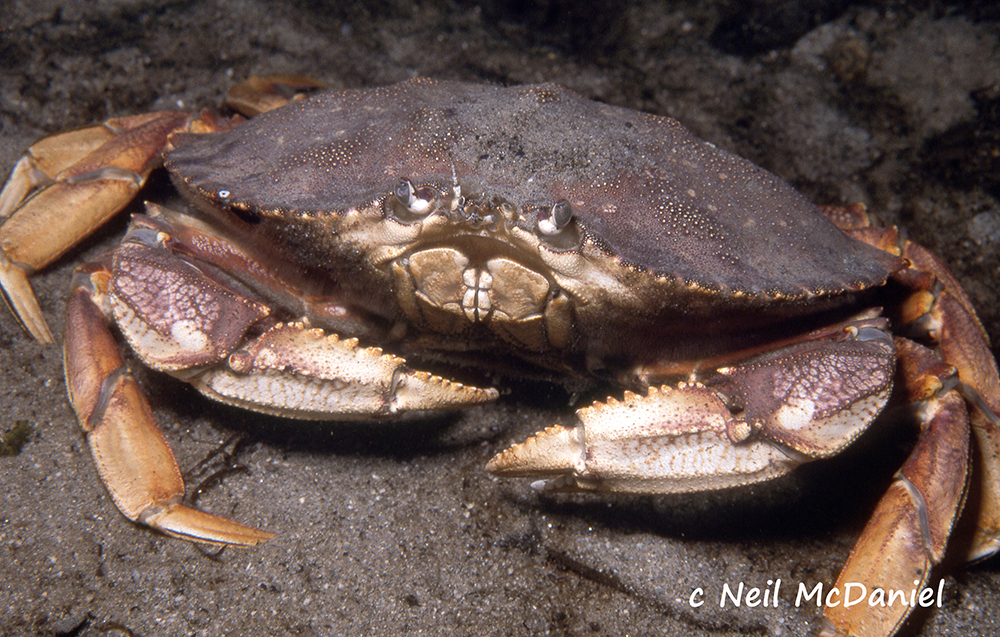
Dungeness Crab
Metacarcinus magister
The Dungeness crab (Metacarcinus magister) is a species of crab in the family Cancridae. It makes up one of the most important seafood industries along the west coast of North America. Its typical range extends from Alaska's Aleutian Islands to Point Conception, near Santa Barbara, California. Dungeness typically grow 6–7 in (150–180 mm) at their widest point and inhabit eelgrass beds and sandy bottoms. Its common name comes from the Dungeness Spit in the Strait of Juan de Fuca, Washington state, United States, which shelters a shallow bay inhabited by the crabs.
From the article Dungeness crab on Wikipedia (CC BY-SA), quoted section by section
Description
Dungeness crabs have four pairs of armored legs, two claws, and a wide, hard shell. A Dungeness's legs are shorter compared to other commercial crabs and their claws have a distinctive hook. The claws of the crab are used both as defense and to tear apart large food items. The crab uses its smaller appendages to pass the food particles into its mouth. Once inside the crab's stomach, food is further digested by the "gastric mill", a collection of tooth-like structures. Crabs must periodically molt to grow; this process is called ecdysis. Molting has the ability to regenerate lost limbs, although they will be smaller the first molt after loss. During a molt, the shell will separate where the carapace and abdomen meet. This allows the crab to exit the old shell. Once outside the old shell the soft new shell will fill with water and the crab will become 15-25% bigger than its original size. During the first few weeks after molting, the crab is very vulnerable due to the softness of its shell; the shell will not fully harden for two months after molting. For the first two years of a crab's life, it will molt six times a year. In the third year, males molt twice and females molt once. After that, all crabs will molt once a year, with females molting in the spring and males molting in the summer. …
Range & habitat
Dungeness are most often found in areas with sandy bottoms but can be found on a wide variety of bottom types. The crabs are found in high density from the intertidal zone to a depth of between 170 and 300 ft (52 and 91 m). Individual Dungeness have been found as deep as 2,624 ft (800 m). Adult Dungeness require water with surface temperatures ranging from 38–65 °F (3–18 °C) and salinity ranging from 11 to 35 practical salinity units (PSU). Larvae are much more sensitive to such environmental conditions as salinity and require temperatures of between 50 and 57 °F (10 and 14 °C). The typical range of the Dungeness extends from Alaska's Aleutian Islands to Point Conception, near Santa Barbara, California. Occasionally, the crab can be found as far south as Magdalena Bay, Baja California Sur, Mexico.
Wikipedia: “Habitat and range”
What it does
Mature female crabs generally molt in late spring, although exact timing varies with location. Mating occurs immediately after the female has molted and before the new exoskeleton hardens. Males are able to detect when females are molting, presumably through pheromones although this is not confirmed yet. Each mating season, male crabs may mate with many partners. Upon locating an available female, the male initiates a protective premating embrace that lasts for several days. In this embrace, the female is tucked underneath the male, oriented such that their abdomens touch and their heads face each other. The sperm deposited by the male is stored in the spermatheca and all sperm can be stored for up to two and a half years. This means a female may choose to use older sperm or not to mate at all during a given year. Fertilization occurs from October to December when eggs are deposited into the adnominal flap of the female. The females extrude the fertilized eggs and hold them in specialized hair located on their tail flap. Dungeness eggs are at first bright orange and darken as they develop. A single female can hold up to 2 million eggs depending on her size; females that use older sperm will carry fewer eggs. In the winter, a female crab will bury herself in the sand and become inactive in order to protect her eggs. …
Wikipedia: “Life cycle”
At the table
The Dungeness crab is considered a delicacy in the United States and Canada. Long before the area was settled by Europeans, Indigenous peoples throughout the crustacean's range had the crab as a traditional part of their diet and harvested them every year at low tide. The flesh has what is considered to be a delicate flavor and slightly sweet taste. Today they are an integral part of the cuisines of California, British Columbia, and the Pacific Northwest and traditionally feature in dishes like crab Louie or cioppino. About one-quarter of the crab's weight is meat. Dungeness crabs can typically be purchased either live or cooked. A humane way to kill a live crab is to: 1) stun the crab by submerging it in ice water for several minutes, 2) flip the crab onto its back, and 3) drive the tip of a small pick about an inch below the center of its mouth. However, many cook live crabs by simply dropping them into boiling salt water. The crab then is allowed to cook for 15 minutes, after which time the crabs are removed and placed into cold water to cool and then cleaned. Cleaning the crab consists of removing the shell, scooping out the gills and intestines, and separating the legs and claws from the body. When removing the shell there will be a yellow substance, called crab fat or crab mustard (which is not fat, but actually the hepatopancreas) and is used in many dishes. …
Wikipedia: “Culinary use”
Where it lives
Recorded sightings
—
geo-referenced records in GBIF, from museums, herbaria and field observers.
Drag the globe to turn it. Dots are where records exist, not a range map; darker means more records.
In the stacks
Searching the stacks…
Every page naming Metacarcinus magister in the Biodiversity Heritage Library →
This page is assembled live from iNaturalist, GBIF, Wikipedia, the Source Library and the Internet Archive. It is not yet part of the hand-edited codex. iNaturalist taxon 63697.