- Animals
- ›Echinoderms
- ›Sea Stars and Brittle Stars
- ›Sea Stars
- ›Spinulosacean Sea Stars
- ›Spinulosida
- ›Echinasterid Sea Stars
- ›Henricia
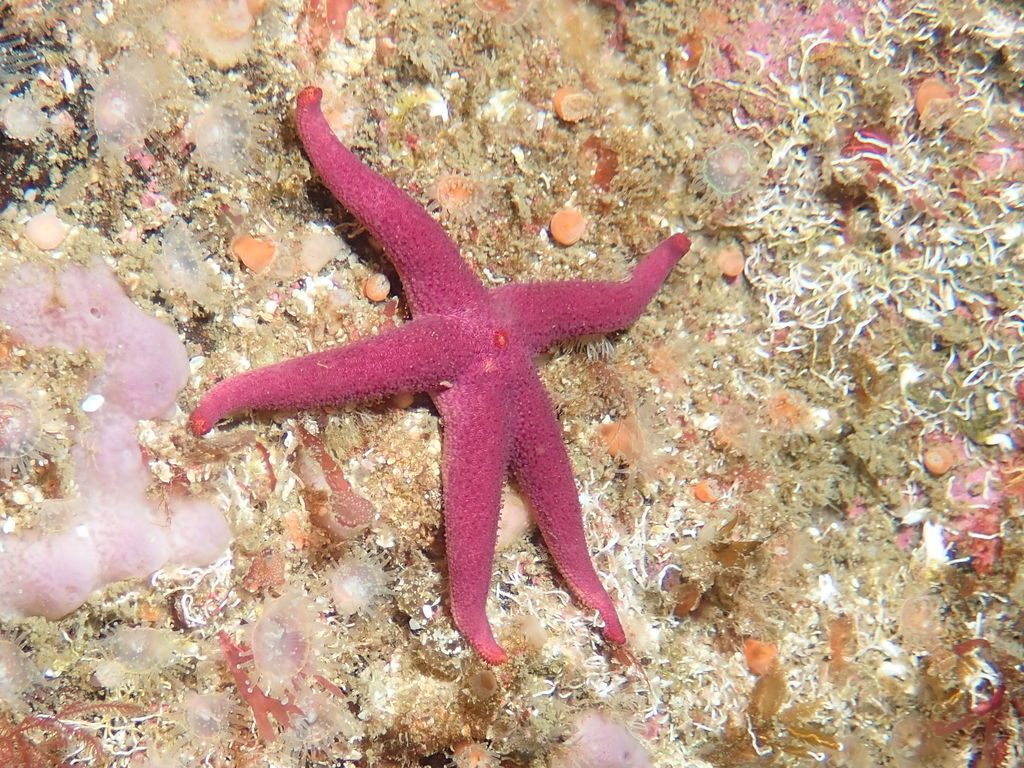
Northern Blood Star
Henricia sanguinolenta
Henricia sanguinolenta, commonly known as the northern henricia, is a species of sea star from the North Atlantic and North Pacific Oceans. Henricia sanguinolenta is very similar to Henricia oculata, also known as "bloody Henry", and the two can only be distinguished by laboratory tests. It comes in colors of red, yellow, orange, purple, and lavender.
From the article Henricia sanguinolenta on Wikipedia (CC BY-SA), quoted section by section
Description
Rays
Henricia sanguinolenta is an invertebrate. It has slender five rays that taper evenly to tips that are connected by a central disc. The sea star grows to a diameter of 5 to 12 centimeters. On the oral side, the rays are smooth and have an ambulacral groove that contains two tube foot rows. On the dorsal side, the rays are rough with groupings of spinelets, each one have three to six glassy points. The sides of the rays are curving and smooth. The rays contain many of the organs in the sea star. On the tips of the rays are the eyespots. These are dark pigmented organs that sense the presence of light. The rays also contain parts of the pyloric stomach, parts of the nervous system, and most other organs.
Tube foot rows
The tube foot rows are on the oral side of the rays. Each ray has two tube foot rows. The tube foot rows are attached to the rays by ambulacral grooves. The Tube Foot Rows use a chemical adhesive to stick to surfaces instead of suction. The tube foot rows help the sea star stick to its prey, and to bring the prey to its mouth. The tube foot rows also aid in gas exchange. the tube foot rows are sensitive to chemicals enabling the sea star to detect chemical trails left by possible food. The tube foot rows also excrete waste ammonia through diffusion.
Nervous system
Henricia sanguinolenta has no brain, but has a nervous system. …
Wikipedia: “Anatomy”
Range & habitat
Henricia sanguinolenta is found in the North Atlantic and North Pacific oceans. The sea star can be seen on the beach, under rocks, in tidal pools when available, and on gravel. Its aquatic biomes are the coastal and benthic zones. The sea star is almost always found near sponges and coral because of the currents they create, making it easier for the sea star to filter feed. Henricia sanguinolenta is found from depths of 0 to 2414 meters.
Wikipedia: “Habitat”
What it does
Henricia sanguinolenta is a planktivore and carnivore. The sea star filter feeds upon detritus and plankton floating in the water, and uses currents made by sponges or coral to make this process easier. Henricia feeds on plankton, sponge tissue, ascidians, and other invertebrates. It is eaten by vertebrates.
Wikipedia: “Diet”
Where it lives
Recorded sightings
—
geo-referenced records in GBIF, from museums, herbaria and field observers.
Drag the globe to turn it. Dots are where records exist, not a range map; darker means more records.
In the stacks
Searching the stacks…
Every page naming Henricia sanguinolenta in the Biodiversity Heritage Library →
This page is assembled live from iNaturalist, GBIF, Wikipedia, the Source Library and the Internet Archive. It is not yet part of the hand-edited codex. iNaturalist taxon 62364.