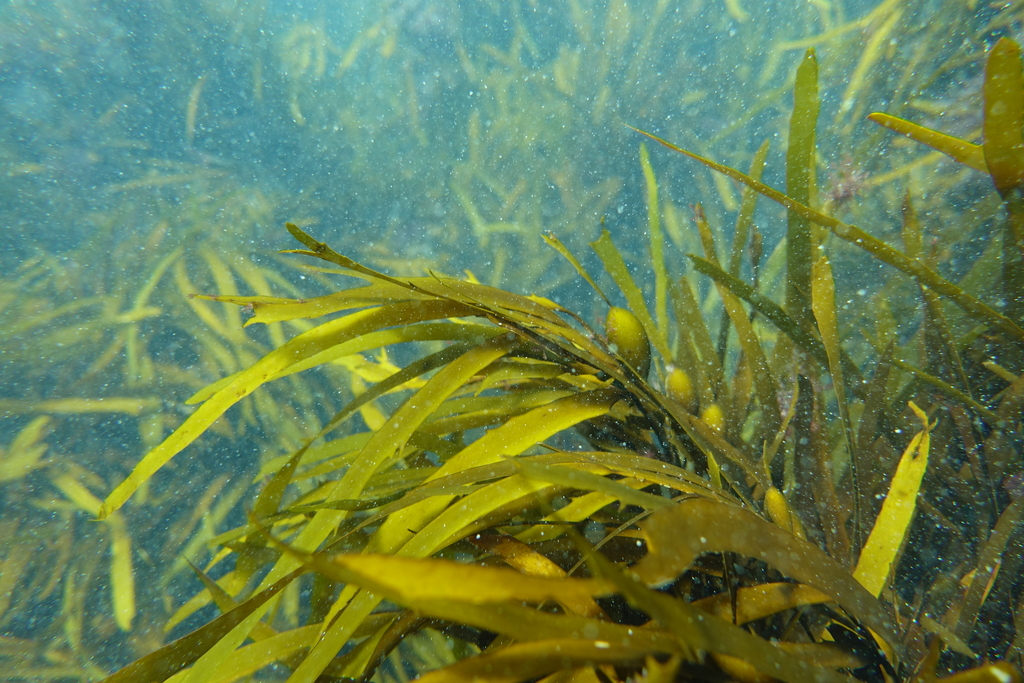
Crayweed
Phyllospora comosa
Phyllospora comosa, known as crayweed, is a species of brown algae in the Seirococcaceae family. It forms temperate seaweed forests that are important as habitat for many marine species and also for producing oxygen and capturing atmospheric carbon.
From the article Phyllospora comosa on Wikipedia (CC BY-SA), quoted section by section
Description
Crayweed grows up to 2.5 m (8 ft 2 in) in length and forms dense, shallow forests.
Range & habitat
Crayweed is found in the oceans around Australia and New Zealand. It is abundant in cooler waters along the south-eastern coastline of Australia, around Tasmania and in South Australia. It occurs to a depth of around five metres (16 ft) on the east coast and farther south to about three metres (9.8 ft). On some Tasmanian coasts it can occur depths of at 18 metres (59 ft). It used to occur around Sydney, but disappeared from metropolitan areas under pressure from human activities during the 1970s and 1980s. The algae have a central main axis, usually up to 3 m (9.8 ft) long, which bear many branches along their length, with closely arranged, leaf-like laterals. Some laterals have conceptacles, in which develop cells which produce sperm and eggs. The strongly seasonal growth of the algae depends on the length of daylight; it occurs from apical cells and is restricted to the top 20–30 cm (7.9–11.8 in) of the branches.
Wikipedia: “Distribution”
Where it lives
Recorded sightings
—
geo-referenced records in GBIF, from museums, herbaria and field observers.
Drag the globe to turn it. Dots are where records exist, not a range map; darker means more records.
In the stacks
Searching the stacks…
Every page naming Phyllospora comosa in the Biodiversity Heritage Library →
This page is assembled live from iNaturalist, GBIF, Wikipedia, the Source Library and the Internet Archive. It is not yet part of the hand-edited codex. iNaturalist taxon 623246.