- Animals
- ›Molluscs
- ›Gastropods
- ›Heterobranchs
- ›Euthyneura
- ›Tectipleura
- ›Hygrophila
- ›Pond Snails, Bladder Snails, and Allies
- ›Pond and Melantho Snails
- ›Pond Snails
- ›Lymnaeini
- ›Lymnaea
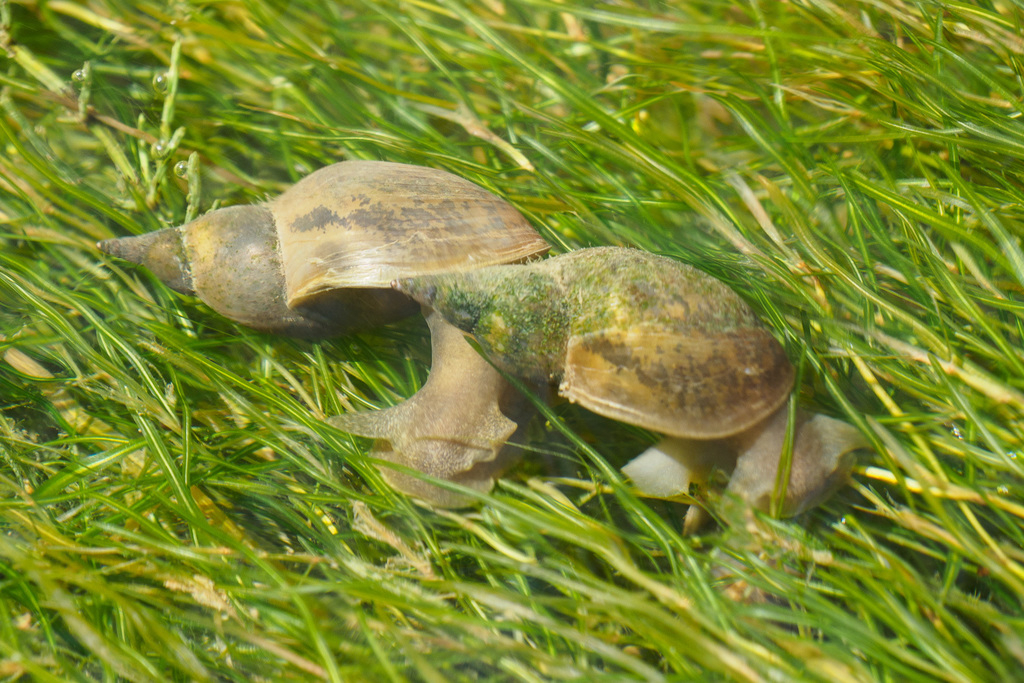
Great Pond Snail
Lymnaea stagnalis
Lymnaea stagnalis, better known as the great pond snail, is a species of large air-breathing freshwater snail, an aquatic pulmonate gastropod mollusk in the family Lymnaeidae. The great pond snail is a model organism to study parasitology, neurology, embryonal development and genetic regulation.
Limnaea stagnalis var. baltica Lindström, 1868: synonym of Lymnaea stagnalis (Linnaeus, 1758)
From the article Lymnaea stagnalis on Wikipedia (CC BY-SA), quoted section by section
Range & habitat
The distribution of this species is holarctic, mainly the temperate zones of Northern America, Europe and Asia. The snail can be found in many ponds, lakes and very slow-moving rivers with a rich underwater vegetation. The northernmost populations exist in northern Norway, and in Central Europe, it inhabits even montane ecosystems at 1700 meters above sea level. In the Saprobic system used in Germany to judge the quality of freshwater biotopes, the species has a value of 1.9 and indicates a biotope with a water quality class II, the second-highest.
Wikipedia: “Distribution”
What it does
Lymnaea stagnalis is a simultaneously hermaphroditic species and can mate in the male and female role, but within one copulation only one sexual role is performed at a time. Lymnaea stagnalis perform more inseminations in larger groups and prefer to inseminate novel over familiar partners. Such higher motivation to copulate when a new partner is encountered is known as the Coolidge effect and has been demonstrated in hermaphrodites firstly in 2007.
Wikipedia: “Life cycle”
Where it lives
Recorded sightings
—
geo-referenced records in GBIF, from museums, herbaria and field observers.
Drag the globe to turn it. Dots are where records exist, not a range map; darker means more records.
In the stacks
Searching the stacks…
Every page naming Lymnaea stagnalis in the Biodiversity Heritage Library →
This page is assembled live from iNaturalist, GBIF, Wikipedia, the Source Library and the Internet Archive. It is not yet part of the hand-edited codex. iNaturalist taxon 61770.