- Animals
- ›Arthropods
- ›Chelicerates
- ›Arachnids
- ›Spiders
- ›Typical Spiders
- ›Entelegyne Spiders
- ›Thomisoidea Spiders
- ›Crab Spiders
- ›Thomisinae
- ›Thomisini
- ›Thomisus
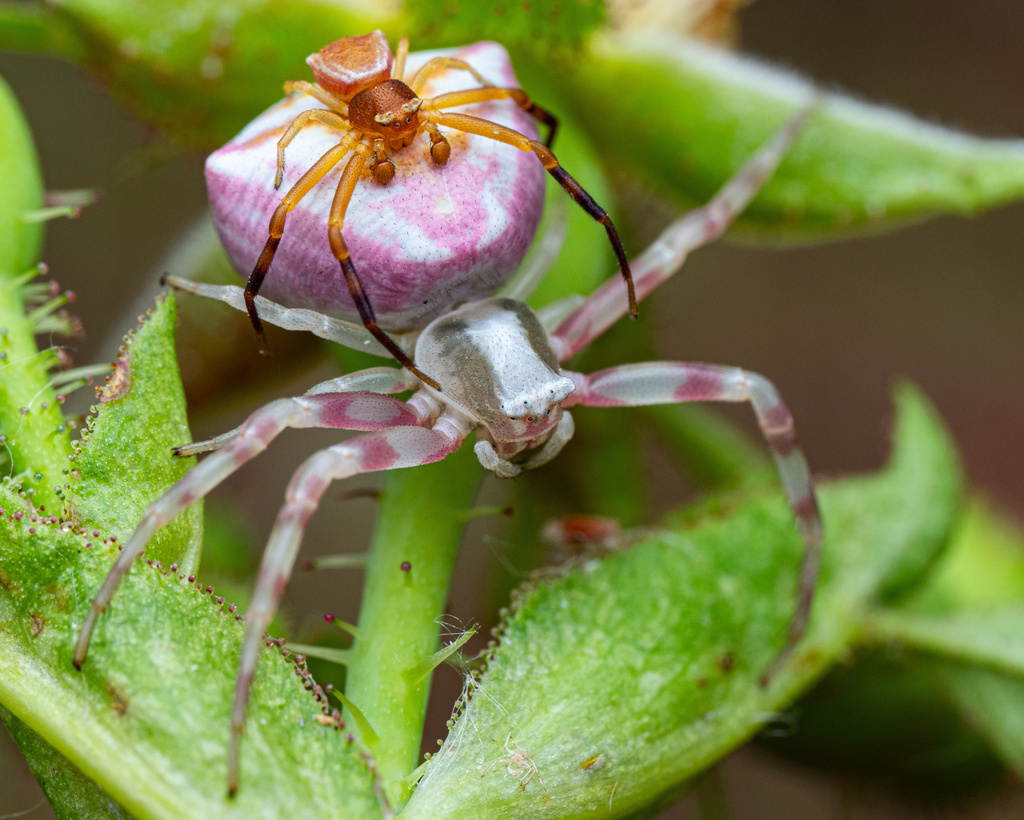
Heather crab spider
Thomisus onustus
Thomisus onustus is a crab spider belonging to the genus Thomisus. These spiders are found across Europe, North Africa, and parts of the Middle East and Asia. T. onustus reside in flowers in lowland vegetation. Females are distinguished by their larger size and ability to change color between white, yellow, and pink as a means of matching flower color. This cryptic mimicry allows them to both evade predators and enhance insect prey capture abilities. Males are smaller, more slender, and drab in coloration, usually green or brown. T. onustus is also distinguished from other relatives by its distinct life cycle patterns in which spiderlings emerge in either late summer or early spring. Furthermore, T. onustus have developed a mutualistic relationship with host plants where spiders feed on and/or deter harmful florivores while benefiting from the plant's supply of pollen and nectar, which T. onustus spiders are able to use as food sources, especially during periods of low insect prey abundance.
From the article Thomisus onustus on Wikipedia (CC BY-SA), quoted section by section
Description
T. onustus is a medium-sized spider that exhibits sexual dimorphism, with females between lengths of 7–11 mm and smaller males ranging between lengths of 2–4 mm. Females are heavy-bodied and mostly stationary, whereas males are slender and more motile. Females have a pink, yellow, or white prosoma and males are brown to green-yellow in color. Both sexes have a triangular opisthosoma. This species can be distinguished from its close relative Thomisus zyuzini by its long ventral tibial apophysis and retrolateral tibial apophysis, the arrangement of the basal tibia tubercle on the male palp, and the circular intromittent orifice, which is oriented anteriad in the epigynum.
Range & habitat
T. onustus typically reside on shrubs and within lowland vegetation, preferring warmer areas. They inhabit a wide variety of flowers and herbs, usually staying at the flowering peaks. T. onustus is unique among crab spider species in that it prefers to situate itself in flower centers, which have unique spectral properties, over petals. T. onustus are distributed across Europe, North Africa, Turkey, Caucasus, Russia (from Europe to South Siberia), Israel, Central Asia, Iran, China, Korea, and Japan, preferring warm areas.
Wikipedia: “Habitat and distribution”
What it does
T. onustus are summer-stenochronus spiders (summer reproductive season) and sit-and-wait predators. They stay in flower corollas and wait for insect prey including bees (Apoidea), butterflies (Lepidoptera), hoverflies (Syrphidae), diptera, hymenoptera, and other spiders. T. onustus are cursorial spiders and do not use silk for prey capture. Instead, they use their long raptorial forelegs to ambush nearby insects. They frequently prey on insects far larger than themselves, ranging from 1.25 to 16.00mm in length. Males feed less and tend to prey on smaller insects. While some Australian crab spider species are able to use the reflection of UV light to generate a deceptive signal that attracts prey to host flower species, European species, including T. onustus, lack this ability. Honeybees attracted to the UV reflectance of Australian species, for example, are repelled by the presence of T. onustus. When T. onustus acts as an ambush predator, it influences the ways in which pollinators, such as honeybees and hoverflies, manage the trade-off between predation rate and resource intake. Honey bees, for example, will avoid resource (nectar) poor habitats as well as those with higher concentrations of crab spiders, preferring to frequent safer areas. However, honeybees are more susceptible to predation by crab spiders and competition is more intense in these areas. …
Wikipedia: “Predatory feeding”
Where it lives
Recorded sightings
—
geo-referenced records in GBIF, from museums, herbaria and field observers.
Drag the globe to turn it. Dots are where records exist, not a range map; darker means more records.
In the stacks
Searching the stacks…
Every page naming Thomisus onustus in the Biodiversity Heritage Library →
This page is assembled live from iNaturalist, GBIF, Wikipedia, the Source Library and the Internet Archive. It is not yet part of the hand-edited codex. iNaturalist taxon 59281.