- Animals
- ›Echinoderms
- ›Sea Stars and Brittle Stars
- ›Sea Stars
- ›Valvatacean Sea Stars
- ›Valvatidan Sea Stars
- ›Ophidiasteridae
- ›Linckia
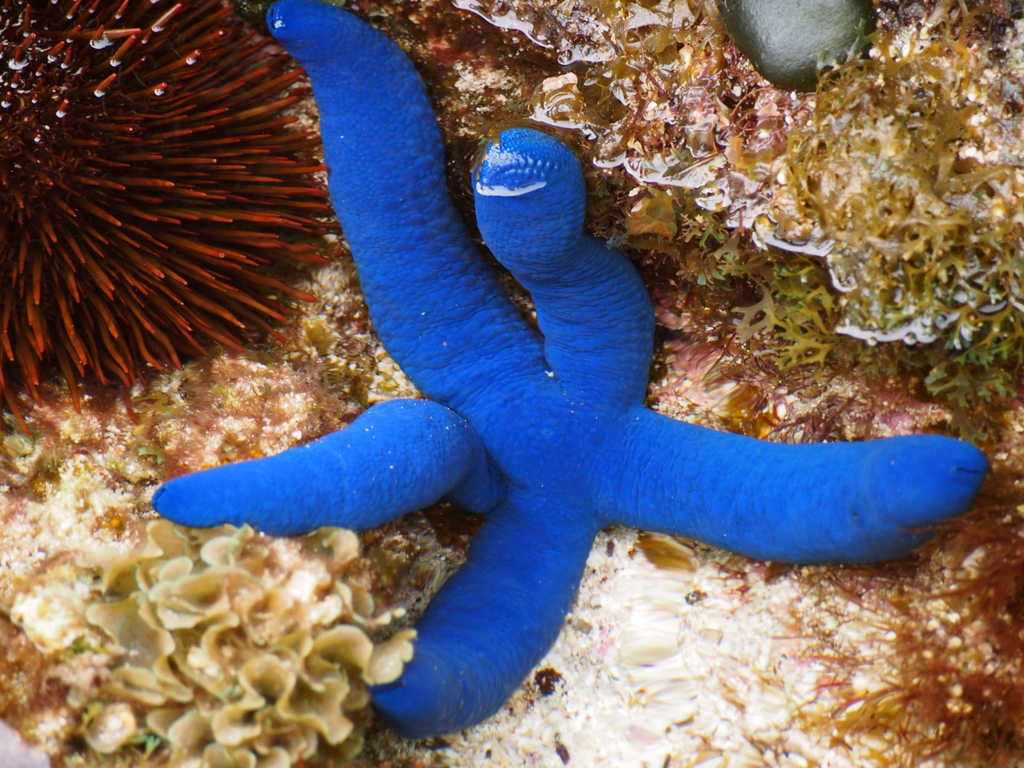
Blue Linckia
Linckia laevigata
Linckia laevigata (sometimes called the "blue Linckia" or blue star) is a species of sea star (commonly known as a starfish) in the shallow waters of tropical Indo-Pacific (a biogeographic region of the Earth's seas, comprising the tropical waters of the Indian Ocean, the western and central Pacific Ocean, and the seas connecting the two in the general area of Indonesia.
From the article Linckia laevigata on Wikipedia (CC BY-SA), quoted section by section
Description
The variation ("polymorphism", in this case, a "color morph") most commonly found is pure blue, dark blue, or light blue, although observers find the aqua, purple, or orange variation throughout the ocean. These sea stars may grow up to 30 cm (11.8 in) in diameter, with rounded tips at each of the arms; some individuals may bear lighter or darker spots along each of their arms. Individual specimens are typically firm in texture, possessing the slightly tubular, elongated arms common to most of other members of the family Ophidiasteridae, and usually possessing short, yellowish tube feet. An inhabitant of coral reefs and sea grass beds, this species is relatively common and is typically found in sparse density throughout its range. Blue stars live subtidally, or sometimes intertidally, on fine (sand) or hard substrata and move relatively slowly (mean locomotion rate of 8.1 cm/min). The genus Linckia, as is true of other species of starfish, is recognized by scientists as being possessed of remarkable regenerative capabilities, and endowed with powers of defensive autotomy against predators: Although not yet documented, L. …
Wikipedia: “Description and characteristics”
Where it lives
Recorded sightings
—
geo-referenced records in GBIF, from museums, herbaria and field observers.
Drag the globe to turn it. Dots are where records exist, not a range map; darker means more records.
In the stacks
Searching the stacks…
Every page naming Linckia laevigata in the Biodiversity Heritage Library →
This page is assembled live from iNaturalist, GBIF, Wikipedia, the Source Library and the Internet Archive. It is not yet part of the hand-edited codex. iNaturalist taxon 57745.