- Animals
- ›Arthropods
- ›Chelicerates
- ›Arachnids
- ›Spiders
- ›Mygalomorphs
- ›Avicularioidea
- ›Tarantulas
- ›Southern Baboon Spiders
- ›Harpactira
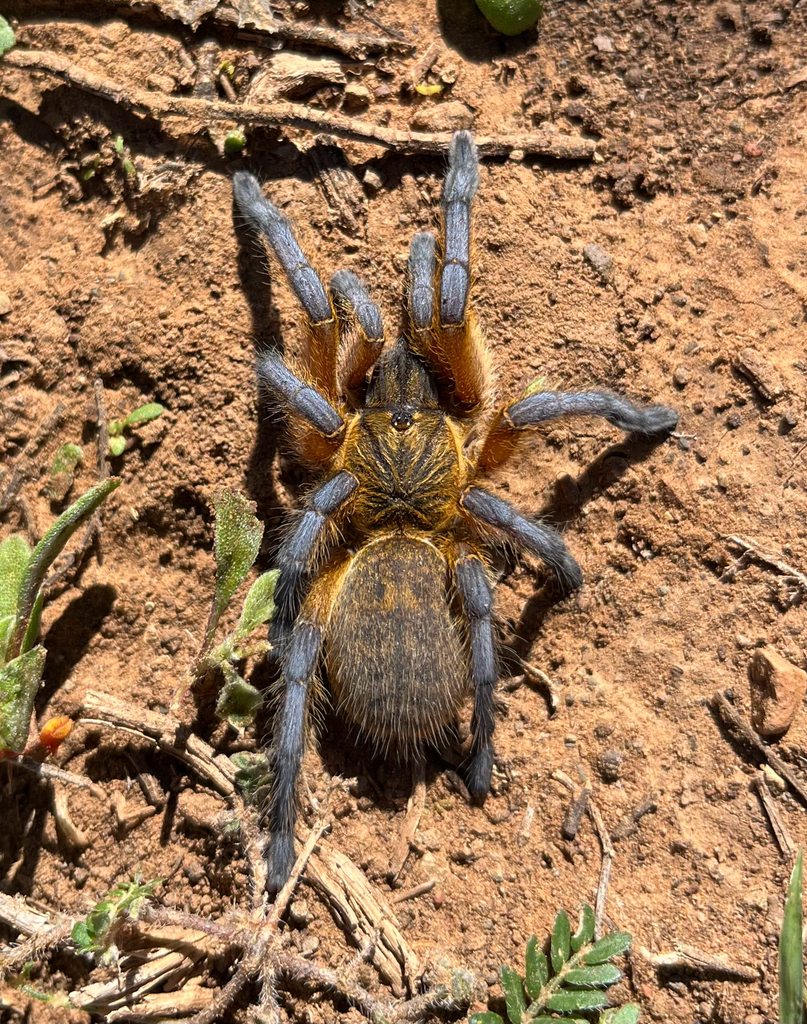
Golden Blue Leg Baboon Spider
Harpactira pulchripes
Harpactira pulchripes, also known as the golden blue-legged baboon spider, is a bright yellow-bodied and metallic blue-legged tarantula found in South Africa. It was first described by Reginald Innes Pocock in 1901. It is a very highly desired tarantula in the European and American tarantula keeping hobby.
Its specific name pulchripes is derived from Latin "pulchripes" meaning the "beautiful foot".
From the article Harpactira pulchripes on Wikipedia (CC BY-SA), quoted section by section
Description
Harpactira pulchripes has metallic blue legs. This blue color stretches from the tarsus all the way to the trochanter, where it changes to a vivid orange or yellow. Its carapace is orange or yellow with some black patterning which is the same with the opisthosoma. They are sexually dimorphic, as the males have longer legs and duller colors. Females reach a maximum diagonal leg span of 14 cm while males reach 10 cm. Females live to around 12 years, while males only live to 2 to 3 years. This spider has medically significant venom, though there is little information about its strength.
Range & habitat
This tarantula is found in South Africa in Grahamstown, now known as Makhanda, where its mainly arid with average temperatures of 25 °C, an average yearly rainfall of 628 mm, and an average humidity of 77%, with the average height above sea level being 580 m.
Wikipedia: “Habitat”
What it does
This spider is a fossorial Old World tarantula. Though it is part of the Harpactirinae, known for being aggressive, this tarantula is the exception, having a noticeably more relaxed temper than other in its subfamily. They are incredibly fast, though this spider is skittish rather than defensive, which is odd considering their medically significant venom. In addition to their calm demeanor, they spend much of their time on display in their webs.
Wikipedia: “Behavior”
Where it lives
Recorded sightings
—
geo-referenced records in GBIF, from museums, herbaria and field observers.
Drag the globe to turn it. Dots are where records exist, not a range map; darker means more records.
In the stacks
Searching the stacks…
Every page naming Harpactira pulchripes in the Biodiversity Heritage Library →
This page is assembled live from iNaturalist, GBIF, Wikipedia, the Source Library and the Internet Archive. It is not yet part of the hand-edited codex. iNaturalist taxon 571331.