- Animals
- ›Arthropods
- ›Crustaceans
- ›Typical Crustaceans
- ›Barnacles and Copepods
- ›Copepods
- ›Neocopepoda
- ›Gymnoplea
- ›Calanoid Copepods
- ›Calanidae
- ›Calanus
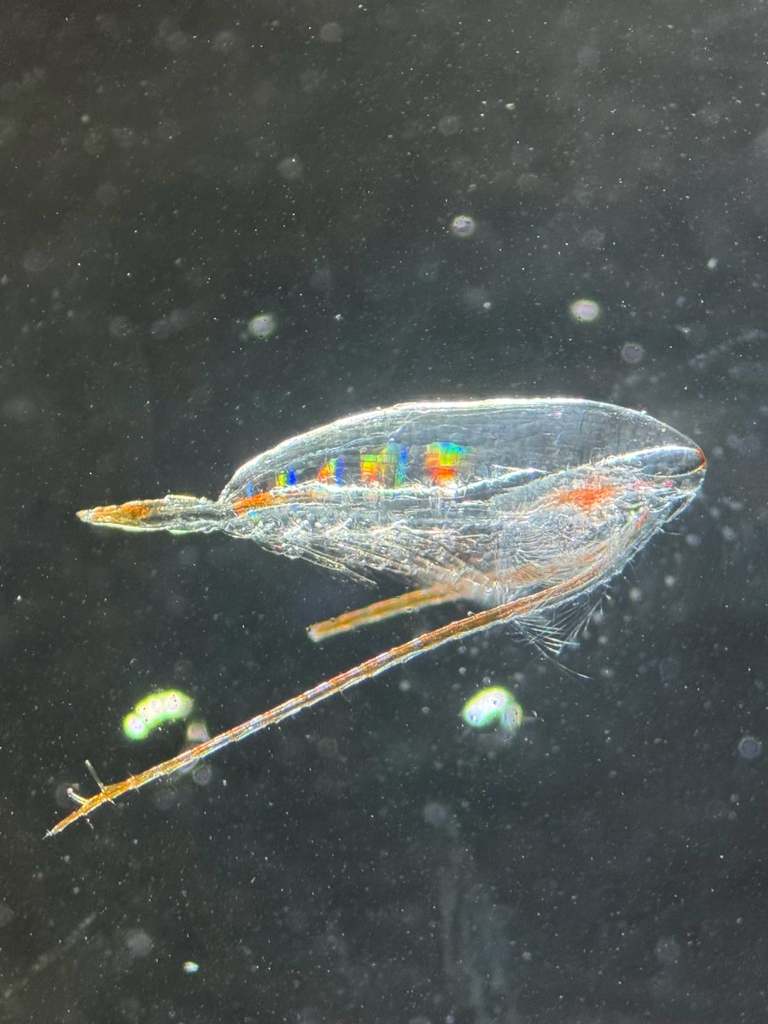
Calanus hyperboreus
Calanus hyperboreus is a copepod found in the Arctic and northern Atlantic. It occurs from the surface to depths of 5,000 metres (16,000 ft).
From the article Calanus hyperboreus on Wikipedia (CC BY-SA), quoted section by section
Description
The size of C. hyperboreus varies with its geography; individuals located in more temperate waters usually range from just over 4 to 5.5 millimetres (0.16 to 0.22 in) in more temperate waters, whereas those in colder areas usually range from 6 to 7 millimetres (0.24 to 0.28 in). The length of its prosome can vary anywhere from 2.5 to 5.6 millimetres (0.098 to 0.220 in). The antennae are longer or of equal length to the body. This copepod is very clear, and is generally colourless. The gut walls and posterior may be orange to dark red in colour, with a prominent lipid sac that is usually red-orange. The borders between segments have a deep red pigment.
Range & habitat
Calanus hyperboreus is found in the Arctic, north of the Bering Strait in the Pacific and the Lofoten Islands in the Atlantic. It occurs as deep as 5,000 metres (16,000 ft).
Wikipedia: “Distribution”
What it does
This copepod spawns between October and March (winter), using lipid-reserves to fuel reproduction (making it a capital breeder). The male is most abundant during the breeding season, found between 500 and 1,000 metres (1,600 and 3,300 ft) in depth at this time. The females lay clutches at depths between 200 and 500 metres (660 and 1,640 ft), usually at intervals of 9 to 10 days, generally containing 51 to 150 eggs. Life spans from one to two years to four to six years have been suggested for C. hyperboreus based on food availability. After the plankton bloom, the eggs develop into stage II and III copepodites and feed actively near the surface from May to October (summer). They then overwinter, generally at depths from 800 to 1,500 metres (2,600 to 4,900 ft), as stage III copepodites, and grow to stage IV copepodites over the next summer. After overwintering again, they grow to stage V during the next summer, increasing their dry mass by a factor of seven, and expanding their lipid content to be more than 65% of their dry mass. The development into an adult occurs over another winter, after which C. hyperboreus breeds. In some areas, such as the West Spitsbergen Current, stage V copepodites likely moult (below depths of 500 metres (1,600 ft) to males and females before their third-year of overwintering. During this winter, some mature females are found near the surface. …
Wikipedia: “Reproduction and life-cycle”
Where it lives
Recorded sightings
—
geo-referenced records in GBIF, from museums, herbaria and field observers.
Drag the globe to turn it. Dots are where records exist, not a range map; darker means more records.
In the stacks
Searching the stacks…
Every page naming Calanus hyperboreus in the Biodiversity Heritage Library →
This page is assembled live from iNaturalist, GBIF, Wikipedia, the Source Library and the Internet Archive. It is not yet part of the hand-edited codex. iNaturalist taxon 567477.