- Animals
- ›Arthropods
- ›Myriapods
- ›Millipedes
- ›Chilognathan Millipedes
- ›Pill and Slug Millipedes
- ›Pill Millipedes
- ›Northern Pill Millipedes
- ›Glomeroidea
- ›Glomeridae
- ›Glomerinae
- ›Glomerini
- ›Glomeris
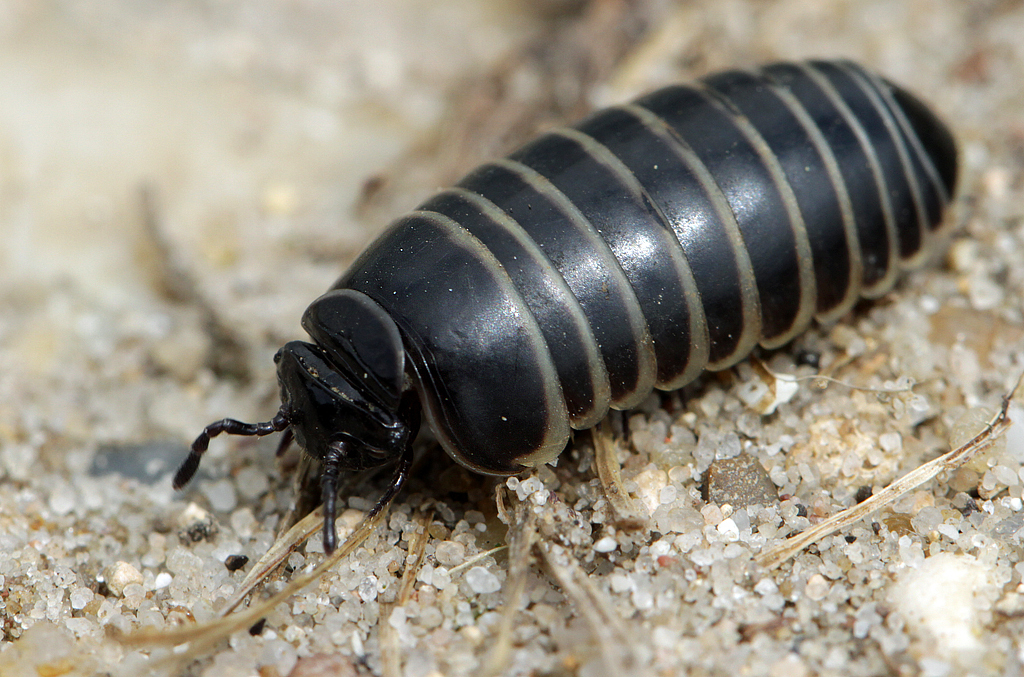
Common Pill Millipede
Glomeris marginata
Glomeris marginata is a European species of pill millipede in the family Glomeridae. Like other species in this family, this millipede is short and stout, rounded in cross section, and can roll into a ball when disturbed. This millipede is often confused with the pill woodlouse Armadillidium, which is also capable of rolling into a ball (volvation).
From the article Glomeris marginata on Wikipedia (CC BY-SA), quoted section by section
Description
Females of this species range from 8 mm to 20 mm in length and from 4 mm to 8 mm in width, whereas males tend to be somewhat smaller, ranging from 7 mm to 15 mm in length and from 3.5 mm to 6 mm in width. Behind the head, the body of the adult is covered by 12 tergites (dorsal plates), counting the collum as the first and the anal plate (also called the telson) as the last. These tergites are arched like semicircles in cross section. The tergites are usually black with lighter rims but can also be brown, red, or yellow.
As in other species in the order Glomerida, the collum is reduced in size in this species, whereas the second tergite (also called the thoracic shield) is enlarged to nearly twice the size of the following tergites. When fully rolled into a ball, these millipedes hide the head and collum inside the ball, with the anal shield covering the anterior margin of the thoracic shield. When fully enrolled, G. marginata forms a "pill" shaped like an oblate spheroid rather than a sphere, with the diameter in the vertical plane slightly larger than the width along the transverse axis. As in other species in this order, the adult female of this species features 17 pairs of legs, and the adult male features 19 leg pairs. Juveniles grow and develop through a series of molts, adding tergites and legs until they reach the numbers observed in the adult stage. …
Range & habitat
Glomeris marginata is found in Europe from the Pyrenees to the British Isles, southern Scandinavia, and the coastal plain of Poland. This species has been recorded in Spain, France, Belgium the Netherlands, Germany, Switzerland, Austria, and Denmark, as well as in Sweden south of Lake Vänern and along the east coast of southern Norway. In the British Isles, this millipede is common in England, Ireland, and Wales, but is found in Scotland only as far north as the Midland Valley. This species is most common in western Europe near the Atlantic. This millipede appears to be averse to prolonged cold and is rarely found more than 300 meters above sea level.
Wikipedia: “Distribution”
What it does
Glomeris marginata lives in leaf litter as well as in grass and under stones, with a preference for calcareous soils. In domestic gardens, this millipede can be found along hedgerows and at the bases of old walls, where the mortar has started to crumble, leaching lime into the soil. This species is more tolerant of arid and inhospitable conditions than many other millipedes, and specimens can be found on dry hot sand in the middle of the day. Nevertheless, this species is more active at night and prefers more humid areas. This millipede feeds on old decaying leaves, despite the greater digestibility of freshly fallen leaves. This species can serve an important role in recycling the nutrients in the leaf litter. Predators of Glomeris marginata include the starling, the common toad, and the woodlouse spider. As well as rolling up into a ball for protection, G. marginata produces noxious chemicals to ward off potential predators, as many millipedes do. When attacked, this species secretes one to eight drops of a viscid fluid containing the quinazolinone alkaloids (glomerin and homoglomerin) dissolved in a watery protein matrix. These chemicals act as antifeedants and toxins to spiders, insects and vertebrates, and the fluid is sticky enough to entrap the legs of ants. …
Wikipedia: “Ecology and habitats”
Where it lives
Recorded sightings
—
geo-referenced records in GBIF, from museums, herbaria and field observers.
Drag the globe to turn it. Dots are where records exist, not a range map; darker means more records.
In the stacks
Searching the stacks…
Every page naming Glomeris marginata in the Biodiversity Heritage Library →
This page is assembled live from iNaturalist, GBIF, Wikipedia, the Source Library and the Internet Archive. It is not yet part of the hand-edited codex. iNaturalist taxon 56078.