- Animals
- ›Molluscs
- ›Gastropods
- ›Heterobranchs
- ›Euthyneura
- ›Tectipleura
- ›Sacoglossans
- ›Plakobranchoidea
- ›Plakobranchidae
- ›Elysia
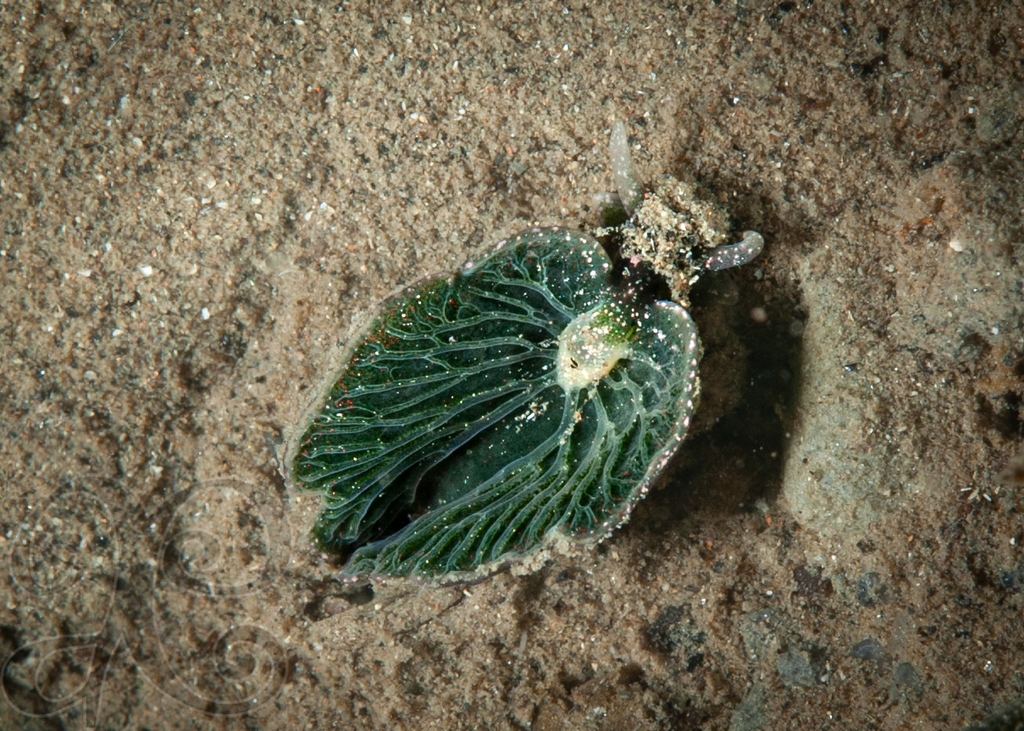
Eastern Emerald Elysia
Elysia chlorotica
Elysia chlorotica (common name the eastern emerald elysia) is a small-to-medium-sized species of green sea slug, a marine opisthobranch gastropod mollusc. This sea slug superficially resembles a nudibranch, yet it does not belong to that clade. Instead it is a member of the clade Sacoglossa, the sap-sucking sea slugs. Some members of this group use chloroplasts from the algae they eat for photosynthesis, a phenomenon known as kleptoplasty. Elysia chlorotica is one species of such "solar-powered sea slugs". It lives in a subcellular endosymbiotic relationship with chloroplasts of the marine heterokont alga Vaucheria litorea.
From the article Elysia chlorotica on Wikipedia (CC BY-SA), quoted section by section
Description
Adult Elysia chlorotica are usually bright green in color owing to the presence of Vaucheria litorea chloroplasts in the cells of the slug's digestive diverticula. Since the slug does not have a protective shell or any other means of protection, the green color obtained from the algae also functions as a camouflage against predators. By taking on the green color from the chloroplasts of the algal cells, the slugs are able to blend in with the sea bed, helping them improve their chances of survival and fitness. However, they can occasionally appear reddish or greyish in colour, which is thought to depend on the amount of chlorophyll in the branches of the digestive gland throughout the body. This species can also have very small red or white spots scattered over the body. A juvenile, prior to feeding on algae, is brown with red pigment spots due to the absence of chloroplasts. Elysia chlorotica have a typical elysiid shape with large lateral parapodia which can fold over to enclose the body. Elysia chlorotica can grow up to 60 mm in length but are more commonly found between 20 mm to 30 mm in length.
Range & habitat
Elysia chlorotica can be found along the east coast of the United States, including the states of Massachusetts, Connecticut, New York, New Jersey, Maryland, Rhode Island, Florida, (east Florida and west Florida) and Texas. They can also be found as far north as Nova Scotia, Canada.
Wikipedia: “Distribution”
What it does
This species is most commonly found in salt marshes, tidal marshes, pools, and shallow creeks, at depths of 0m to 0.5m (50cm) .
Wikipedia: “Ecology”
Where it lives
Recorded sightings
—
geo-referenced records in GBIF, from museums, herbaria and field observers.
Drag the globe to turn it. Dots are where records exist, not a range map; darker means more records.
In the stacks
Searching the stacks…
Every page naming Elysia chlorotica in the Biodiversity Heritage Library →
This page is assembled live from iNaturalist, GBIF, Wikipedia, the Source Library and the Internet Archive. It is not yet part of the hand-edited codex. iNaturalist taxon 55169.