- Animals
- ›Molluscs
- ›Gastropods
- ›Vetigastropods
- ›Trochida
- ›Top Snails, Turban Snails, and Allies
- ›Turban Snails
- ›Turbininae
- ›Turbo
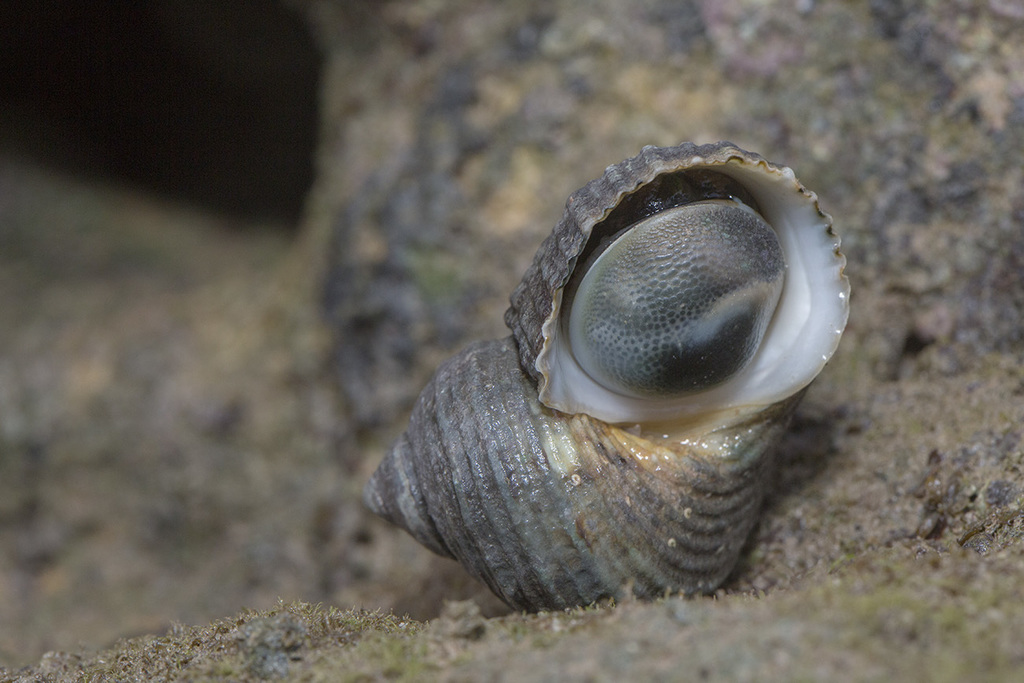
Little Burnt Turbo
Turbo bruneus
Turbo bruneus, commonly named the brown (Pacific) dwarf turban or the little burnt turbo, is a species of sea snail, marine gastropod mollusk in the family Turbinidae. These snails are called "turbo" because they can move quite quickly for a snail, using a muscular foot to glide along the ocean floor. They feed on algae and other small organisms that they scrape off rocks and other surfaces.
Turbo bruneus snails are important members of their ecosystem because they help to control the population of algae and other small organisms, which can become overgrown and harm other marine life if left unchecked.
From the article Turbo bruneus on Wikipedia (CC BY-SA), quoted section by section
Description
The length of the shell varies between 20 mm and 50 mm. The size of the Turbo bruneus shells are basically about 5-6 centimeters in diameter and have a rounded, conical shape with a pointed vertex. The color of the shell is brown, with a glossy, polished appearance. These snails are found in a wide range of habitats, including coral reefs, rocky shorelines and seagrass beds. They can be found at depths of up to 30 meters but are more commonly found in shallow waters around 5–10 meters deep. Turbo bruneus snails are firstly herbivores, feeding on a variety of seaweed and other small organisms that they scrape off surfaces using a specialized feeding structure called a radula. They are also known to consume small crustaceans and other invertebrates when food is in short supply. Turbo bruneus snails have an interesting reproduction process. They are dioecious, meaning that each individual snail is either male or female. During mating season, male snails release their sperm into the water, which is then carried by currents to nearby females. After fertilization, the female snail lays hundreds of small eggs, which are enclosed in a jelly-like substance and attached to rocks or other hard surfaces. The eggs hatch into free-swimming larvae, which eventually settle on the ocean floor and grow into adult snails. One of the interesting feature of Turbo bruneus snails is their operculum. …
Range & habitat
This marine species occurs in the Red Sea, in the Central Indo-Pacific, in the Western Pacific Ocean, off East India, the Philippines and off Western Australia.
Wikipedia: “Distribution”
Where it lives
Recorded sightings
—
geo-referenced records in GBIF, from museums, herbaria and field observers.
Drag the globe to turn it. Dots are where records exist, not a range map; darker means more records.
In the stacks
Searching the stacks…
Every page naming Turbo bruneus in the Biodiversity Heritage Library →
This page is assembled live from iNaturalist, GBIF, Wikipedia, the Source Library and the Internet Archive. It is not yet part of the hand-edited codex. iNaturalist taxon 541826.