- Animals
- ›Arthropods
- ›Chelicerates
- ›Arachnids
- ›Mites and Ticks
- ›Parasitiformes
- ›Ticks
- ›Hardbacked Ticks
- ›Ixodes
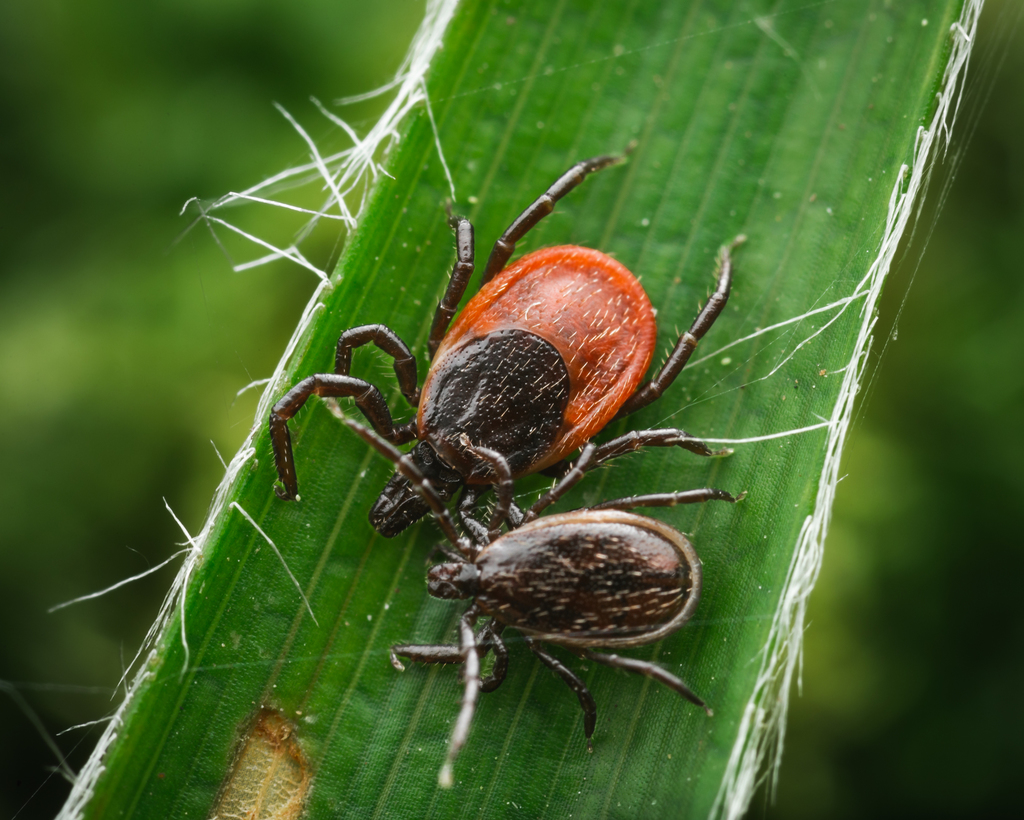
Castor Bean Tick
Ixodes ricinus
Ixodes ricinus, commonly known as the castor bean tick, the sheep ked, sheep tick, is a chiefly European species of hard-bodied tick. It may reach a length of 11 mm (0.43 in) when engorged with a blood meal, and can transmit both bacterial and viral pathogens such as the causative agents of Lyme disease and tick-borne encephalitis.
From the article Ixodes ricinus on Wikipedia (CC BY-SA), quoted section by section
Description
In common with other species of Ixodes, I. ricinus has no eyes and is not ornate; it has no festoons (wrinkles along the posterior margin). The palpi are longer than they are wide, and an anal groove is above the anus. It has a hard dorsal shield which covers the entire opisthosoma (abdomen), but only part of it in females and nymphs. I. ricinus is the largest of the three common species of Ixodes in the British Isles (the other two being I. canisuga, the British dog tick, and I. trianguliceps, the vole tick). Adult males are 2.4–2.8 mm (0.09–0.11 in) long, and unfed nymphs are 1.3–1.5 mm (0.05–0.06 in) long; females are 3.0–3.6 mm (0.12–0.14 in) long before feeding and 11 mm (0.43 in) long when engorged.
Range & habitat
Ixodes ricinus is found across Europe and into neighbouring parts of North Africa and the Middle East, extending as far north as Iceland and as far east as parts of Russia. Its northern limit seems to be determined by environmental factors, including temperature, since a series of mild winters in Scandinavia coincided with an expansion northwards in the range of I. ricinus. I. ricinus is most frequent in habitats where its hosts are plentiful, including woodlands, heaths and forests. It is most prevalent in relatively humid areas, and is absent from much of the Mediterranean Region where summers are dry.
Wikipedia: “Distribution”
In human culture
The scientific name of the castor bean tick dates back to the starting point of zoological nomenclature, the 1758 tenth edition of Carl Linnaeus' Systema Naturae, where it appeared as Acarus ricinus. Pierre André Latreille split the new genus Ixodes from Linnaeus' Acarus (which at that time contained all known ticks and mites), and I. ricinus was chosen as the type species. It has subsequently been redescribed under a number of junior synonyms and subsequent combinations into different genera; these synonyms include Acarus ricinoides, Cynorhaestes reduvius, Cynorhaestes ricinus, Ixodes megathyreus, Ixodes bipunctatus, Cynorhaestes hermanni, Crotonus ricinus, Ixodes trabeatus, Ixodes plumbeus, Ixodes reduvius, Ixodes pustularum, Ixodes fodiens, Ixodes rufus, Ixodes sulcatus and Ixodes sciuri.
Wikipedia: “Taxonomic history”
Where it lives
Recorded sightings
—
geo-referenced records in GBIF, from museums, herbaria and field observers.
Drag the globe to turn it. Dots are where records exist, not a range map; darker means more records.
In the stacks
Searching the stacks…
Every page naming Ixodes ricinus in the Biodiversity Heritage Library →
This page is assembled live from iNaturalist, GBIF, Wikipedia, the Source Library and the Internet Archive. It is not yet part of the hand-edited codex. iNaturalist taxon 51671.