- Animals
- ›Arthropods
- ›Myriapods
- ›Millipedes
- ›Chilognathan Millipedes
- ›Worm-like Millipedes
- ›Eugnatha
- ›Round-backed Millipedes
- ›Iron Millipedes
- ›Rhinocricidea
- ›Rhinocricidae
- ›Anadenobolus
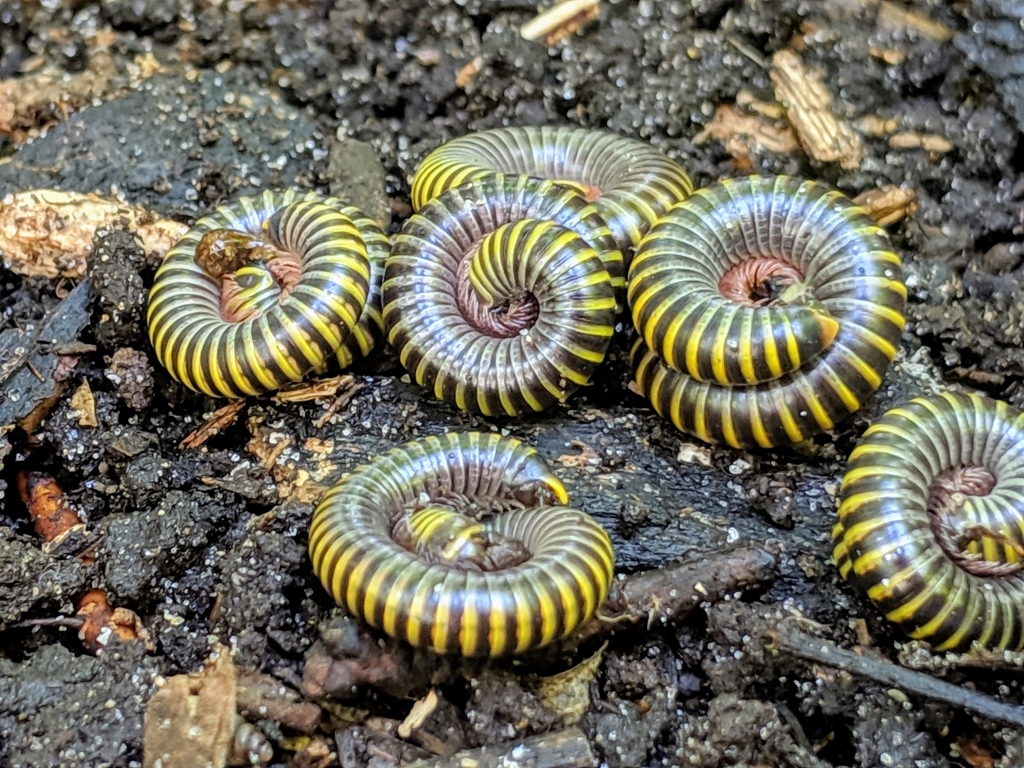
Bumblebee Millipede
Anadenobolus monilicornis
Anadenobolus monilicornis, known as the yellow-banded millipede or bumblebee millipede, is a species of millipede in the family Rhinocricidae. It is native to the Caribbean and has also been introduced to the southeastern United States.
From the article Anadenobolus monilicornis on Wikipedia (CC BY-SA), quoted section by section
Description
Individuals are dark brown with distinctive yellow bands, and measure 2.5–3 centimetres (1.0–1.2 in) long. The legs and antennae are red.
Range & habitat
This species is native to the Caribbean: it is found in Brazil, Venezuela, Suriname, Guyana, and on Barbados, Trinidad and Tobago, St. Maarten, St. Kitts, Martinique, Dominica, Guadeloupe, Jamaica, Puerto Rico and Haiti. This species has been introduced to southern Florida, where it can occur in large numbers but is not considered a pest.
== References ==
Wikipedia: “Distribution”
What it does
This species inhabits leaf litter. Birds and captive monkeys have been observed crushing these millipedes and rubbing their secretions on their wings or fur, potentially to repel insects. The secretions of millipedes may have some properties that repel insects.
Wikipedia: “Ecology and behaviour”
Where it lives
Recorded sightings
—
geo-referenced records in GBIF, from museums, herbaria and field observers.
Drag the globe to turn it. Dots are where records exist, not a range map; darker means more records.
In the stacks
Searching the stacks…
Every page naming Anadenobolus monilicornis in the Biodiversity Heritage Library →
This page is assembled live from iNaturalist, GBIF, Wikipedia, the Source Library and the Internet Archive. It is not yet part of the hand-edited codex. iNaturalist taxon 51602.