- Fungi Including Lichens
- ›Basidiomycete Fungi
- ›Higher Basidiomycetes
- ›Mushrooms, Bracket Fungi, Puffballs, and Allies
- ›Agaricomycetidae
- ›Common Gilled Mushrooms and Allies
- ›Pluteineae
- ›amanita mushrooms and allies
- ›Amaniteae
- ›Amanita
- ›Amanita
- ›Vaginatae
- ›Amanita crocea
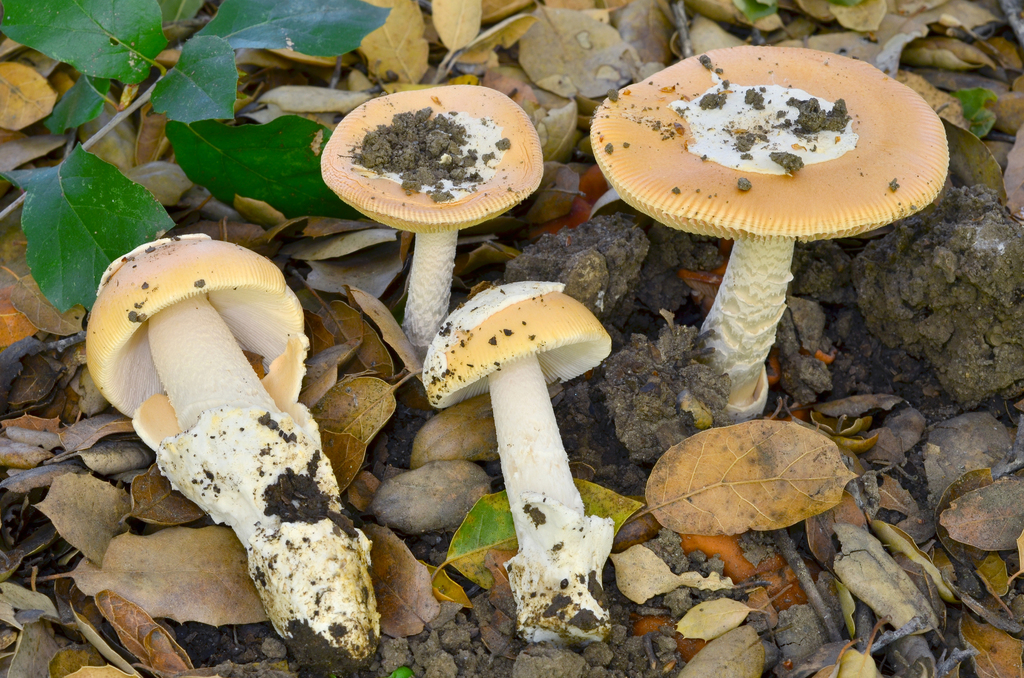
springtime amanita
Amanita velosa
Amanita velosa, commonly known as the springtime amanita, or bittersweet orange ringless amanita is a species of agaric found in California, as well as southern Oregon and Baja California. Although a prized edible mushroom, it bears similarities to some deadly poisonous species.
From the article Amanita velosa on Wikipedia (CC BY-SA), quoted section by section
Description
It is part of Amanita section Vaginatae, and like other species in this group, it is characterized by its lack of an annulus, striate pileus margin, thick universal veil remnants comprising the veil, volva, and pileus patches, inamyloid spores, and lack of characteristic Amanita toxins such as amatoxins and ibotenic acid. It is distinguished from other species in section Vaginatae by its lack of any kind of umbo on its pileus, its short pileus striae, and its distinct pale orange to pale salmon coloration when young. Its coloration can become more brownish with age and entirely white specimens are occasionally seen as well. Like many other Amanita, the gills are white, but occasionally have a distinct pinkish or orangish tint. In older specimens, the odor can become pungent and fishy. The cap is 5–15 cm wide, convex then plane, with an orange-pink or salmon-like color; it usually has a white universal veil patch. The gills are adnexed to free, close and white (or pinkish with age). The stalk is 5–15 cm long, and 1–3 cm wide. The volva is white, saclike and sheathes the stalk base. The spores are white, smooth, elliptical, and inamyloid.
Similar species. The deadly A. ocreata and occasionally A. phalloides are found in the same habitat at the same time of year as A. velosa, and can often be found in close proximity. A. ocreata and A. …
Range & habitat
A. velosa is a late-season mushroom in its range of occurrence, being primarily found in the coastal regions of California, Oregon, and Baja California, from midwinter up until the end of the California rainy season. Its favored habitat is the ecotone between oak (particularly coast live oak) woodlands and open grassland, living in an ectomycorrhizal relationship with young oak trees. The species is also reported to have been found in association with aspen and conifers in the Sierra Nevada, with one report of it being found growing with spruce in the eastern United States' Great Smoky Mountains National Park.
Wikipedia: “Distribution and habitat”
At the table
It is considered to be an outstanding edible species with a distinctively sweet or nutty flavor, but great caution must be exercised to properly identify it due to its similarity to deadly species.
Wikipedia: “Edibility”
Where it lives
Recorded sightings
—
geo-referenced records in GBIF, from museums, herbaria and field observers.
Drag the globe to turn it. Dots are where records exist, not a range map; darker means more records.
In the stacks
Searching the stacks…
Every page naming Amanita velosa in the Biodiversity Heritage Library →
This page is assembled live from iNaturalist, GBIF, Wikipedia, the Source Library and the Internet Archive. It is not yet part of the hand-edited codex. iNaturalist taxon 51314.