- Animals
- ›Arthropods
- ›Crustaceans
- ›Typical Crustaceans
- ›Barnacles and Copepods
- ›Barnacles and Allies
- ›Barnacles
- ›Normal Barnacles
- ›Thoracican Barnacles
- ›Symmetrical Sessile Barnacles
- ›Balanoidea
- ›Balanidae
- ›Balanus
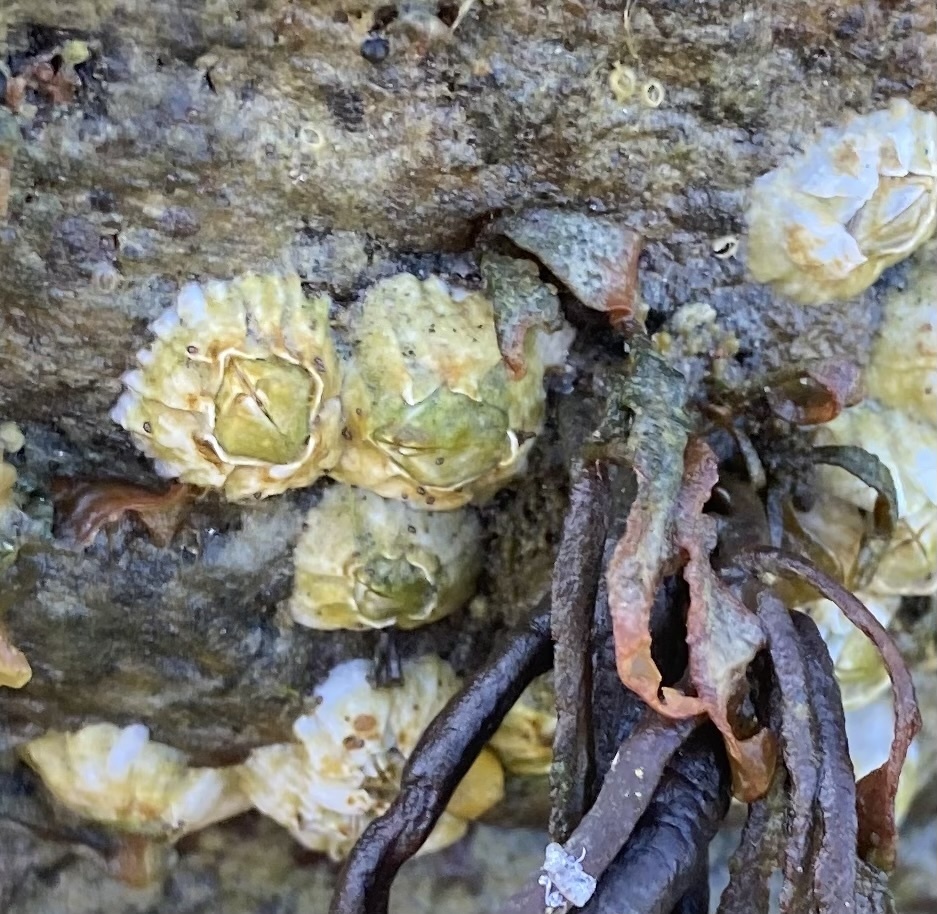
rough barnacle
Balanus balanus
Balanus balanus is a species of acorn barnacle in the Balanidae family. It is native to the colder seas of the northern hemisphere.
From the article Balanus balanus on Wikipedia (CC BY-SA), quoted section by section
Description
Unlike most crustaceans, barnacles are unable to move from place to place. Cement glands near the base of the antennae fix them to the rock. The carapace of this species is conical with a circular base which has an irregular edge and a diameter of up to three centimeters. The surface is ridged and white or pale brown. The cover plates protecting the opening are shaped like the beak of a bird.
Range & habitat
Balanus balanus is found in the Arctic Ocean and the more northerly seas of the northern hemisphere. It has been introduced to Argentina where it is displacing other species and is considered invasive.
Wikipedia: “Distribution”
What it does
This species is found at depths of up to 150 metres (490 ft), commonly between 20 -- 30 meters and grows on bedrock, boulders, pebbles and shells. It seems to favor habitats with strong currents and when overcrowding occurs, adopts different shapes to fit the space available. It is often found growing alongside another barnacle, Balanus crenatus. Other species often found in its vicinity include Tubularia larynx, Obelia geniculata, Pomatoceros triqueter, Pecten maximus, Hydroides norvegica, Chlamys opercularis and Sertularia species. Coralline algae was often present as were the whelk, the European edible sea urchin (Echinus esculentus), the great spider crab (Hyas araneus) and the shore crab (Carcinus maenas). The main predator is the juvenile common starfish (Asterias rubens). Medium sized barnacles seem to be at greatest risk. Small specimens are ignored while large specimens seem able to withstand attack. Other predators are snails, worms and birds.
Wikipedia: “Ecology”
Where it lives
Recorded sightings
—
geo-referenced records in GBIF, from museums, herbaria and field observers.
Drag the globe to turn it. Dots are where records exist, not a range map; darker means more records.
In the stacks
Searching the stacks…
Every page naming Balanus balanus in the Biodiversity Heritage Library →
This page is assembled live from iNaturalist, GBIF, Wikipedia, the Source Library and the Internet Archive. It is not yet part of the hand-edited codex. iNaturalist taxon 507992.