- Animals
- ›Arthropods
- ›Chelicerates
- ›Arachnids
- ›Mites and Ticks
- ›Acariformes
- ›Trombidiform Mites
- ›Prostigs
- ›Eleutherengona
- ›Heterostigs
- ›Pyemotoidea
- ›Pyemotidae
- ›Pyemotes
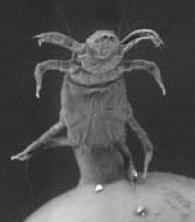
Oak Leaf Gall Mite
Pyemotes herfsi
Pyemotes herfsi, also known as the oak leaf gall mite or the oak leaf itch mite, is an ectoparasitic mite identified in Europe and subsequently found in India, Asia, and the United States. The mite parasitizes a variety of insect hosts and is able to bite humans, causing red, itchy, and painful wheals (welts). The mites are barely visible, measuring about 0.2–0.8 millimeters; their great reproductive potential, small size, and high capacity for dispersal by wind make them difficult to control or avoid.
From the article Pyemotes herfsi on Wikipedia (CC BY-SA), quoted section by section
Range & habitat
P. herfsi has been recorded in Czechoslovakia, Egypt, Australia, northern India, and the United States. It is a regulated pest in Germany.
Wikipedia: “Distribution”
What it does
Newly emerged and mated females inject a neurotoxin-containing saliva into their hosts, which paralyzes the host and enables the gravid female mites to feed on the host's hemolymph. The posterior portion (opisthosoma) of the female enlarges as its progeny develops inside, and, within a few days, up to 250 adult mites emerge from the gravid female. Males emerge before the females, position themselves around the mother's genital opening, and mate with emerging females. Then, mated females disperse to find new hosts. These mites often are dispersed by wind, and when they land on vertebrate hosts, they attempt to feed, resulting in the bites. A life cycle can be completed within seven days, and progeny emergence can be extended to 15 days. The mites' reported hosts have included Anobium punctatum, the pink bollworm, Grapholita molesta, Tineola bisselliella, Apis cerana (Asiatic honey bee), periodical cicadas, and various pests of stored grain, as well as humans and their pets. Their usual hosts in the United States are oak midge larvae. Cooler, more moist conditions favor its population growth. Outbreaks of attacks on humans in the United States have been attributed to fluctuations in the supply of both oak midge larvae and periodical cicada eggs.
Wikipedia: “Life cycle”
Where it lives
Recorded sightings
—
geo-referenced records in GBIF, from museums, herbaria and field observers.
Drag the globe to turn it. Dots are where records exist, not a range map; darker means more records.
In the stacks
Searching the stacks…
Every page naming Pyemotes herfsi in the Biodiversity Heritage Library →
This page is assembled live from iNaturalist, GBIF, Wikipedia, the Source Library and the Internet Archive. It is not yet part of the hand-edited codex. iNaturalist taxon 505686.