- Fungi Including Lichens
- ›Basidiomycete Fungi
- ›Higher Basidiomycetes
- ›Mushrooms, Bracket Fungi, Puffballs, and Allies
- ›Agaricomycetidae
- ›Common Gilled Mushrooms and Allies
- ›Pluteineae
- ›amanita mushrooms and allies
- ›Amaniteae
- ›Amanita
- ›Amanita
- ›Amanita
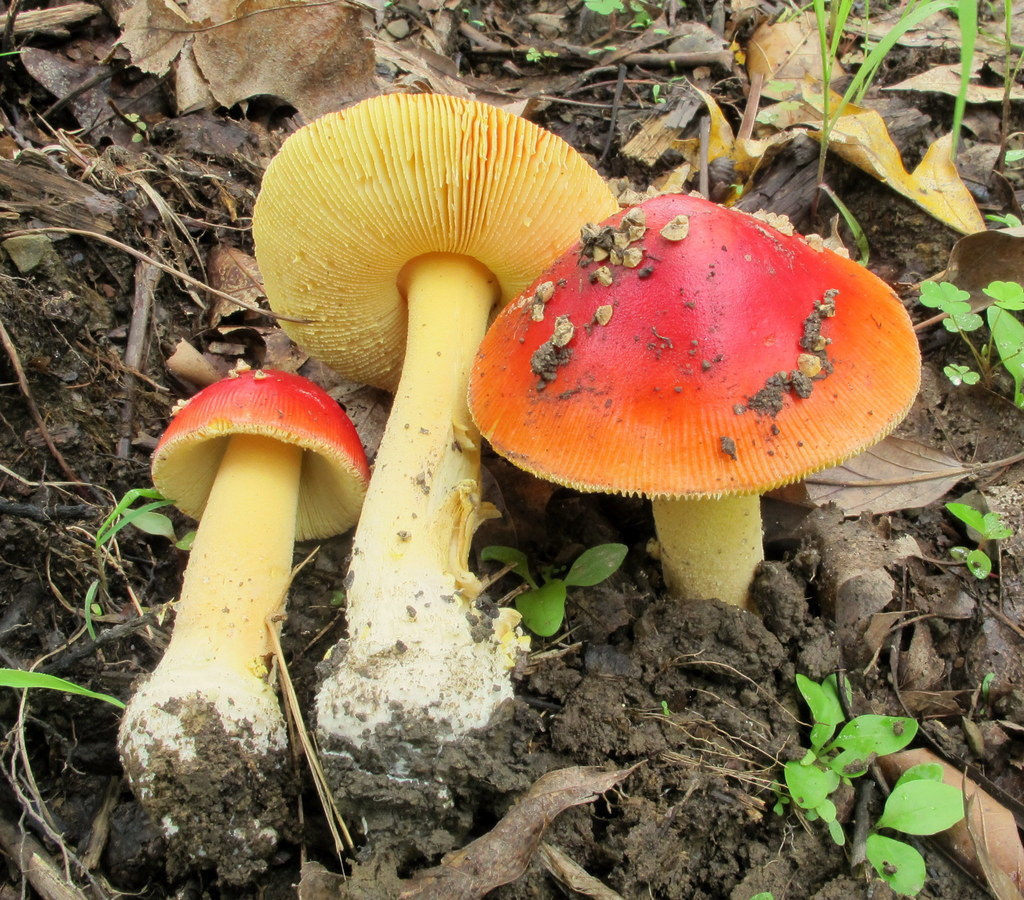
False Caesar's Mushroom
Amanita parcivolvata
Amanita parcivolvata is a fungus that produces fruit bodies that vaguely resemble those of Amanita muscaria. It is differentiated, however, by its lack of an annulus, by the volval deposits on its stipe/base, and by its pileal striations. It occasionally lacks a stipe bulb entirely, instead just tapering to a point in the ground with powdery volval deposits on its surface. It ranges from 3–12 cm (1.2–4.7 in) in length and is occasional to common in the Southeastern...
From the article Amanita parcivolvata on Wikipedia (CC BY-SA), quoted section by section
Description
Cap: The pileus is bright red ranging from 3–12 centimetres (1–4+1⁄2 inches) in diameter with warts which range in color from pale yellow to white. With rain, these can wash off, giving it a somewhat similar appearance to an Amanita in section Caesareae from a distance, especially if all but the cap is covered by detritus. Gills: The lamellae are white to pale yellow, closely spaced, free from the stipe, and sometimes with a serrated margin. Stipe: 3–12 cm (1–4+1⁄2 in) in length and about 1.5 cm (1⁄2 in) in width, with pale yellow to white powdery volval remnants all along the stipe. The volva, if it even may be called that, is rather undeveloped as compared to other members of Amanita. Microscopic features: According to Rod Tulloss, the spores of Amanita parcivolvata measure (8.4-) 9.1-11.5 (-12.6) X (5.6-) 6.3-7.9 (-8.0) μm, are inamyloid, and the basidia rarely have clamps at bases. Chemical reactions: With KOH, the red color of the cap quickly fades to an orange, then yellow color.
Similar species. It vaguely resembles A. muscaria. It is differentiated, however, by its lack of an annulus, by the volval deposits on its stipe/base, and by its pileal striations. It occasionally lacks a stipe bulb entirely, instead just tapering to a point in the ground with powdery volval deposits on its surface.
Range & habitat
It is occasional to common in the Southeastern United States, occurring primarily in Quercus forests though it has been observed in forests with a mix of conifers and oaks.
Wikipedia: “Distribution and habitat”
Where it lives
Recorded sightings
—
geo-referenced records in GBIF, from museums, herbaria and field observers.
Drag the globe to turn it. Dots are where records exist, not a range map; darker means more records.
In the stacks
Searching the stacks…
Every page naming Amanita parcivolvata in the Biodiversity Heritage Library →
This page is assembled live from iNaturalist, GBIF, Wikipedia, the Source Library and the Internet Archive. It is not yet part of the hand-edited codex. iNaturalist taxon 500030.