- Animals
- ›Molluscs
- ›Gastropods
- ›Heterobranchs
- ›Euthyneura
- ›Ringipleura
- ›Nudipleura
- ›Nudibranchs
- ›Doridina
- ›Doridoidei
- ›Chromodoridoidea
- ›Cadlinidae
- ›Cadlina
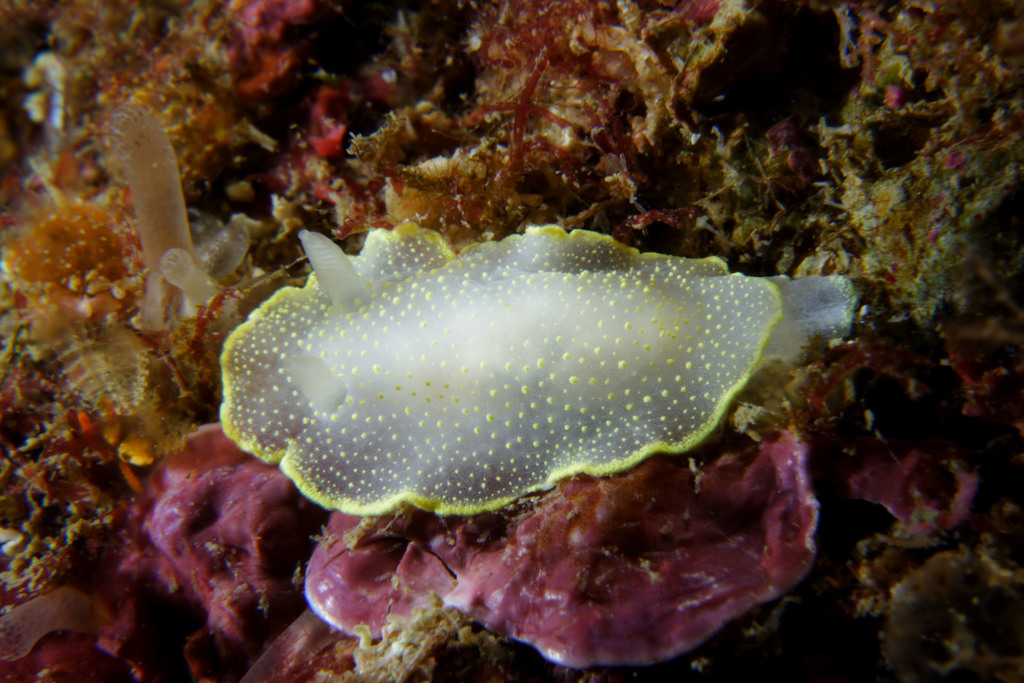
White Atlantic Cadlina
Cadlina laevis
Cadlina laevis, common name the white Atlantic cadlina, is a species of sea slug, a dorid nudibranch, a shell-less marine gastropod mollusk in the family Cadlinidae.
From the article Cadlina laevis on Wikipedia (CC BY-SA), quoted section by section
Description
Cadlina laevis has a flattened, white, semitransparent, oval mantle. There appear to be two color varieties: one showing bright yellow spots near the thin, yellow margin on the back, the other is milky white and lacks spots. There is also an intermediate form with milky yellow spots. These forms do not seem to occur together: the yellow-spotted form lives in deeper water, whereas the other form lives intertidally. The short, cephalic tentacles are comblike, and the short, tripinnate gills at the back are cryptobranchiate, i.e. they can retract at the same time in a common branchial pit. The observed length of these sea slugs varies between 25 mm and 32 mm. The maximum recorded length is 17 mm.
Range & habitat
The white Atlantic cadlina is found, dispersed in widely separated populations, on rocky bottoms from the low tide zone to depths of 800 m, ranging from the Arctic to the North Atlantic (Canadian Arctic Archipelago, Spitsbergen, Iceland, Greenland). Along the North American coast its range reaches as far south as Massachusetts. It also occurs along the European coast from Norway to northern Spain. The reporting of a Cadlina with yellow markings near the Portuguese west coast could be an unnamed species of Cadlina.
Wikipedia: “Distribution”
What it does
Minimum recorded depth is 0 m. Maximum recorded depth is 250 m. This nudibranch preys on encrusting slime sponges, such as Halisarca dujardini or, in deeper waters, the sponge Dysidea fragilis. They are reported to breed at the end of winter. The penis of the male is encrusted with tiny chitinous hooks. They reproduce by direct development. When the eggs hatch after ca. fifty days, they give small slugs, forgoing the planktonic larval stage. The veliger phase occurs within the eggs.
Wikipedia: “Ecology”
Where it lives
Recorded sightings
—
geo-referenced records in GBIF, from museums, herbaria and field observers.
Drag the globe to turn it. Dots are where records exist, not a range map; darker means more records.
In the stacks
Searching the stacks…
Every page naming Cadlina laevis in the Biodiversity Heritage Library →
This page is assembled live from iNaturalist, GBIF, Wikipedia, the Source Library and the Internet Archive. It is not yet part of the hand-edited codex. iNaturalist taxon 492412.