- Animals
- ›Arthropods
- ›Crustaceans
- ›Typical Crustaceans
- ›Malacostracans
- ›Decapods, Isopods, and allies
- ›Decapods and Krill
- ›Decapods
- ›Crabs, Lobsters, Shrimps, and Allies
- ›Anomurans
- ›Hermit Crabs
- ›Pagurid Hermit Crabs
- ›Pagurus
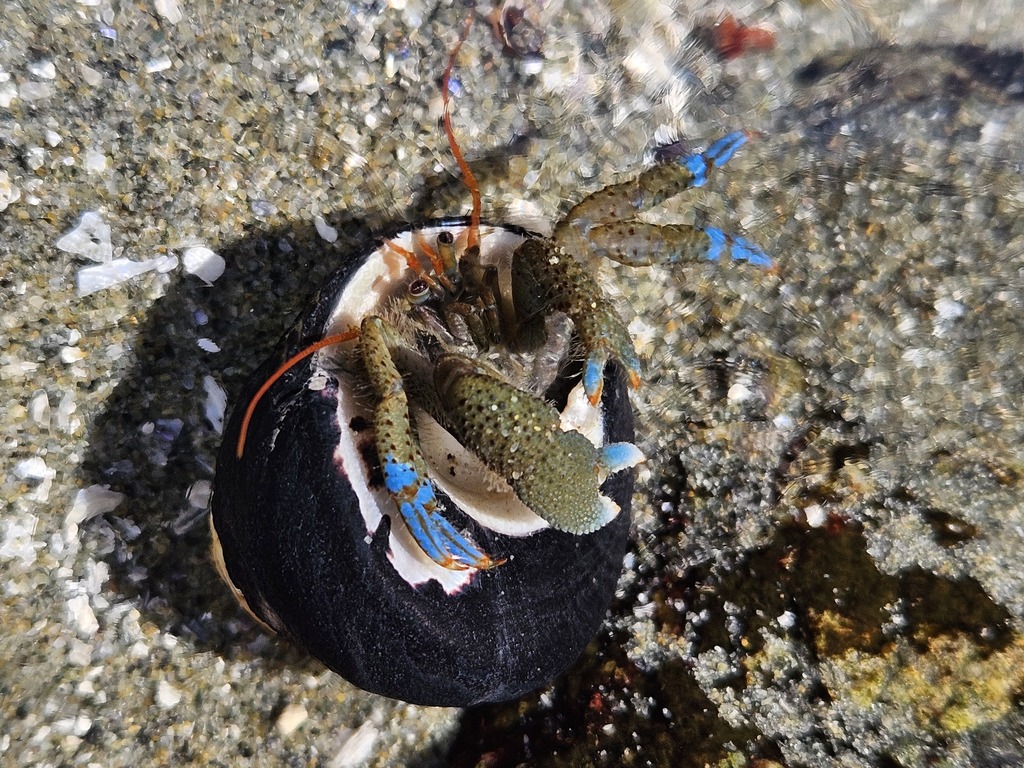
Blueband Hermit Crab
Pagurus samuelis
Pagurus samuelis, the blueband hermit crab, is a species of hermit crab from the west coast of North America, and the most common hermit crab in California. It is a small species, with distinctive blue bands on its legs. It prefers to live in the shell of the black turban snail, and is a nocturnal scavenger of algae and carrion.
From the article Pagurus samuelis on Wikipedia (CC BY-SA), quoted section by section
Description
Pagurus samuelis is a small hermit crab, at up to a total length of 40 mm (1.6 in) and a carapace width of up to 19 mm (0.75 in). The base colour of the exoskeleton is brown or green, but the antennae are red, and adults have bright blue bands near the tips of their legs. In smaller individuals, the bands may be white. The legs and carapace are covered in setae, and the rostrum at the front of the carapace is triangular.
Range & habitat
Pagurus samuelis is found from Alaska to Punta Eugenia in Baja California, Mexico. It was formerly thought to also occur in Japan, but the Japanese specimens which were formerly assigned to this species are now recognised as Pagurus filholi.
Wikipedia: “Distribution”
What it does
Pagurus samuelis prefers to use the discarded shell of the black turban snail, Tegula funebralis. They are chiefly nocturnal scavengers that feed on algae, especially the giant kelp Macrocystis pyrifera, and detritus. In a laboratory setting, P. samuelis can survive on a diet of Pelvetia canaliculata. Predators of P. samuelis include fishes such as the pile perch (Rhacochilus vacca), California sheephead (Semicossyphus pulcher) and the spotted kelpfish, Gibbonsia elegans. In the breeding season, males carry females on their backs, sometimes for more than a day. Eggs are produced from May to July, and are carried on the female's abdomen, inside the shell.
Wikipedia: “Ecology and life cycle”
Where it lives
Recorded sightings
—
geo-referenced records in GBIF, from museums, herbaria and field observers.
Drag the globe to turn it. Dots are where records exist, not a range map; darker means more records.
In the stacks
Searching the stacks…
Every page naming Pagurus samuelis in the Biodiversity Heritage Library →
This page is assembled live from iNaturalist, GBIF, Wikipedia, the Source Library and the Internet Archive. It is not yet part of the hand-edited codex. iNaturalist taxon 49095.