- Animals
- ›Echinoderms
- ›Sea Stars and Brittle Stars
- ›Sea Stars
- ›Valvatacean Sea Stars
- ›Valvatidan Sea Stars
- ›Cushion Stars, Carpet Stars, and Allies
- ›Patiria
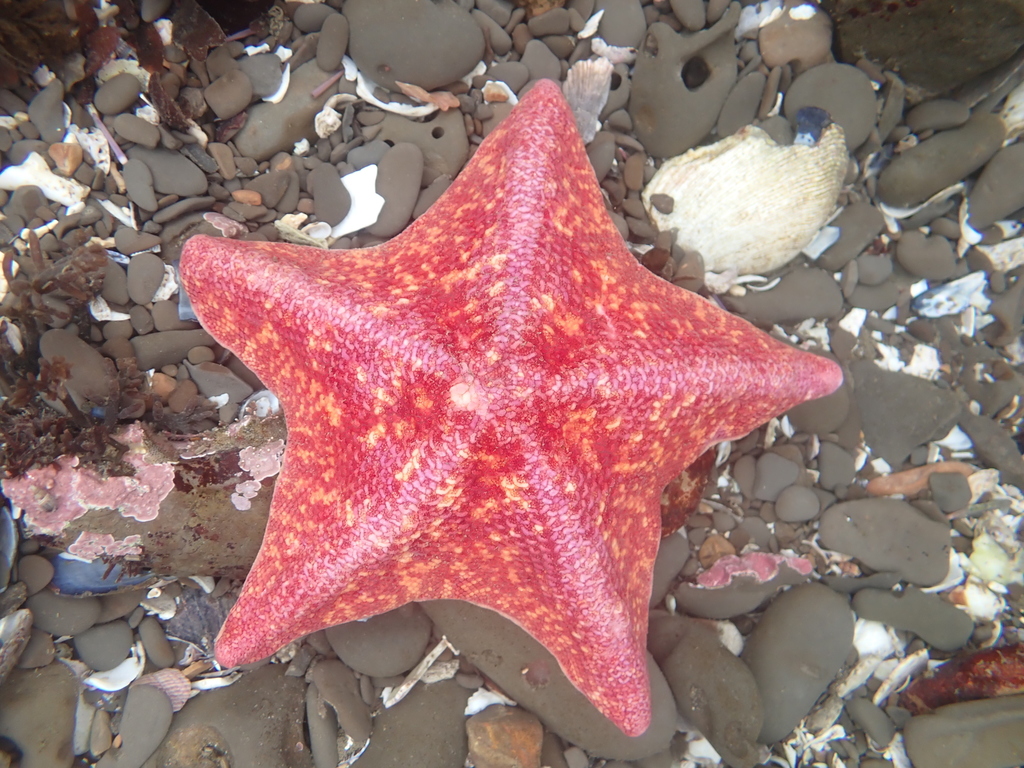
Bat Star
Patiria miniata
Patiria miniata, the bat star, sea bat, webbed star, or broad-disk star, is a species of sea star (also called a starfish) in the family Asterinidae. It typically has five arms, with the center disk of the animal being much wider than the stubby arms are in length. Although the bat star usually has five arms, it sometimes has as many as nine. Bat stars occur in many colors, including green, purple, red, orange, yellow and brown, either mottled or solid. The bat star gets its name from the webbing between its arms, which is said to resemble a bat's wings.
The bat star is usually found in the intertidal zone to a depth of 300 metres (980 ft). Its range extends from Sitka, Alaska to Baja California in the Pacific Ocean. It is most abundant along the Central Coast of California, usually residing in kelp forests due the consistent food source it provides.
From the article Patiria miniata on Wikipedia (CC BY-SA), quoted section by section
Description
Bat stars can be many different types of colors. The bat star breathes through gill-like structures on its back that perform as respirators. It lacks the pincers or pedicellariae that most starfish use to clean the skin surface of debris, but its small, moving hairs or cilia may create enough of a water current to keep the surface of its skin clean. Bat stars also have an endoskeleton that is made up of vesicles that are under the star's tissues. It has visual sensors at the end of each ray that can detect light and note prey. To eat its prey, it covers the prey with its stomach and oozes digestive juices over it; this liquefies the food, enabling the bat star to ingest it. It is omnivorous, eating both plants and animals alive or dead. Instead of a circulatory system since bat stars are echinoderms they have a water vascular system. This type of system allows them to be able to use their tube as well as move their food and waste. They also use the water vascular system as a part of their respiratory system. They pull water in using their madreporite (located on the top side of their body) and move it through their body using canals and muscular storage sacs.
Wikipedia: “Anatomy”
What it does
The bat stars reproduce through spawning. The male casts sperm and the female drops eggs; each has pores at the base of the rays for this purpose. The sperm and egg unite at sea and are carried away by ocean currents.
Wikipedia: “Reproduction”
Where it lives
Recorded sightings
—
geo-referenced records in GBIF, from museums, herbaria and field observers.
Drag the globe to turn it. Dots are where records exist, not a range map; darker means more records.
In the stacks
Searching the stacks…
Every page naming Patiria miniata in the Biodiversity Heritage Library →
This page is assembled live from iNaturalist, GBIF, Wikipedia, the Source Library and the Internet Archive. It is not yet part of the hand-edited codex. iNaturalist taxon 48830.