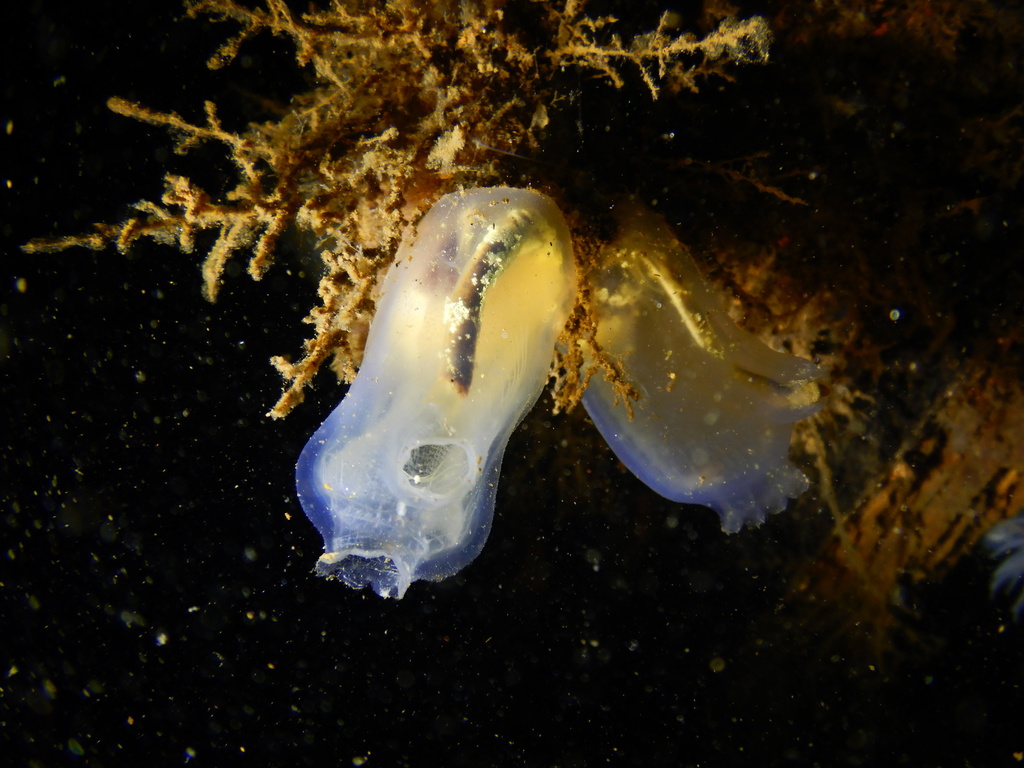
Sea Vase
Ciona intestinalis
Ciona intestinalis (sometimes known by the common name of vase tunicate) is an ascidian (sea squirt), a tunicate with very soft tunic. Its Latin name literally means "pillar of intestines", referring to the fact that its body is a soft, translucent column-like structure, resembling a mass of intestines sprouting from a rock. It is a globally distributed cosmopolitan species: this species has been introduced to various parts of the world and is considered as an invasive species.
Since Linnaeus described the species, Ciona intestinalis has been used as a model species of an invertebrate chordate in developmental biology and genomics.
From the article Ciona intestinalis on Wikipedia (CC BY-SA), quoted section by section
Description
Ciona intestinalis is a solitary tunicate with a cylindrical, soft, gelatinous body, up to 20 centimetres (8 in) long. The body colour and colour at the distal end of siphons are major external characters distinguishing sister species within the species complex. The body of Ciona is bag-like and covered by a tunic, which is a secretion of the epidermal cells. The body is attached by a permanent base located at the posterior end, while the opposite extremity has two openings, the buccal and atrial siphons. Water is drawn into the ascidian through the buccal (oral) siphon and leaves the atrium through the atrial siphon (cloacal). In the sea squirt C. intestinalis a CB1 and CB2-type cannabinoid receptors is found to be targeted to axons, indicative of an ancient role for cannabinoid receptors as axonal regulators of neuronal signalling.
Genetics. Ciona intestinalis was one of the first animals to have its full genome sequenced in 2002, using a specimen from Half Moon Bay in California, US, It possesses a very small genome size, about 160 Mbp, or less than 1/20 of the human genome, which consists of 14 pairs of chromosomes with about 16,000 genes. A number of these genes correspond to almost every family of genes in vertebrates. The draft genome analysis identified nine Hox genes, which are Ci-Hox1, 2, 3, 4, 5, 6, 10, 12, and 13. …
What it does
Ciona intestinalis is a hermaphroditic broadcast spawner though cannot self-fertilize. Released gametes can stay in the water column for 1 to 2 days, while the larvae are free-swimming for 2 to 10 days. C. intestinalis is self-sterile, as sperm and eggs are released into the surrounding seawater almost simultaneously, and it thus has been used for studies on the mechanism of self-incompatibility. Self/non-self-recognition molecules are considered to play a key role in the process of interaction between sperm and the vitelline coat of the egg. It appears that self/non-self recognition in ascidians such as C. intestinalis is mechanistically similar to self-incompatibility systems in flowering plants. Self-incompatibility promotes out-crossing which provides the adaptive advantage at each generation of masking deleterious recessive mutations (i.e. genetic complementation).
Wikipedia: “Reproduction”
Where it lives
Recorded sightings
—
geo-referenced records in GBIF, from museums, herbaria and field observers.
Drag the globe to turn it. Dots are where records exist, not a range map; darker means more records.
In the stacks
Searching the stacks…
Every page naming Ciona intestinalis in the Biodiversity Heritage Library →
This page is assembled live from iNaturalist, GBIF, Wikipedia, the Source Library and the Internet Archive. It is not yet part of the hand-edited codex. iNaturalist taxon 48272.