- Animals
- ›Molluscs
- ›Gastropods
- ›Vetigastropods
- ›Trochida
- ›Top Snails, Turban Snails, and Allies
- ›Pheasant Shells
- ›Eulithidium
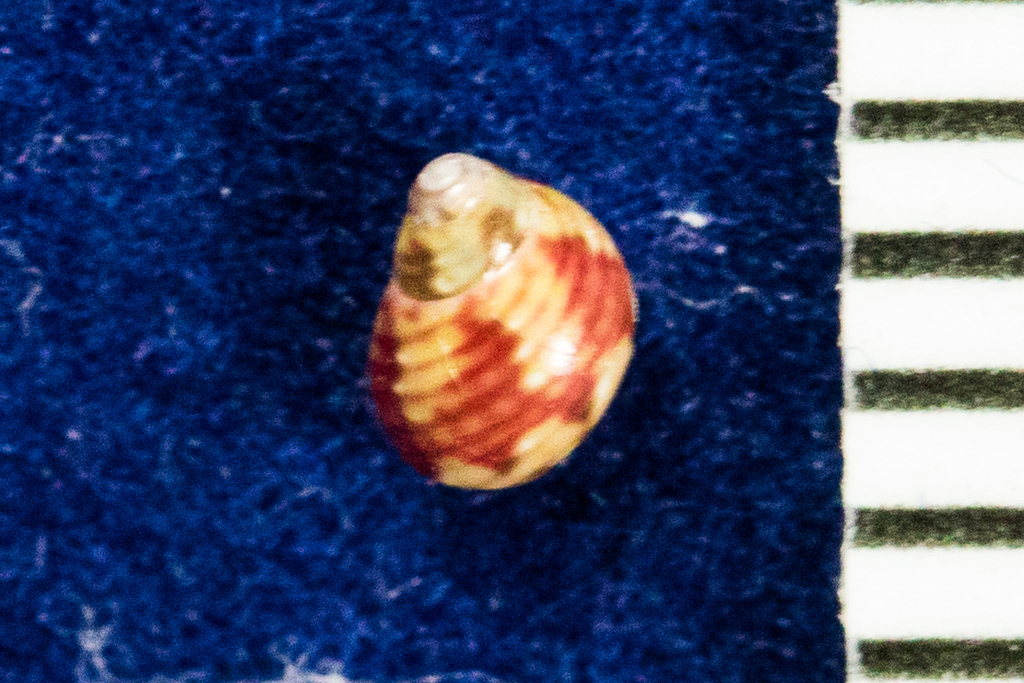
Eulithidium comptum
Eulithidium comptum, common name the Californian banded pheasant shell, is a species of small sea snail with calcareous opercula, a marine gastropod mollusk in the family Phasianellidae, the pheasant snails.
From the article Eulithidium comptum on Wikipedia (CC BY-SA), quoted section by section
Description
This small, high-spired shell grows to a height varying between 6 mm and 10 mm. It has a pointed-oblong shape. It is somewhat solid, yellowish, pinkish or whitish, more or less clouded longitudinally with purple, dull pink or gray. It is marked with numerous narrow close revolving descending lines of purple, pink or drab, sometimes conspicuously flammulated below the sutures, and broadly transversely fasciate on its base. The 5-6 smooth whorls are closely coiled above, with shallow sutures. The body whorl is more rapidly descending, separated by a deep suture. The aperture is usually less than half the length of shell. It is very oblique, short ovate with the inner margin arcuate. The narrow umbilical region is excavated and generally minutely perforate. The operculum is white, inside stained with blue above. The radula is similar to that of Tricolia pullus (Linnaeus, 1758) but has only 4 lateral teeth on either side, by atrophy of the narrow outer one.
Range & habitat
It is found in abundant numbers on eelgrass in shallow water in the Pacific Ocean from Southern California to northern Baja California.
Wikipedia: “Distribution”
Where it lives
Recorded sightings
—
geo-referenced records in GBIF, from museums, herbaria and field observers.
Drag the globe to turn it. Dots are where records exist, not a range map; darker means more records.
In the stacks
Searching the stacks…
Every page naming Eulithidium comptum in the Biodiversity Heritage Library →
This page is assembled live from iNaturalist, GBIF, Wikipedia, the Source Library and the Internet Archive. It is not yet part of the hand-edited codex. iNaturalist taxon 475228.