- Animals
- ›Arthropods
- ›Crustaceans
- ›Typical Crustaceans
- ›Malacostracans
- ›Decapods, Isopods, and allies
- ›Decapods and Krill
- ›Decapods
- ›Crabs, Lobsters, Shrimps, and Allies
- ›Spiny and Slipper Lobsters
- ›Spiny Lobsters
- ›Panulirus
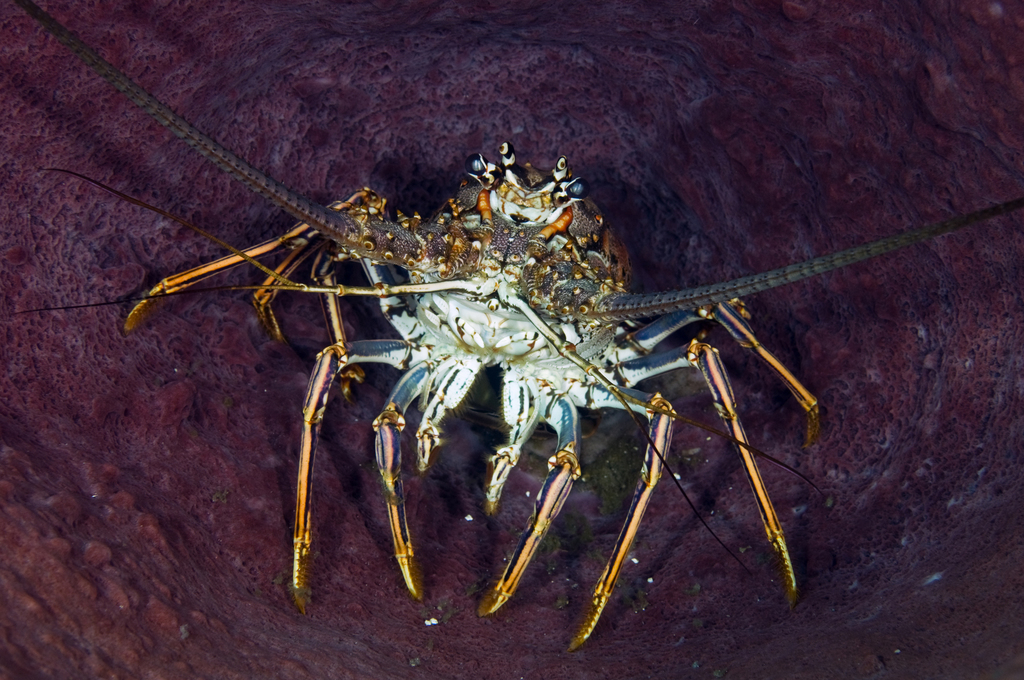
Caribbean Spiny Lobster
Panulirus argus
Panulirus argus, the Caribbean spiny lobster, is a species of spiny lobster that lives on reefs and in mangrove swamps in the western Atlantic Ocean.
From the article Panulirus argus on Wikipedia (CC BY-SA), quoted section by section
Description
P. argus have long, cylindrical bodies covered with spines. Two large spines form forward-pointing "horns" above the eyestalks. They are generally olive greenish or brown, but can be tan to mahogany. There is a scattering of yellowish to cream-colored spots on the carapace and larger (usually four to six) yellow to cream-colored spots on the abdomen. They have one pair of antennae that are longer than the body, and covered with forward pointing spines. The bases of the second antennae are thick, can have a bluish tinge, and are likewise covered with rows of spines. The legs are usually striped longitudinally with blue and yellow and terminate in a single spine-like point. The somites of the abdomen are smooth and have a shallow furrow across the middle. Each has pairs of swimmerets on the underside that are yellow and black. The lobes of the tail are colored similarly to the swimmerets. P. argus may reach up to 60 cm (24 in) long, but typically around 20 cm (7.9 in), and is fished throughout its range. Sexual maturity in females is reached at a carapace length of 54–80 mm (2.1–3.1 in).
Wikipedia: “Anatomy”
Range & habitat
Individuals can be found at depths of up to 100 m (330 ft) from Rio de Janeiro, Brazil to Beaufort, North Carolina, including the Caribbean Sea, the Bahamas and Bermuda, with occasional reports from West Africa. Although they range throughout the entire Gulf of Mexico, in the northern portions of the Gulf they generally are only found at depths of 33 m (108 ft) and greater due to the seasonal variation in the water temperature. Around the southern portion of the Florida peninsula and throughout the Bahamas and Caribbean, they are found in shallower water. They generally prefer habitat with some sort of cover and can be found around coral reefs, artificial reefs, sponges, bridge pilings, wooden bridge bumpers, piers, and under the prop roots of mangroves.
Wikipedia: “Habitat”
Where it lives
Recorded sightings
—
geo-referenced records in GBIF, from museums, herbaria and field observers.
Drag the globe to turn it. Dots are where records exist, not a range map; darker means more records.
In the stacks
Searching the stacks…
Every page naming Panulirus argus in the Biodiversity Heritage Library →
This page is assembled live from iNaturalist, GBIF, Wikipedia, the Source Library and the Internet Archive. It is not yet part of the hand-edited codex. iNaturalist taxon 47299.