- Animals
- ›Arthropods
- ›Chelicerates
- ›Arachnids
- ›Mites and Ticks
- ›Acariformes
- ›Sarcoptiformes
- ›Endeostigmatan Mites
- ›Eriophyoidea
- ›Gall and Rust Mites
- ›Phyllocoptinae
- ›Anthocoptini
- ›Aculus
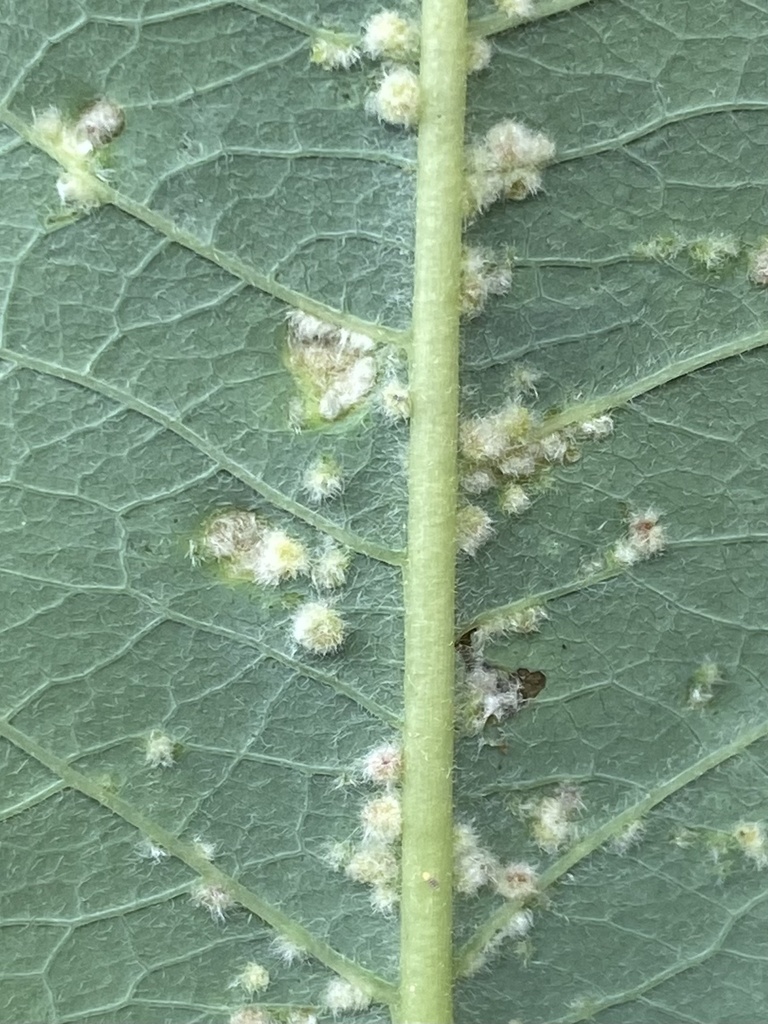
Willow Bead Gall Mite
Aculus tetanothrix
Aculus tetanothrix is a species of mite which causes galls on the leaves of willows (Salix species). It was first described by Alfred Nalepa in 1889.
From the article Aculus tetanothrix on Wikipedia (CC BY-SA), quoted section by section
Description
The gall is a green or reddish, rounded pouch or pustule on the upperside of a leaf, which also protrudes on the lower surface of the leaf. There is a slit-like opening on the underside of the leaf which, when mature, is hairy inside but the hairs do not protrude outside of the gall. Many mites can be seen within the opening. The galls are found on white willow (S. alba), eared willow (S. aurita), grey willow (S. cinerea), S. eriocephala, crack willow (S. fragilis), S. integra, bay willow (S. pentandra), purple willow (S. purpurea), Sitka willow (S. sitchensis), S. smithiana, almond willow (S. triandra) and common ossier (S. viminalis).
Similar species It is possible that A. tetanothrix is one of a number of closely related species, and the galls on S. alba could be caused by A. salicisalbae.
Wikipedia: “Description of the gall”
Range & habitat
Aculus tetanothrix has been recorded from Germany, Slovenia, Great Britain (England, Scotland and Wales), the Netherlands, Norway, Russia, Sweden and the USA.
Wikipedia: “Distribution”
Where it lives
Recorded sightings
—
geo-referenced records in GBIF, from museums, herbaria and field observers.
Drag the globe to turn it. Dots are where records exist, not a range map; darker means more records.
In the stacks
Searching the stacks…
Every page naming Aculus tetanothrix in the Biodiversity Heritage Library →
This page is assembled live from iNaturalist, GBIF, Wikipedia, the Source Library and the Internet Archive. It is not yet part of the hand-edited codex. iNaturalist taxon 469076.