- Animals
- ›Molluscs
- ›Gastropods
- ›Heterobranchs
- ›Euthyneura
- ›Tectipleura
- ›Eupulmonata
- ›Common Land Snails and Slugs
- ›Helicina
- ›Limacoidei
- ›Limacoidea
- ›Keelback Slugs
- ›Limacinae
- ›Bielzia
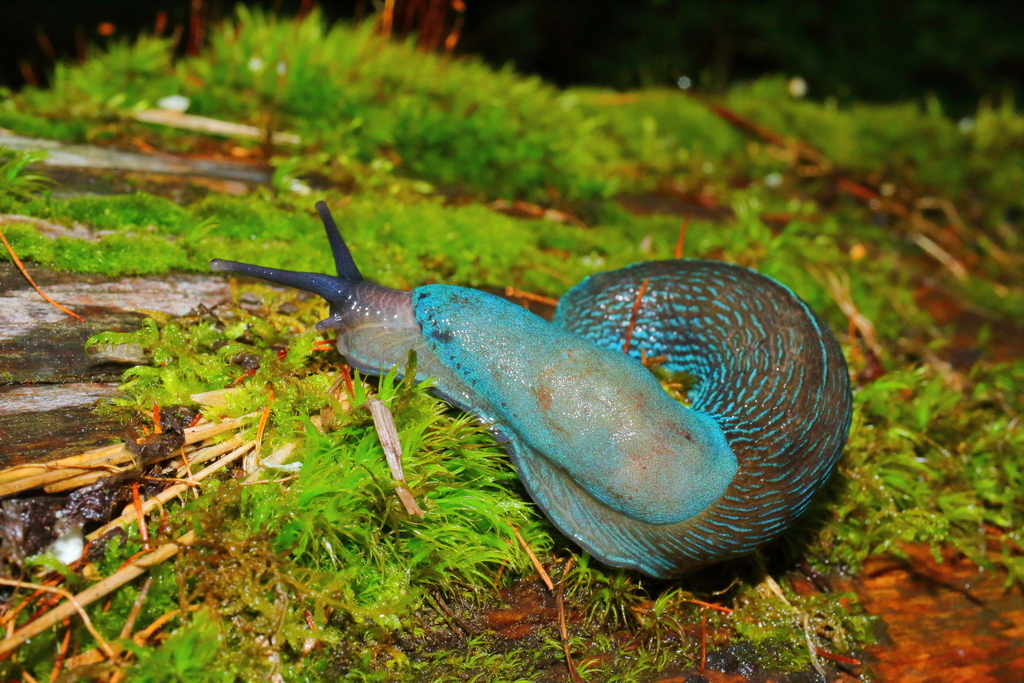
Carpathian Blue Slug
Bielzia coerulans
Bielzia coerulans, commonly known as the Carpathian blue slug or simply the blue slug, is a species of very large land slug, a terrestrial pulmonate gastropod in the family Limacidae, the keelback slugs.
From the article Bielzia on Wikipedia (CC BY-SA), quoted section by section
Description
This slug turns blue when an adult and becomes 100 – 140 mm in length. It is evenly blue or bluish green (occasionally black) with a dark greyish head and tentacles, and margins pale yellowish, sole pale yellowish or whitish. Juveniles are yellowish brown with dark lateral bands. Reproductive system: Genitalia are without penis. There is only an accessory organ for copulation.
Range & habitat
This species is endemic to the Carpathian Mountains in Central and Eastern Europe. The type locality of Bielzia coerulans is the South Carpathians in Romania.
Czech Republic - in Moravia only, vulnerable (VU) in Moravia Southern Poland Slovakia Ukraine Romania Hungary Germany (presumed introduction in Westerwald, Rhineland-Palatinate, discovered 2012)
Wikipedia: “Distribution”
What it does
Bielzia coerulans inhabits deciduous and coniferous forests in mountains, usually at the bottom, or under dead wood logs. Maturity is in June to July. Copulation occurs at the soil. There are 30-80 eggs laid in one clutch. Adults die after egg deposition. Half grown juveniles hibernate. Fully grown slugs appear in May.
Wikipedia: “Ecology”
Where it lives
Recorded sightings
—
geo-referenced records in GBIF, from museums, herbaria and field observers.
Drag the globe to turn it. Dots are where records exist, not a range map; darker means more records.
In the stacks
Searching the stacks…
Every page naming Bielzia coerulans in the Biodiversity Heritage Library →
This page is assembled live from iNaturalist, GBIF, Wikipedia, the Source Library and the Internet Archive. It is not yet part of the hand-edited codex. iNaturalist taxon 467115.