- Animals
- ›Arthropods
- ›Chelicerates
- ›Arachnids
- ›Spiders
- ›Typical Spiders
- ›Entelegyne Spiders
- ›Salticoid Spiders
- ›Jumping Spiders
- ›Typical Jumping Spiders
- ›Plexippini
- ›Plexippina
- ›Hyllus
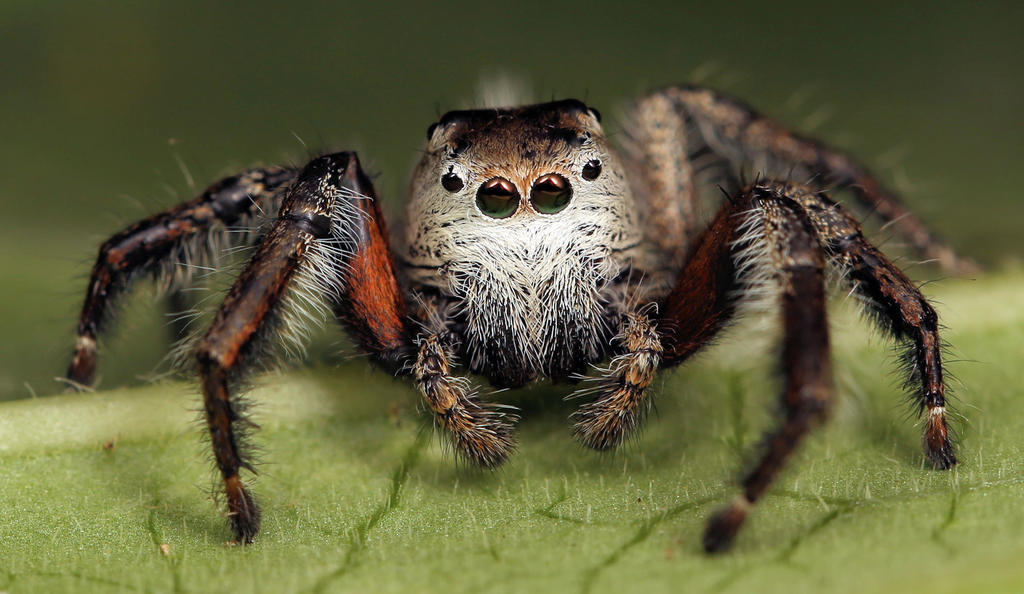
Brown Hyllus Jumping Spider
Hyllus brevitarsis
Hyllus brevitarsis is a species of spider in the family Salticidae. It is found in Africa and is commonly known as the brown Hyllus jumping spider.
From the article Hyllus brevitarsis on Wikipedia (CC BY-SA), quoted section by section
Range & habitat
Hyllus brevitarsis is distributed across multiple African countries including Botswana, Ethiopia, Ivory Coast, Mozambique, Namibia, Somalia, South Africa, Tanzania and Zimbabwe. In South Africa, the species has been recorded from Eastern Cape, Gauteng, KwaZulu-Natal, Limpopo, Mpumalanga and North West.
Wikipedia: “Distribution”
What it does
H. brevitarsis sits still and pressed against the substrate, resembling a honey bee both in size and in its striped orange and black abdomen. It has only been collected in late spring and summer. In South Africa, Hyllus brevitarsis has been sampled from multiple biomes including Fynbos, Forest, Grassland, Indian Ocean Coastal Belt, Savanna and Thicket, at altitudes ranging from 7 to 1303 m. The species has also been sampled from avocado, lemon and macadamia orchards. This medium-sized spider is occasionally collected by beating foliage of shrubs and trees in various savannah and floodplain habitats. Some specimens have been extracted from retreats constructed on the ventral side of leaves of Sansevieria hyacinthoides plants. One female was extracted from a silk retreat constructed in a grass inflorescence.
Wikipedia: “Habitat and ecology”
Where it lives
Recorded sightings
—
geo-referenced records in GBIF, from museums, herbaria and field observers.
Drag the globe to turn it. Dots are where records exist, not a range map; darker means more records.
In the stacks
Searching the stacks…
Every page naming Hyllus brevitarsis in the Biodiversity Heritage Library →
This page is assembled live from iNaturalist, GBIF, Wikipedia, the Source Library and the Internet Archive. It is not yet part of the hand-edited codex. iNaturalist taxon 465922.