- Animals
- ›Molluscs
- ›Gastropods
- ›Heterobranchs
- ›Euthyneura
- ›Tectipleura
- ›Eupulmonata
- ›Common Land Snails and Slugs
- ›Helicina
- ›Limacoidei
- ›Limacoidea
- ›Keelback Slugs
- ›Limacinae
- ›Ambigolimax
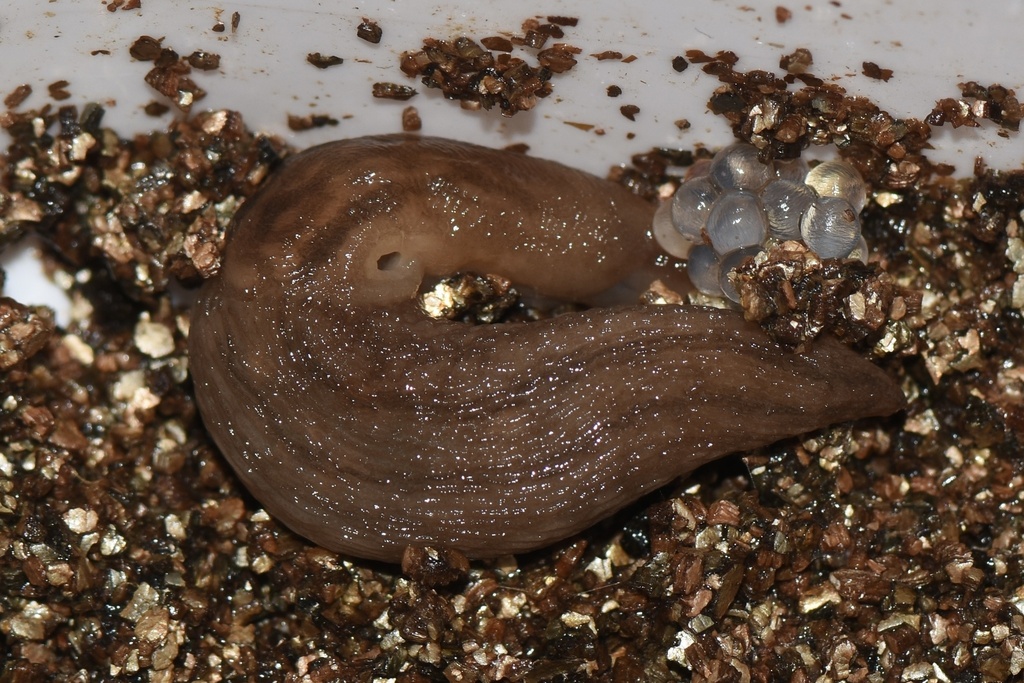
Striped Greenhouse Slug
Ambigolimax valentianus
Ambigolimax valentianus (formerly known as Lehmannia valentiana) is a species of terrestrial slug, a pulmonate gastropod mollusc in the family Limacidae.
It has spread very widely around the world, especially in greenhouses, where it can be a pest; in warmer climates it has often then spread outdoors. Comparatively much has been learnt about its life cycle and temperature relations. Dissection is necessary to reliably distinguish it from congeners in regions where these co-occur.
From the article Ambigolimax valentianus on Wikipedia (CC BY-SA), quoted section by section
Description
External appearance does not reliably distinguish A. valentianus from other members of the genus, such as A. parvipenis, with which it may co-occur. Like other members of the Limacidae, it has a pointed tail and the pneumostome lies in the posterior half of the mantle. Often the most obvious character of an Ambigolimax slug is the two parallel, sharply defined, dark lines along the mantle, sometimes with a thicker less well defined line lying between. Two similar lines may lie more posteriorly along the back either side of the midline, but all these lines may be faint or even absent in some individuals. Others have further dots and mottled patches of darker pigment. The dorsal coloration is most often pinkish brown, but sometimes dull yellowish or grey, and all shades in between. Older individuals tend to be yellower with less prominent lines but more prominent mottling. The mucus is colourless, transparent, and watery. Maximum length is about 8 cm. Ambigolimax valentianus is identifiable from the internal genitalia, which require dissection to examine. In particular it has a substantial sausage-shaped penial appendage at the inner end of the penis; rarely the appendage is swollen towards its tip. Sometimes the appendage appears absent because it is inverted into the lumen of the penis. This might cause confusion with A. parvipenis but the penis of A. …
Range & habitat
It has often been stated that A. valentianus is native to Spain, but this belief is based only on where it was first recorded. The limited genetic variation in the Iberian Peninsula argues against this hypothesis, and an origin in North Africa has been proposed instead. Ambigolimax valentianus has been recorded widely around the world, with its spread started already in the nineteenth century. In the following list, oceanic islands are considered separately from the mainland countries to which they belong. If the date of first collection is not given in the cited source, the publication date of the first report is listed instead.
Europe
Spain: since 1821 Portugal: since 1891 Andorra: since 2000 France: since 1954 Great Britain: since 1936 (greenhouses), 1985–1986 (outdoors) Island of Ireland: since 1932 (botanic garden), 1981 (outdoors) Belgium: since 1946 (greenhouse), 1973 (outdoors) The Netherlands: since 1962 Germany: since 1948 (greenhouse) Denmark: since 1959 Sweden: since 1921 (greenhouses) Norway: since 1967 (greenhouses) Finland: since 1960s (greenhouses) Latvia: since 2009 (botanical garden) Lithuania: since 2010 (indoor garden) Poland: since 1963 Switzerland: isolated report from 1918 Italy: since 1979 (outdoors) Malta: since 1986 Czech Republic: since 1960 (greenhouses) Slovakia: since 2020 (outdoors) Austria: since 1980 (botanical garden) Hungary: since 1964 (bot …
Wikipedia: “Distribution”
What it does
In captivity, at about 17 °C, eggs took roughly 3 weeks to hatch, and hatchlings took about 24 weeks to first lay eggs. These slugs laid of the order of 150 eggs in their lifetimes, but one individual laid 1510 eggs. Eggs were laid in clutches, ranging widely in size but 40 eggs was typical. About half of slugs kept singly had died within 15 months, but some lived for over two years. At 5 °C eggs took much longer to hatch (17 weeks); above 25 °C all eggs died, although a small proportion survived briefer (1 hour) exposures to 31 °C. Hatchlings mostly survived 34 °C, but not 36 °C. However, resistance to heat varies adaptively through the year, as does resistance to cold; in the middle of winter half the individuals could survive −8 °C, whereas for hatchlings in March the equivalent figure was −3 °C. Increased cold tolerance can be induced by shorter days. In subtropical parts of Japan, A. valentianus has an annual life cycle and reproduces during the colder part of the year; egg laying occurs between November and May but is depressed in the coldest months. Sperm is first produced a little earlier during development than eggs. Most eggs hatch in April. In spring two generations of the slug coexist, overlapping in size, before the older generation dies off by June. …
Wikipedia: “Life cycle and ecology”
Where it lives
Recorded sightings
—
geo-referenced records in GBIF, from museums, herbaria and field observers.
Drag the globe to turn it. Dots are where records exist, not a range map; darker means more records.
In the stacks
Searching the stacks…
Every page naming Ambigolimax valentianus in the Biodiversity Heritage Library →
This page is assembled live from iNaturalist, GBIF, Wikipedia, the Source Library and the Internet Archive. It is not yet part of the hand-edited codex. iNaturalist taxon 448331.