- Animals
- ›Arthropods
- ›Myriapods
- ›Centipedes
- ›Tropical Centipedes
- ›Scolopendrid Centipedes
- ›Scolopendrinae
- ›Scolopendra
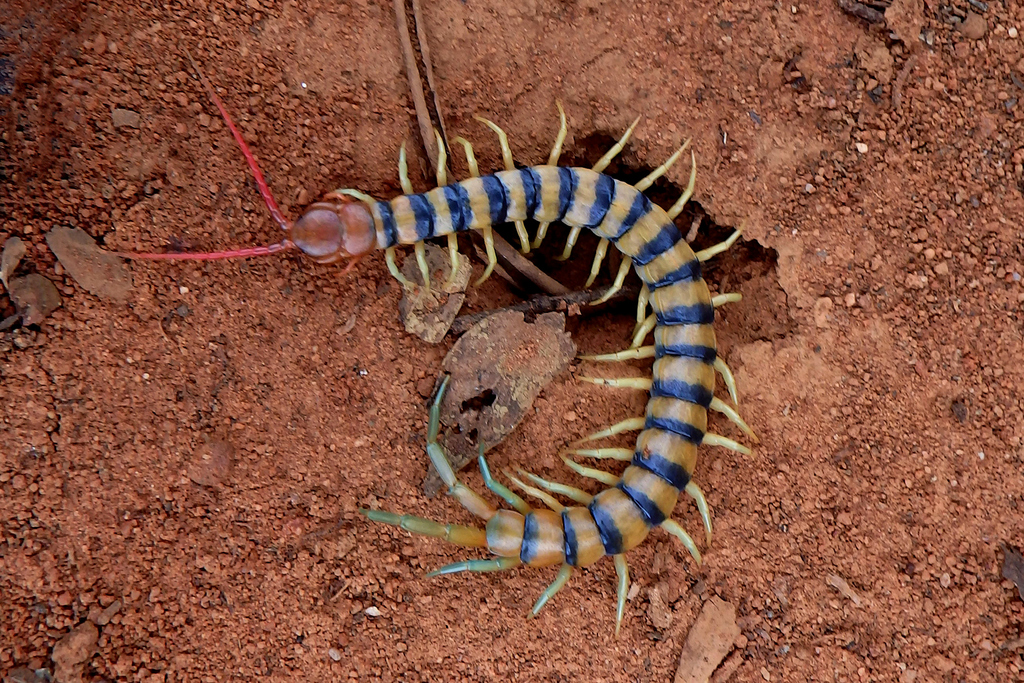
Red-headed Centipede
Scolopendra morsitans
Scolopendra morsitans, also known as the Tanzanian blue ringleg or red-headed centipede, is a species of centipede in the family Scolopendridae. S. morsitans is the type species for the genus Scolopendra.
Adult Tanzanian blue ringlegs grow to around 13 centimetres (5.1 in) and are generally characterised by bright red heads and striated body segments; however, their colouration varies widely across regional populations. The species is found across all inhabited continents and is highly invasive. The centipede is an aggressive and opportunistic predator which hunts primarily at night and feeds on other arthropods and some small vertebrates, using a neurotoxic venom and its strong jaws to capture, incapacitate and digest its prey. The species prefers warm environments and is often found beneath leaves, bark and other substrate on the ground.
From the article Scolopendra morsitans on Wikipedia (CC BY-SA), quoted section by section
Description
Tanzanian blue ringlegs have been recorded to grow to lengths of up to 127 mm (5.0 in) in Australian populations, though in other regions, including Southeast Asia, they rarely exceed 100 mm (3.9 in). Because S. morsitans populations differ greatly in colouration, using colour alone to identify the species can be misleading. However, adults are generally characterised by a bright red head and brownish body with distinct striations between each body segment. Juveniles lack clear stripes and often have a head that is a similar colour to their body trunk. In field observations, the species can sometimes be distinguished from other Scolopendras by its relatively thick rear legs (known as ultimate legs).In north-western Thailand, adult Tanzanian blue ringlegs have dark blackish heads and ultimate legs, whilst in north-east Thailand and Cambodia the centipedes have bright red heads and ultimate legs. Similar variations in colour have been observed across Australia and Africa. The centipede's antennae typically have 18–20 segments (occasionally 17 or 21–23), with the 5–7 segments closest to the head having dorsally facing hairs and the next 5–8 having ventrally facing hairs. Their tooth plates contain 5–6 teeth. …
Range & habitat
The Tanzanian blue ringleg occupies a cosmopolitan distribution, and is found across all major continents; however, it has not been widely documented in Europe. It is thought to be native to the majority of continental Australia (with the exception of Victoria, South Australia, and south-western Western Australia), Africa (except for the Eritrean Highlands and Red Sea Hills), most of South and South East Asia, Madagascar and Sri Lanka. The centipede has been introduced to much of the Americas, with sightings outside its native range in Peru, Mexico, Argentina, the Bahamas and the Southern United States. It has been proposed that the preference of red-headed centipedes for habitats similar to the conditions on ships has resulted in their widespread invasion of inhabited areas. The species occupies a diverse range of habitats, from the arid and semi-arid outback of Australia to the diverse tropics and temperate zones of India and tropical rainforests of Southeast Asia. Tanzanian blue ringlegs have a preference for warmer climates and the range of the centipede appears to be limited by this affinity. Additionally, the centipede requires sufficient air humidity to survive which limits its habitat choice and distribution. …
Wikipedia: “Distribution”
What it does
Male centipedes produce sperm-containing packets known as spermatophores wrapped in a silk-like substance which they then deposit in the sexual organs of female centipedes. The sexual organs of male and female Tanzanian blue ringlegs are not visually distinct, and examination of an individual's tergites is required to reliably determine its sex. Female centipedes construct brood chambers under substrate in protected areas for their young, laying clutches of 22–86 eggs and displaying extended parental care by forming a double coil around their eggs, newly hatched instar embryos, and post embryonic young. When threatened, or otherwise stressed, mothers guarding their offspring are known to engage in filial cannibalism, consuming their own eggs or embryos in order to minimise the energetic loss associated with an attack or perilous situation. Because the Tanzanian blue ringleg finds shelter beneath leaves, logs and other ground substrate and is primarily active at night, very little is known about the species' natural biology, including precise information relating to their lifespan or length to maturity. However, the closely related Scolopendra subspinipes is known to live for upwards of 10 years on average. In captivity, S. morsitans has been reported to live for around 4 years.
Wikipedia: “Life cycle”
Toxicity
Tanzanian blue ringleg venom is neurotoxic and acts on the nervous systems of invertebrates, and autonomic nervous system of vertebrates, to rapidly paralyse and kill the centipede's prey. The centipede's venom contains serotonin, which causes a pain response, as well as a mix of proteins, enzymes, lipoproteins, cholesterol, triglycerides, cholesteryl esters, squalene, free fatty acids, and phospholipids. Although the exact action of the fatty components of the centipede's venom are unknown, removing the fatty portion of other venoms, such as that of the Indian cobra, is known to significantly reduce the lethality of the venom in vertebrates by a factor of 40–50%. The protein components of the centipede's venom bear close resemblance to the venom compositions of scorpions and spiders such as the Mexican scorpion Centruroides limpidus, the black widow spider, and the brown recluse spider. Esterases in the venom of the Tanzanian blue ringleg were the first active enzymes to be found in the venom of any centipede, and were discovered by researchers at Ain Shams University in 1983. The presence of enzymes in the centipede's venom such as estirases, acid and alkaline phosphatases, and proteases, allows the Tanzanian blue ringleg to digest its prey outside of its body, sucking the broken down components of the animals that it captures out of their body cavities. …
Wikipedia: “Toxicology”
Where it lives
Recorded sightings
—
geo-referenced records in GBIF, from museums, herbaria and field observers.
Drag the globe to turn it. Dots are where records exist, not a range map; darker means more records.
In the stacks
Searching the stacks…
Every page naming Scolopendra morsitans in the Biodiversity Heritage Library →
This page is assembled live from iNaturalist, GBIF, Wikipedia, the Source Library and the Internet Archive. It is not yet part of the hand-edited codex. iNaturalist taxon 447908.