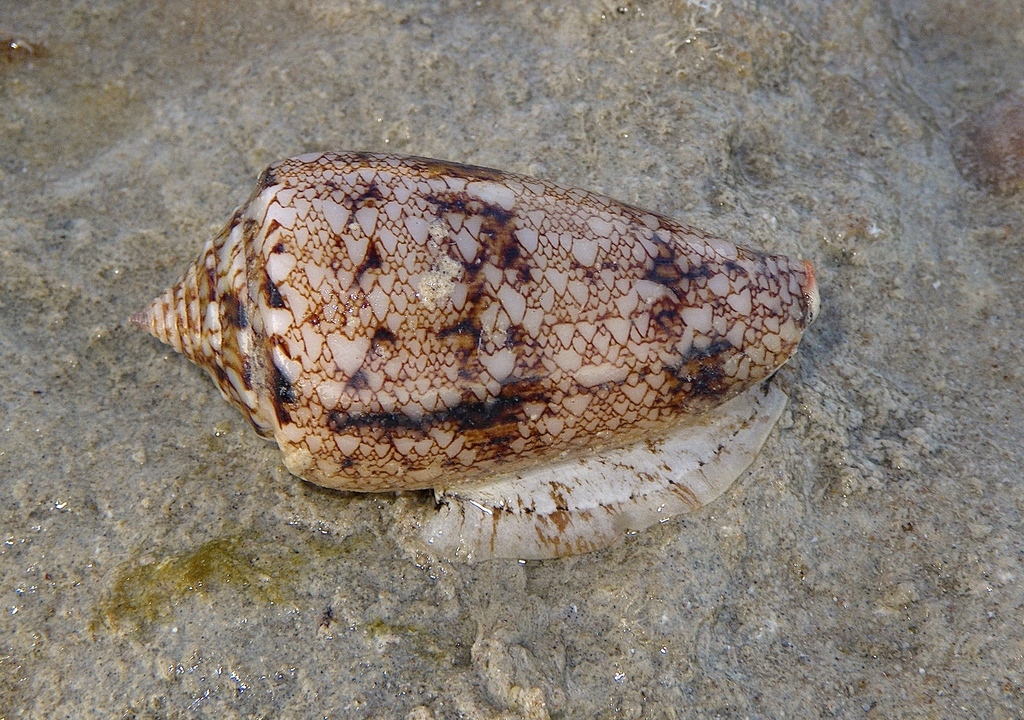
Queen Victoria Cone
Conus victoriae
Conus victoriae, common name the Queen Victoria cone, is a species of sea snail, a marine gastropod mollusk in the family Conidae, the cone snails and their allies.
Like all species within the genus Conus, these snails are predatory and venomous. They are capable of stinging humans, therefore live ones should be handled carefully or not at all.
From the article Conus victoriae on Wikipedia (CC BY-SA), quoted section by section
Description
The size of the shell varies between 35 and 94 mm (1.4 and 3.7 in). Conus victoriae is a mollusc-eating cone (molluscivore) possibly related to Conus textile . It differs from Conus textile in the reticulations. These are mostly smaller, arid light-colored, contrasting strongly with the bands of very dark chocolate longitudinal stripes. They are also more or less overlaid with violaceous clouds. A component of its venom, alpha conotoxin Vc1.1 (ACV1) has been shown to be a potent analgesic in pain tests in animals and is a potential replacement for morphine for the treatment of neuropathic pain. The biology of this cone species has been extensively studied, in particular the embryonic development of its venom apparatus, the expression of the venom gland proteome and the role of the venom bulb in delivery of venom components to the radulae.
Range & habitat
This marine species is endemic to Australia (Western Australia from Broome north to the mouth of the Victoria River, Northern Territory where it was first discovered by Reeve in 1843)
Wikipedia: “Distribution”
Where it lives
Recorded sightings
—
geo-referenced records in GBIF, from museums, herbaria and field observers.
Drag the globe to turn it. Dots are where records exist, not a range map; darker means more records.
In the stacks
Searching the stacks…
Every page naming Conus victoriae in the Biodiversity Heritage Library →
This page is assembled live from iNaturalist, GBIF, Wikipedia, the Source Library and the Internet Archive. It is not yet part of the hand-edited codex. iNaturalist taxon 432246.