- Animals
- ›Arthropods
- ›Chelicerates
- ›Arachnids
- ›Spiders
- ›Typical Spiders
- ›Entelegyne Spiders
- ›RTA Clade Spiders
- ›Oval calamistrum clade spiders
- ›Wolf Spiders and Allies
- ›Dolomedidae
- ›Dolomedes
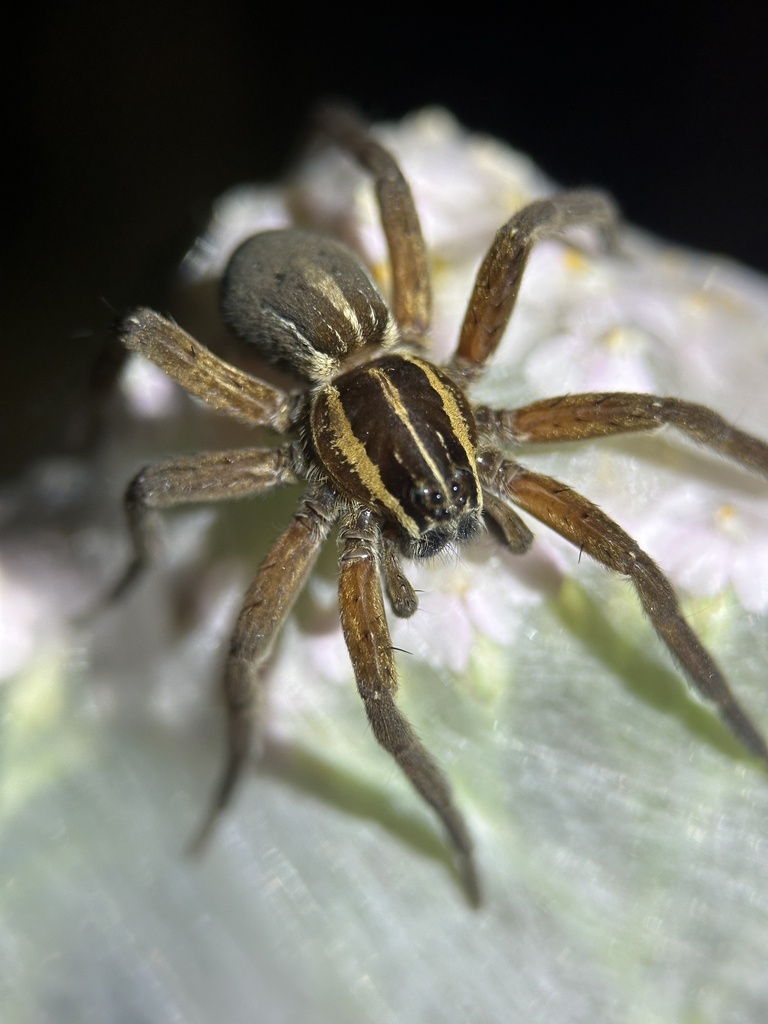
New Zealand Nursery Web Spider
Dolomedes minor
Dolomedes minor is a semiaquatic spider in the family Dolomedidae that is endemic to New Zealand, where it is known as the nursery web spider, not to be confused with the family Pisauridae.
From the article Dolomedes minor on Wikipedia (CC BY-SA), quoted section by section
Range & habitat
D. minor is found in a variety of habitats throughout New Zealand. They survive in a variety of terrains, from sea level up to subalpine areas, including shrubland containing gorse (Ulex europaeus) and mānuka (Leptospermum scoparium), swamps and grasslands. When hunting, they can be seen waiting around the water's edge and active amongst the stones, although they are nocturnal hunters. The spider is noticeable in these areas due to the large white nests thickly webbed to the ends of plants throughout these regions. Females will usually remain with their young in these habitats once their nursery webs have been constructed.
Wikipedia: “Habitat”
What it does
D. minor are most commonly seen through the summer months from November to May. Over these months the females have been found with egg-sacs attached to them which are carried for at least 5 weeks beneath the spider in their chelicerae. After this the female will start to construct her nursery web, which is not made to catch prey but to ‘nurse’ young. This is made at night and built at and amongst the tips of foliage. It can be around 6 inches (150 mm) or more in length. At night the females guard the web and during the day have been noted to move towards the base of the vegetation. The spiderlings will emerge shortly after the web's construction, usually within a week or after they have moulted, and after two weeks most young leave the nest. It is presumed this is done by ballooning, a type of air dispersal to allow them to leave the nest. There has been sightings of adult males with young adult females, but no courtship or mating has been recorded. In other Dolomedes species, sexual cannibalism is high so it is possible that D. minor males will try mate with virgin females to avoid this. Hurried copulation has also been found to be common in other Dolomedes species.
Wikipedia: “Life cycle and phenology”
Where it lives
Recorded sightings
—
geo-referenced records in GBIF, from museums, herbaria and field observers.
Drag the globe to turn it. Dots are where records exist, not a range map; darker means more records.
In the stacks
Searching the stacks…
Every page naming Dolomedes minor in the Biodiversity Heritage Library →
This page is assembled live from iNaturalist, GBIF, Wikipedia, the Source Library and the Internet Archive. It is not yet part of the hand-edited codex. iNaturalist taxon 407459.