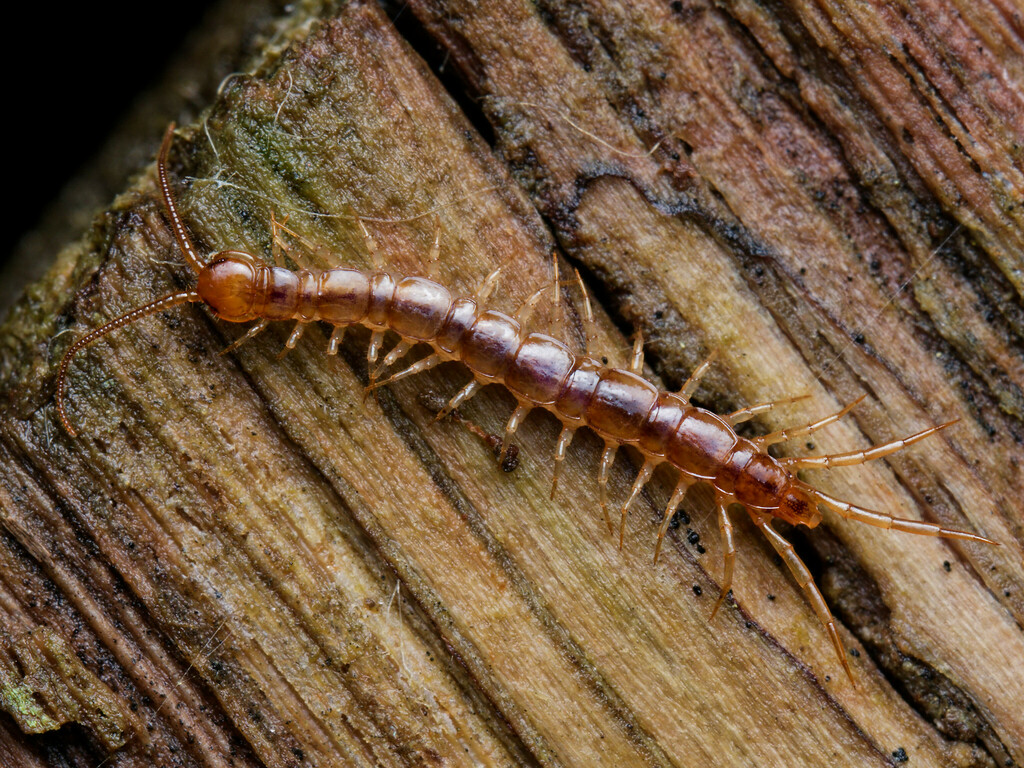
Garden Lithobius
Lithobius melanops
Lithobius melanops, sometimes called the garden lithobius or European steppe centipede, is a species of Lithobiomorph centipede that occurs in many parts of the world.
From the article Lithobius melanops on Wikipedia (CC BY-SA), quoted section by section
Description
Body length of this species ranges from 11 millimeters to 17 millimeters. The animal's body is fusiform and dorsoventrally flattened, its width can range from 1,5 to 2,5 millimeters. This species is usually of pale brown coloration and has darker longitudinal stripe in the middle of the dorsal side. The key distinguishing features of this species are: antennal articles 32–44, ocelli 10-13 (with posterior ocellus being much larger), forcipular teeth 2+2 (rarely 3+3), 3-6 round pores on each hind coxa, backwards projections on tergites 9, 11 and 13 and 15th leg with double claws (one smaller and one larger). Only possession of all of these features can reliably identify specimen as L. melanops.
Range & habitat
This species is reported from many parts of the world. In Europe it can be found in Iceland, Ireland, United Kingdom, Spain, France, Belgium, Netherlands, Luxembourg, Switzerland, Germany, Denmark (including Faroe Islands), Norway, Sweden, Finland, Austria, Czechia, Slovakia, Poland, Hungary, Slovenia, Croatia, Bosnia-Herzegovina, Italy, Romania, Bulgaria, Latvia, Lithuania, Ukraine, Russia. In Africa it can be found in Morocco, the Azores, Madeira, Canary islands, Saint Helena and it is also reported from South Africa. In North America it is found in the United States and Canada, it is also reported from Mexico. In South America it is reported from Ecuador, Brazil and Argentina. In Asia it is reported from Israel, the Asian portion of Russia and Kazakhstan. This species is also reported from New Zealand.
Wikipedia: “Distribution”
In human culture
As all centipedes in the order Lithiobiomorpha, L. melanops exhibits a hemianamorphic life cycle, which is a life cycle that combines elements of anamorphic and epimorphic development. Juveniles possess fewer body segments and legs than adults, the juveniles will acquire more body segments and legs through successive molts until they reach the adult species-specific number. Further molts result in growth of body size and additional anatomical development. Lithobius melanops is a nocturnal opportunistic predator which feeds on various soil-dwelling invertebrates including earthworms, potworms, small millipedes, springtails, spiders and insect larvae. This species is also an occasional scavenger. It kills its prey by venom which it delivers via forcipules. Venom of Lithobius melanops is not known to be medically significant to humans. Lithobius melanops can be found all year round.
Wikipedia: “Life history”
Where it lives
Recorded sightings
—
geo-referenced records in GBIF, from museums, herbaria and field observers.
Drag the globe to turn it. Dots are where records exist, not a range map; darker means more records.
In the stacks
Searching the stacks…
Every page naming Lithobius melanops in the Biodiversity Heritage Library →
This page is assembled live from iNaturalist, GBIF, Wikipedia, the Source Library and the Internet Archive. It is not yet part of the hand-edited codex. iNaturalist taxon 407287.