- Animals
- ›Echinoderms
- ›Sea Stars and Brittle Stars
- ›Sea Stars
- ›Valvatacean Sea Stars
- ›Paxillosidan Sea Stars
- ›Luidia Sea Stars
- ›Luidia
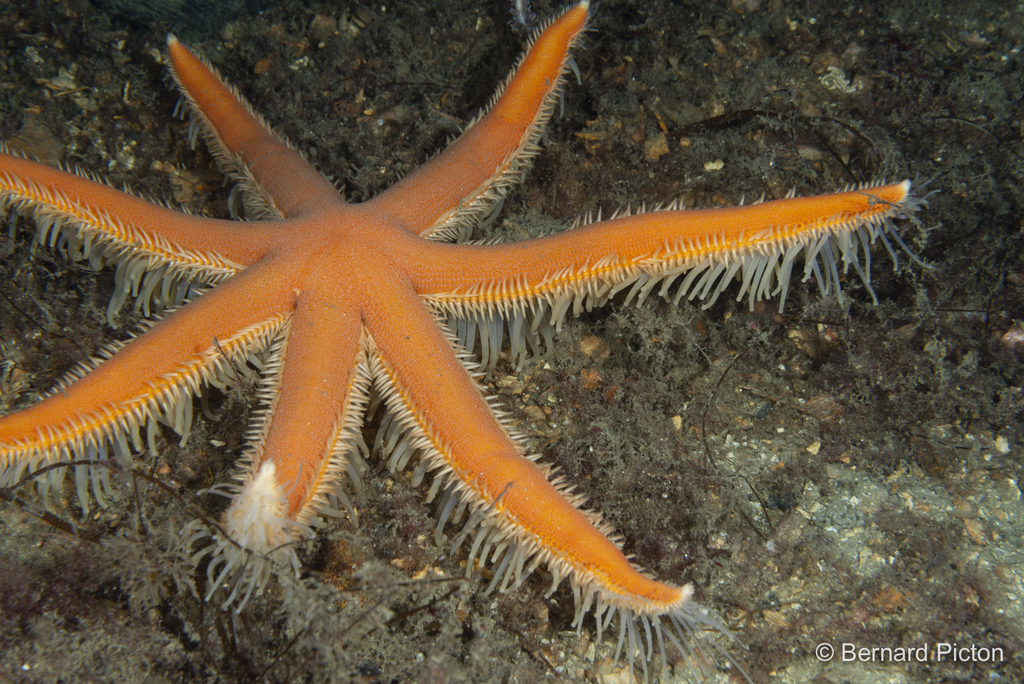
Seven Armed Sea Star
Luidia ciliaris
The seven-armed sea star (Luidia ciliaris) is a species of sea star (starfish) in the family Luidiidae. It is found in the eastern Atlantic Ocean and the Mediterranean Sea.
From the article Luidia ciliaris on Wikipedia (CC BY-SA), quoted section by section
Description
L. ciliaris is an orangeish-brown colour and has seven long arms radiating from a small disk. It is a large but fragile sea star, growing to 40 cm (16 in) across, and easily losing its arms (which afterwards regenerate). The arms have parallel sides and taper only near the tip. They have a conspicuous fringe of white spines along the margins. The upper surface is clothed in paxillae, spines shaped like a pillar with a flat top bearing tiny spinules. Also, many-lobed, nipple-like papillae are seen. No marginal plates are on the upper side of the arms, but those on the lower side bear pedicellariae with two valves. The tube feet are long and numerous. They do not have suction pads, but have two sets of terminal bulbs. The gonads are arranged in two rows along the length of the arms. A mouth is at the centre of the underside, with an oesophagus and a cardiac stomach, but no intestine, pyloric stomach, or anus.
Range & habitat
L. ciliaris occurs on the seabed in the eastern Atlantic Ocean from Norway and the Faroe Islands southwards to Cape Verde and the Azores and in the Mediterranean Sea. It is found in the neritic zone at depths down to 400 m (1,300 ft), mainly on soft sediments into which it sometimes burrows, but sometimes on rock.
Wikipedia: “Distribution and habitat”
Where it lives
Recorded sightings
—
geo-referenced records in GBIF, from museums, herbaria and field observers.
Drag the globe to turn it. Dots are where records exist, not a range map; darker means more records.
In the stacks
Searching the stacks…
Every page naming Luidia ciliaris in the Biodiversity Heritage Library →
This page is assembled live from iNaturalist, GBIF, Wikipedia, the Source Library and the Internet Archive. It is not yet part of the hand-edited codex. iNaturalist taxon 363970.