- Animals
- ›Arthropods
- ›Crustaceans
- ›Typical Crustaceans
- ›Malacostracans
- ›Decapods, Isopods, and allies
- ›Decapods and Krill
- ›Decapods
- ›Crabs, Lobsters, Shrimps, and Allies
- ›Anomurans
- ›Squat Lobsters and Porcelain Crabs
- ›Porcelain Crabs
- ›Polyonyx
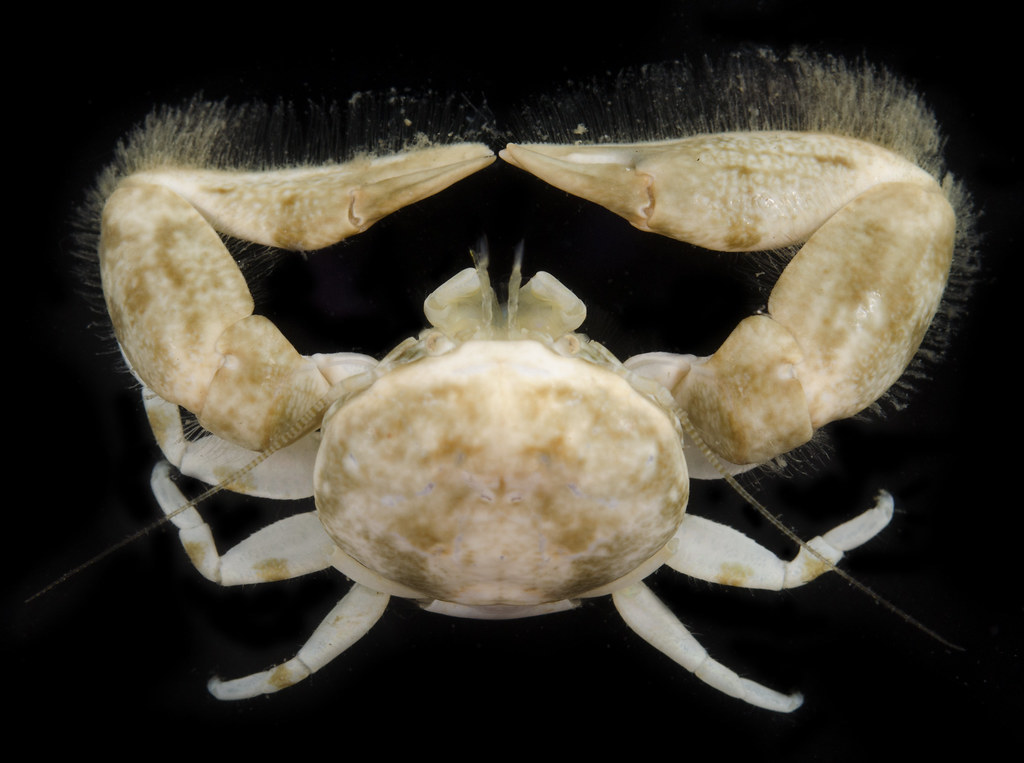
Eastern Tube Crab
Polyonyx gibbesi
Polyonyx gibbesi, the eastern tube crab, is a species of porcelain crab in the family Porcellanidae. It is found in the western Atlantic Ocean.
From the article Polyonyx gibbesi on Wikipedia (CC BY-SA), quoted section by section
Range & habitat
P. gibbesi is mostly found along the western Atlantic Ocean, from Cape Cod, Massachusetts, to Uruguay. It has been found along the coast of Argentina in the stomach contents of a narrownose smooth-hound shark. Within the tropical region of this range, the porcelain crab is less common and only found sporadically. The porcelain crab lives in sandy or muddy substrates. Once in the adult stage, they live in the tunnels of tube-dwelling annelids.
Wikipedia: “Distribution and habitat”
What it does
P. gibbesi has a symbiotic relationship with tube-dwelling annelid worms. They live in the tunnels of these annelids, such as those in the genus Chaetopterus, known as the parchment worms. The porcelain crabs typically live as male-female pairs within the tunnels.
Wikipedia: “Ecology”
Where it lives
Recorded sightings
—
geo-referenced records in GBIF, from museums, herbaria and field observers.
Drag the globe to turn it. Dots are where records exist, not a range map; darker means more records.
In the stacks
Searching the stacks…
Every page naming Polyonyx gibbesi in the Biodiversity Heritage Library →
This page is assembled live from iNaturalist, GBIF, Wikipedia, the Source Library and the Internet Archive. It is not yet part of the hand-edited codex. iNaturalist taxon 363675.