- Animals
- ›Arthropods
- ›Crustaceans
- ›Typical Crustaceans
- ›Malacostracans
- ›Decapods, Isopods, and allies
- ›Decapods and Krill
- ›Decapods
- ›Crabs, Lobsters, Shrimps, and Allies
- ›True Crabs
- ›Eubrachyuran Crabs
- ›Heterotrematan Crabs
- ›Spider Crabs and Decorator Crabs
- ›Mithracidae
- ›Mithraculus
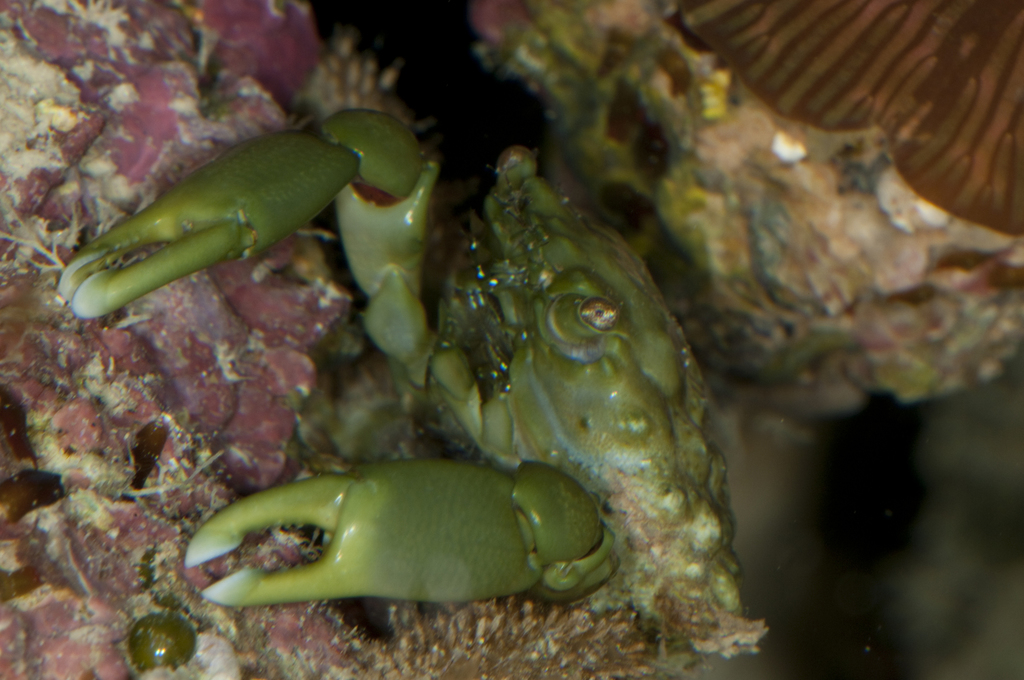
Green Clinging Crab
Mithraculus sculptus
Mithraculus sculptus, the green clinging crab or emerald crab, is a species of crab in the family Majidae. It is a dark green colour and is found in tropical waters in the Caribbean Sea. It is sometimes kept in reef aquaria.
From the article Mithraculus sculptus on Wikipedia (CC BY-SA), quoted section by section
Description
Mithraculus sculptus is a small crab with a carapace longer than it is wide and large chelae (claws). The carapace is flat, shiny and green, finely sculpted, with whitish material adhering to the projections. The chelae are also green and are spoon-shaped and tipped with white. The walking legs are rather paler in colour and are hairy and often covered with encrustations. This crab grows to a length of about 4 cm (1.6 in).
Range & habitat
Mithraculus sculptus is native to the Caribbean Sea and Gulf of Mexico. Its range extends from the Bahamas and southern Florida to the northern part of Brazil at depths down to about 54 metres (177 ft). It is found in a number of varied habitats but may be most abundant in back reef environments.
Wikipedia: “Distribution and habitat”
What it does
Mithraculus sculptus is largely nocturnal, hiding in caves, crevices and under rocks during the day. It is principally a scavenger but it also feeds on algae. It is tolerant of both high and low temperatures and is capable of withstanding strong currents as it can use its legs to cling on to the substrate. It is often to be seen among the branches of corals such as the Porites furcata. It also feeds on organisms encrusting the leaf blades of turtle grass (Thalassia testudinum). When threatened it often hides beneath the extended tentacles of the sun anemone (Stichodactyla helianthus).
Wikipedia: “Behaviour”
Where it lives
Recorded sightings
—
geo-referenced records in GBIF, from museums, herbaria and field observers.
Drag the globe to turn it. Dots are where records exist, not a range map; darker means more records.
In the stacks
Searching the stacks…
Every page naming Mithraculus sculptus in the Biodiversity Heritage Library →
This page is assembled live from iNaturalist, GBIF, Wikipedia, the Source Library and the Internet Archive. It is not yet part of the hand-edited codex. iNaturalist taxon 361286.