- Animals
- ›Arthropods
- ›Crustaceans
- ›Typical Crustaceans
- ›Malacostracans
- ›Decapods, Isopods, and allies
- ›Decapods and Krill
- ›Decapods
- ›Crabs, Lobsters, Shrimps, and Allies
- ›True Crabs
- ›Eubrachyuran Crabs
- ›Thoracotrematan Crabs
- ›Shore and marsh crabs
- ›Shore Crabs
- ›Grapsus
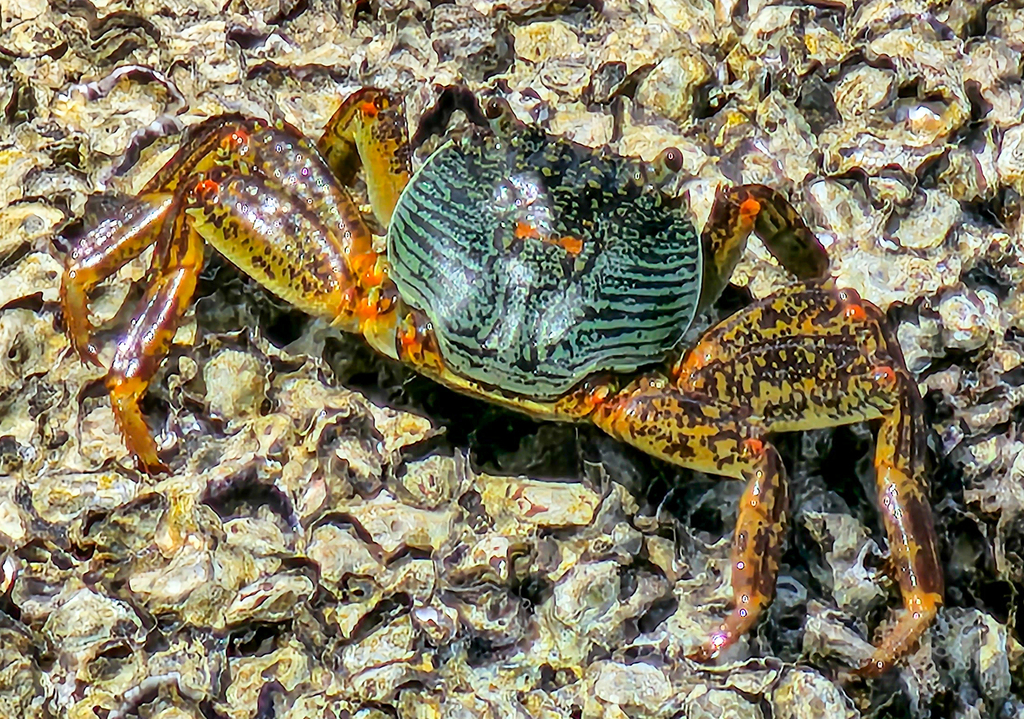
Mottled Lightfoot Crab
Grapsus albolineatus
Grapsus albolineatus, also called the mottled crab or mottled lightfoot crab, is a species of decapod crustacean in the family Grapsidae, native to the Indo-Pacific.
From the article Grapsus albolineatus on Wikipedia (CC BY-SA), quoted section by section
Description
Its carapace, or upper shell, is flat, circular, and rough with arched lateral margins, and may be up to 37 mm in length. Its chelae, or claws, are short, small, and flattened. Its pereiopods, or legs, are long with a tapered end. The margin of the inferior extremity of its last pair of legs is serrate. Males have bigger claws than females. This species is red, blue, or green in color. Its legs are the same color and have irregular dark-brown mottling.
Range & habitat
This species occurs in rocky depths and in coral reefs. It is found in the Indo-Pacific from the East African coast to the Chilean coast. This includes the waters of the Red Sea, the Gulf of Aqaba, India, Indonesia, Pakistan, Japan, Australia, and the tropical islands of the Pacific Ocean (such as Hawaii).
Wikipedia: “Habitat and distribution”
What it does
Like in most other true crabs, light and temperature are the main environmental factors that determine reproductive activity. The female releases her fertilized eggs in its abdomen. This species has a long planktonic larval phase. As the larva matures, it undergoes a series of molts that allow it to grow and reach maturity.
Wikipedia: “Reproduction”
Where it lives
Recorded sightings
—
geo-referenced records in GBIF, from museums, herbaria and field observers.
Drag the globe to turn it. Dots are where records exist, not a range map; darker means more records.
In the stacks
Searching the stacks…
Every page naming Grapsus albolineatus in the Biodiversity Heritage Library →
This page is assembled live from iNaturalist, GBIF, Wikipedia, the Source Library and the Internet Archive. It is not yet part of the hand-edited codex. iNaturalist taxon 354596.