- Animals
- ›Arthropods
- ›Crustaceans
- ›Typical Crustaceans
- ›Malacostracans
- ›Decapods, Isopods, and allies
- ›Decapods and Krill
- ›Decapods
- ›Crabs, Lobsters, Shrimps, and Allies
- ›True Crabs
- ›Eubrachyuran Crabs
- ›Heterotrematan Crabs
- ›Swimming Crabs and Allies
- ›Swimming Crabs
- ›Thalamitinae
- ›Charybdis
- ›Charybdis
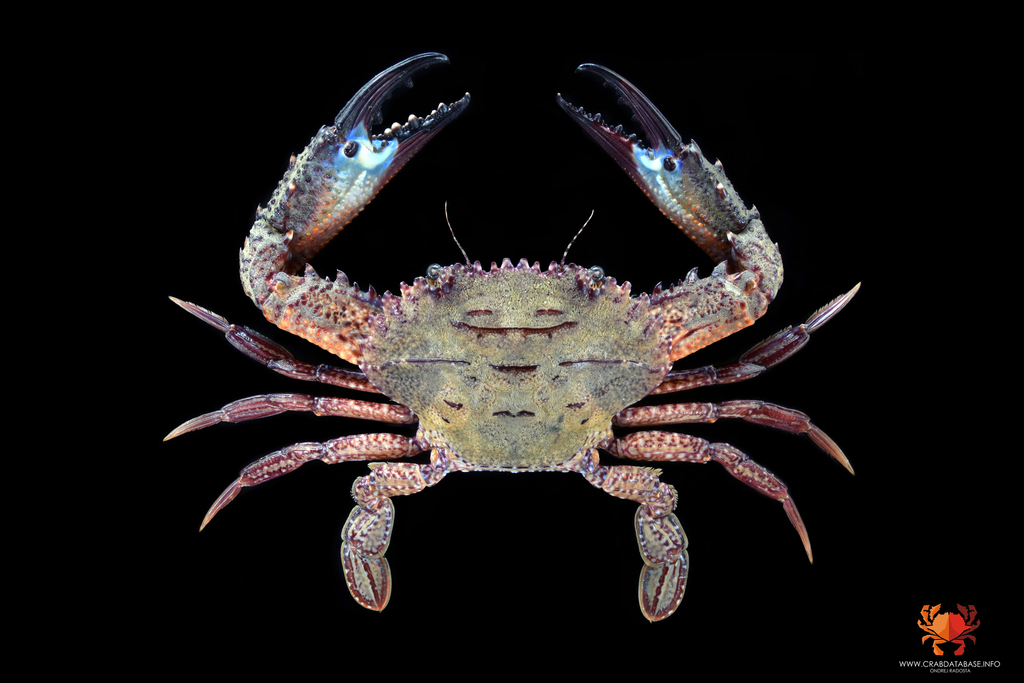
Ridged Swimming Crab
Charybdis natator
Charybdis natator, the ridged swimming crab, wrinkled swimming crab or rock crab, is a widespread Indo-Pacific species of swimming crab from the genus Charybdis . It gets its name from the ridges on the dorsal surface of the carapace. It is a crab species which is of minor importance in fisheries.
From the article Charybdis natator on Wikipedia (CC BY-SA), quoted section by section
Description
Charybdis natator has a fan shaped carapace which is brown to orange in colour on the dorsal surface the ventral surface is bluish mottled with white and pale red spots and the legs are dark, reddish brown in colour. The carapace is densely covered with short pubescence which is absent on the distinct transverse granulated ridges in the anterior surface. There are six spines on each side of the carapace. There are eight small rounded lobes between the orbits which are set close together. The antennae are outside the orbits but are in contact with the supraorbital lobe at their base. The chelipeds are covered with large granules and/or squamiform markings and have distinct black tips with blue spots, this bright blue colour is also visible at the base of the cheliped. The anterior border of the merus of the cheliped has three spines with a single distal spine on its posterior border; the carpus has a robust spine on its inner angle and three spinules on its outer angle. The last pair of legs are flattened and can be rotated in a propeller like manner allowing the crab to swim in any direction. The maximum length is 17 cm.
Range & habitat
Charybdis natator is found throughout the Indian and Pacific Oceans from eastern South Africa and Madagascar north to the Red Sea and across the Indian Ocean, including the Mascarene Islands and the Seychelles, to the western pacific where it extends north to Japan and south to northern Australia including Lord Howe Island.
Wikipedia: “Distribution”
In human culture
The generic name, Charybdis, refers to a whirlpool in Greek while the specific name natator references its swimming ability. It was named as Cancer natator in 1794 by the German zoologist Johann Friedrich Wilhelm Herbst. There are two subspecies:
Charybdis natator natator (Herbst 1794): the continental form Charybdis natator seychellensis Crosnier, 1984: the Seychelles
== References ==
Wikipedia: “Etymology & taxonomy”
Where it lives
Recorded sightings
—
geo-referenced records in GBIF, from museums, herbaria and field observers.
Drag the globe to turn it. Dots are where records exist, not a range map; darker means more records.
In the stacks
Searching the stacks…
Every page naming Charybdis natator in the Biodiversity Heritage Library →
This page is assembled live from iNaturalist, GBIF, Wikipedia, the Source Library and the Internet Archive. It is not yet part of the hand-edited codex. iNaturalist taxon 354388.