- Fungi Including Lichens
- ›Ascomycete Fungi
- ›Sac Fungi and Lichens
- ›Leotiomycetes
- ›Helotiales
- ›Banksiamyces
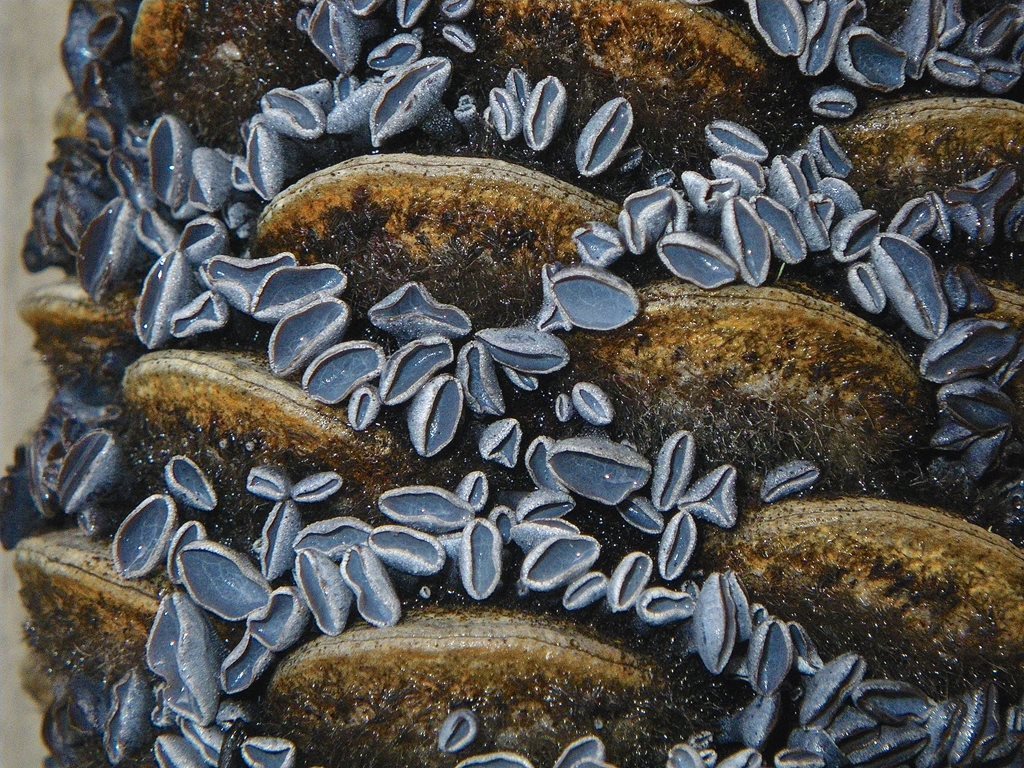
Banksiamyces toomansis
Banksiamyces toomansis is a species of fungus in the family Helotiaceae. It was first described as Tympanis toomansis by Miles Joseph Berkeley and Christopher Edmund Broome in 1886, and transferred to the genus Encoelia in 1957 by R.W.G. Dennis. Gordon William Beaton transferred it to Banksiamyces in 1982.
The fungus grows on dead Banksia cones, and has a distribution limited to Australia. The disc-shaped fruitbodies of the fungus have dimensions of about 2–5 millimetres (0.08–0.20 in), and are light grey to dark charcoal grey. They are attached to the cones by stalks up to 5 mm (0.2 in) long. Its ascospores can range in shape from elliptical to cylindrical, and have dimensions of 6–10 by 2.5–3 μm.
Where it lives
Recorded sightings
—
geo-referenced records in GBIF, from museums, herbaria and field observers.
Drag the globe to turn it. Dots are where records exist, not a range map; darker means more records.
In the stacks
Searching the stacks…
Every page naming Banksiamyces toomansis in the Biodiversity Heritage Library →
This page is assembled live from iNaturalist, GBIF, Wikipedia, the Source Library and the Internet Archive. It is not yet part of the hand-edited codex. iNaturalist taxon 353659.