- Fungi Including Lichens
- ›Basidiomycete Fungi
- ›Higher Basidiomycetes
- ›Mushrooms, Bracket Fungi, Puffballs, and Allies
- ›Agaricomycetidae
- ›Common Gilled Mushrooms and Allies
- ›Pluteineae
- ›amanita mushrooms and allies
- ›Amaniteae
- ›Amanita
- ›Amanita
- ›Caesareae
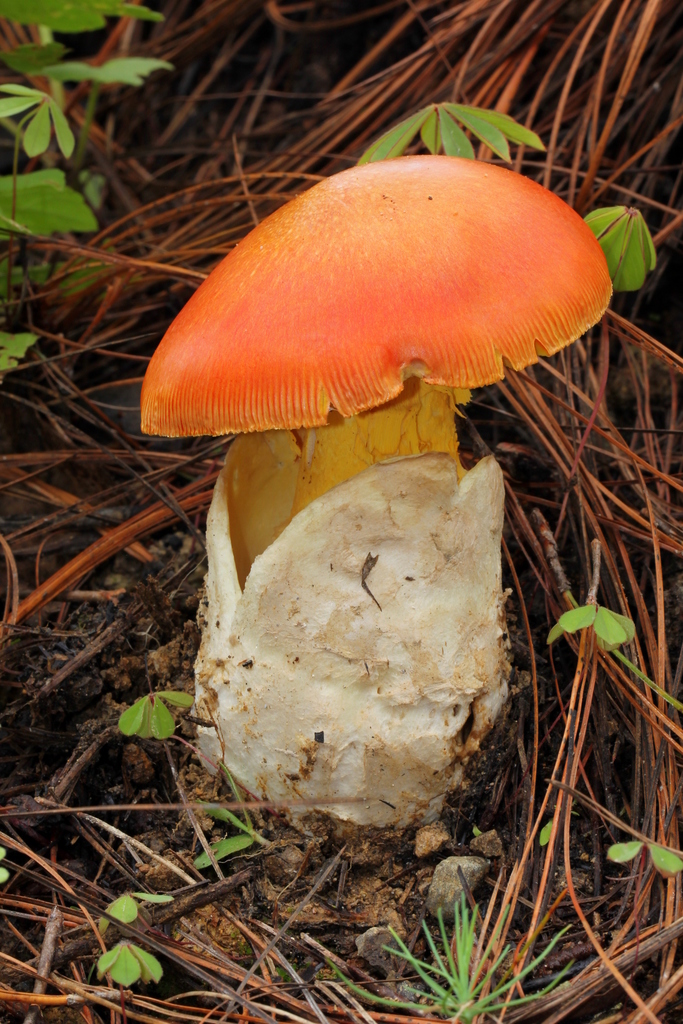
Yolk-Colored Caesar
Amanita yema
Amanita yema is a species of mushroom-forming fungus in the genus Amanita, family Amanitaceae. The fungi can be identified by their pileus, with a red center that gradually fades into a yellow-hued edge. Growing only in forest outskirts in Mexico, the fungus is a member of the plant biome as it is a mycorrhizal fungus.
From the article Amanita yema on Wikipedia (CC BY-SA), quoted section by section
Description
Standing tall with a pileus that fades from a red center to a yellow margin, this fungus stands out. With a base that ranges from a white/yellow color to an orange colored stem. Its gills, or lamella, are also described to have a white or yellow tint. Stemming from the soil, the fungus is often found around forest edges in Mexico. The fungus is said to have a mild odor and taste.
Range & habitat
This mushroom is found in most temperate forests in Mexico and is locally used by its natives. There is a demand for this fungus in Italy, but no trade has been made with Mexico. As part of the Amanita caesarea complex, it is deemed to have a high cultural significance in Ixtlan.
Wikipedia: “Habitat and distribution”
At the table
This mushroom is deemed to be a wild edible fungus, and is said to have a pleasant taste. It is often consumed with other mushrooms and meat. Although with its simplicity and rather small size, many eat the mushroom by itself. With a simple light washing with water, it is ready to be cooked. It is, however, a species of fungi that is avoided, as it is similar in appearance to the toxic fungal species Amanita muscaria. Its local abundance is low.
== References ==
Wikipedia: “Edibility”
Where it lives
Recorded sightings
—
geo-referenced records in GBIF, from museums, herbaria and field observers.
Drag the globe to turn it. Dots are where records exist, not a range map; darker means more records.
In the stacks
Searching the stacks…
Every page naming Amanita yema in the Biodiversity Heritage Library →
This page is assembled live from iNaturalist, GBIF, Wikipedia, the Source Library and the Internet Archive. It is not yet part of the hand-edited codex. iNaturalist taxon 347899.