- Animals
- ›Arthropods
- ›Chelicerates
- ›Arachnids
- ›Spiders
- ›Typical Spiders
- ›Entelegyne Spiders
- ›Salticoid Spiders
- ›Jumping Spiders
- ›Typical Jumping Spiders
- ›Hasariini
- ›Hasarius
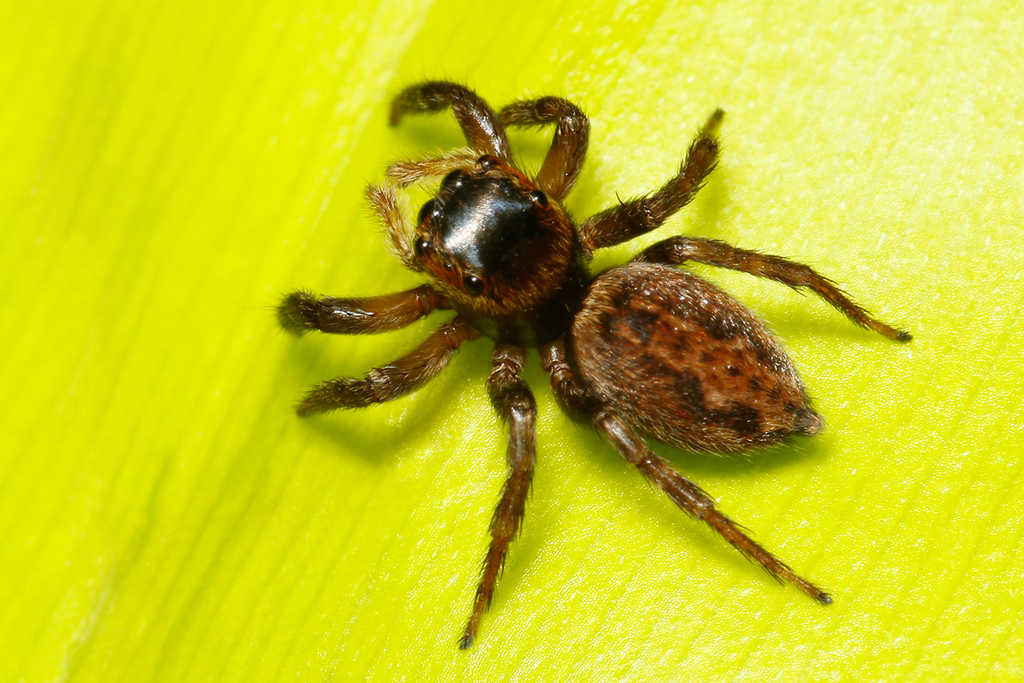
Adanson's House Jumper
Hasarius adansoni
Hasarius adansoni, known commonly as Adanson's house jumper, is a species of jumping spider that is common in warm regions around the world, often associated with people.
From the article Hasarius adansoni on Wikipedia (CC BY-SA), quoted section by section
Description
Females grow up to 8 millimeters in length, males up to 6 millimeters. The males are mostly black, with a red "mask" and pedipalps that are partly white. A white crescent is present on the back part of the abdomen, and another one on the front part of the opisthosoma. There are two small white dots on the posterior back, and two even smaller ones towards the end. These white areas - especially on the pedipalps - have a nacre-like iridescence. Females are dark brown, with a lighter and somewhat rufous opisthosoma.
Range & habitat
H. adansoni is found in warmer climates around the world, for example Malta, India, Japan, Brazil, Taiwan, Tanzania, and Australia. It has also been introduced worldwide in greenhouses and similar places, for example in several German zoos. In China it is distributed in the provinces of Gansu, Guangxi, Guangdong and Yunnan.
Wikipedia: “Distribution”
What it does
These spiders build a silken retreat at night, which is about twice the length of the animal. Although the same retreat is sometimes reused, others are built in the vicinity. Males have been seen to feed on immature females, although this may be by accident.
Wikipedia: “Behavior”
Where it lives
Recorded sightings
—
geo-referenced records in GBIF, from museums, herbaria and field observers.
Drag the globe to turn it. Dots are where records exist, not a range map; darker means more records.
In the stacks
Searching the stacks…
Every page naming Hasarius adansoni in the Biodiversity Heritage Library →
This page is assembled live from iNaturalist, GBIF, Wikipedia, the Source Library and the Internet Archive. It is not yet part of the hand-edited codex. iNaturalist taxon 347886.