- Animals
- ›Molluscs
- ›Gastropods
- ›Heterobranchs
- ›Euthyneura
- ›Tectipleura
- ›Sea Butterflies
- ›Euthecosomata
- ›Limacinoidea
- ›Limacinidae
- ›Limacina
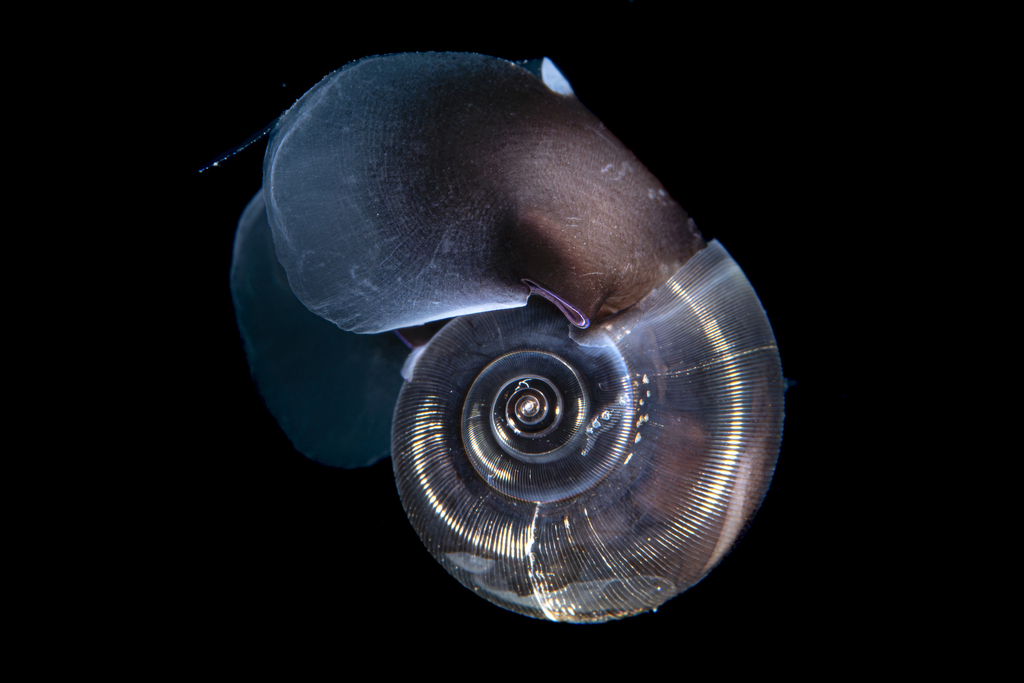
Helicid Pteropod
Limacina helicina
Limacina helicina is a species of small swimming planktonic sea snail, in the family Limacinidae. It belongs to the group commonly known as sea butterflies (Thecosomata).
Limacina helicina is a keystone species of mesozooplankton in Arctic pelagic ecosystems.
From the article Limacina helicina on Wikipedia (CC BY-SA), quoted section by section
Description
Limacina helicina has wing-like parapodia which evolved from the original gastropod foot (as is the case in all other pteropods). In this species, the color of the soft parts is dark purple or violet, with paler pellucid (translucent) parapodia.
The shell is sinistral, subglobose, subdiscoidal, hyaline and very thin. The spire is depressed but it can be considered rather high in comparison of other Limacina species. The shell has a wide umbilicus and the aaperture is higher than it is wide. The shell has 5-6 transversally striated whorls and a distinct suture. The last whorl is large and with very obscure keel next to its umbilicus. The width of the shell is 5–10 mm or up to 13 mm. The height of the shell is up to 6 mm (when maximum width was 8 mm).
Adult specimens in the genus Limacina have usually lost the operculum. The radula consist of 10 rows. Each row consist of one central tooth and two lateral teeth. The Digestive system also includes an esophagus, gizzard sac and gut.
Range & habitat
The type locality of Limacina helicina is "Arctic seas". Limacina helicina is the only thecosome pteropod in Arctic waters. The distribution of Limacina helicina is arctic and subarctic (subpolar–polar) especially in the Arctic Ocean and countries include:
Northern Atlantic Ocean between 50 and 60 °N, Norwegian Sea, Faroe Islands, North of Iceland, Spitsbergen Greenland: Denmark Strait and Davis Strait Canada: Anticosti Island, Laurentian Channel, Magdalen Islands, Prince Edward Island, Newfoundland, Strait of Belle Isle. USA: area between Cape Hatteras (North Carolina, USA) and Newfoundland island; from the Gulf of Alaska to Friday Harbor, Washington state Russia: White Sea and Novaya Zemlya, Sea of Okhotsk, Sea of Japan, Bering Sea, Chukchi Sea, Kurile Islands, Commander Islands Japan: off Kasumi, Hyōgo
Wikipedia: “Distribution”
What it does
They produce large mucus webs to filter-feed on phytoplankton but also small zooplankton. They eat the web with the captured prey and then re-reproduce a web net. The web is large and spherical and it is difficult to see during the day because of diffuse reflection. Webs are easier to see at night. Limacina helicina is easily disturbed (like all other Thecosomata); when disturbed, it retracts into its shell and destroys its web. Gilmer & Harbison (1991) have assumed, that Limacina helicina feeds while motionless (without actively swimming). Its web enables them neutral buoyancy or allows them slow sinking only. Limacina helicina plays a significant ecological role as a phytoplankton grazer. Limacina helicina is an obligate ciliary feeder. Gilmer & Harbison (1991) hypothesized that Limacina helicina are "web trappers", who are also chemically attracting their motile prey. Major parts of the food of Limacina helicina include tintinnid (Tintinnida), small crustaceans - copepods (Copepoda) and juvenile specimen of its own species (cannibalism). Danish zoologist Johan Erik Vesti Boas reported diatoms (Bacillariophyceae), dinoflagellates (Dinoflagellata) and tintinnids in the digestive system of Limacina helicina in 1888 already. Diatoms and dinoflagellates appear to pass the digestive system of adults largely intact. …
Wikipedia: “Feeding habits”
Where it lives
Recorded sightings
—
geo-referenced records in GBIF, from museums, herbaria and field observers.
Drag the globe to turn it. Dots are where records exist, not a range map; darker means more records.
In the stacks
Searching the stacks…
Every page naming Limacina helicina in the Biodiversity Heritage Library →
This page is assembled live from iNaturalist, GBIF, Wikipedia, the Source Library and the Internet Archive. It is not yet part of the hand-edited codex. iNaturalist taxon 345356.