- Animals
- ›Molluscs
- ›Gastropods
- ›Heterobranchs
- ›Euthyneura
- ›Tectipleura
- ›Sea Hares and Akera Snails
- ›Aplysioidea
- ›Seahares
- ›Aplysia
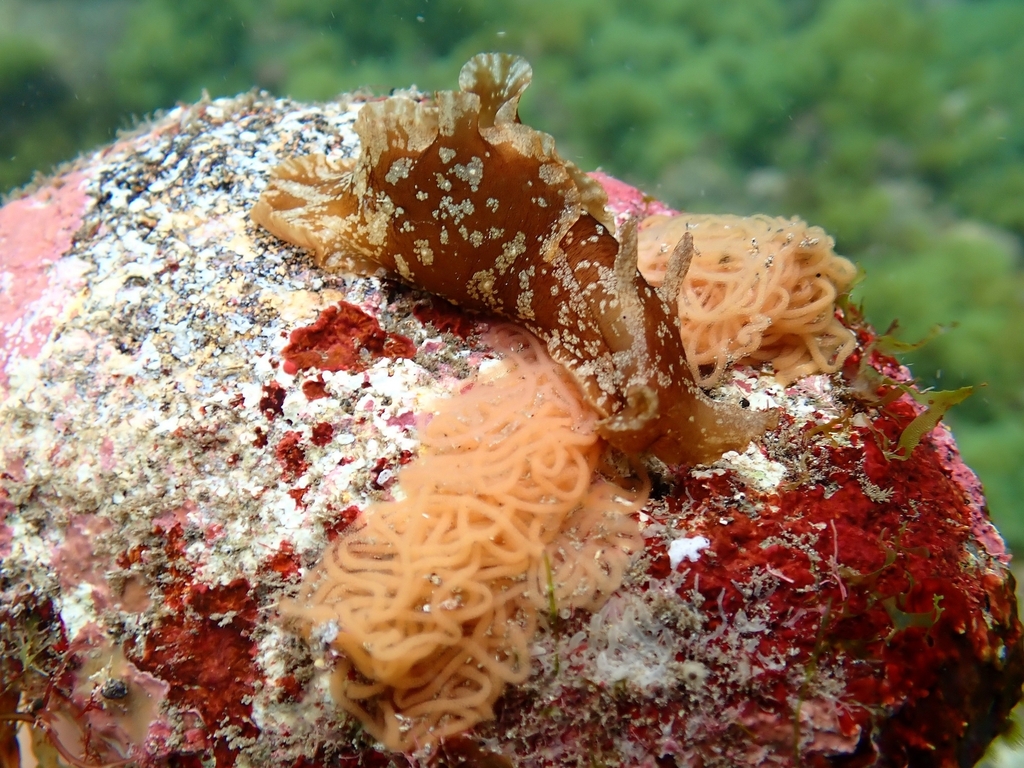
Depilatory Seahare
Aplysia depilans
Aplysia depilans, the "depilatory sea hare", is a species of sea hare or sea slug, a marine opisthobranch gastropod mollusk in the family Aplysiidae.
From the article Aplysia depilans on Wikipedia (CC BY-SA), quoted section by section
Description
Individuals can grow up to 40 cm long and weighs up to 380 g. Their skin is dark brown to reddish brown, with white to light brown blotches. It has a yellow inner shell that is thinner, flatter and more poorly calcified than other sea hares and measures about 1.5 cm long. The shell is oblong, ovate, smooth, and shining, displaying light radial grooves. Its interior is testaceous (shelly). The apex is incurved, reflected, and slightly calloused. The upper margin is excavated, reflected near the apex, and cuneate (wedge-shaped) at its extremity. The outer lip is slightly convex, while the dorsal margin is convex. The lower margin is scarcely excavated.
Range & habitat
This sea hare occurs in the eastern Atlantic and the Mediterranean. It can be found mostly in shallow water of about 1.5 to 10 m. It avoids the intertidal zone because the animals cannot absorb atmospheric oxygen and so die after stranding relatively quickly. Occasionally some are trapped in tide pools at low tide. The adults feed primarily on algae of the genus Ulva, especially sea lettuce Ulva lactuca. During the planktonic phase of life they eat single-celled phytoplankton.
Wikipedia: “Distribution”
What it does
When threatened they emit a white or purple ink. Aplysia depilans are one of the seven species of the genus which are known to swim occasionally rather than crawl. Although hermaphrodites, they cannot self-fertilize and require a partner.
Wikipedia: “Behavior”
Where it lives
Recorded sightings
—
geo-referenced records in GBIF, from museums, herbaria and field observers.
Drag the globe to turn it. Dots are where records exist, not a range map; darker means more records.
In the stacks
Searching the stacks…
Every page naming Aplysia depilans in the Biodiversity Heritage Library →
This page is assembled live from iNaturalist, GBIF, Wikipedia, the Source Library and the Internet Archive. It is not yet part of the hand-edited codex. iNaturalist taxon 342265.