- Animals
- ›Arthropods
- ›Chelicerates
- ›Arachnids
- ›Spiders
- ›Typical Spiders
- ›Haplogyne Spiders
- ›Synspermiatid Spiders
- ›Lost Tracheae Clade
- ›Cellar Spiders
- ›Smeringopinae
- ›Crossopriza
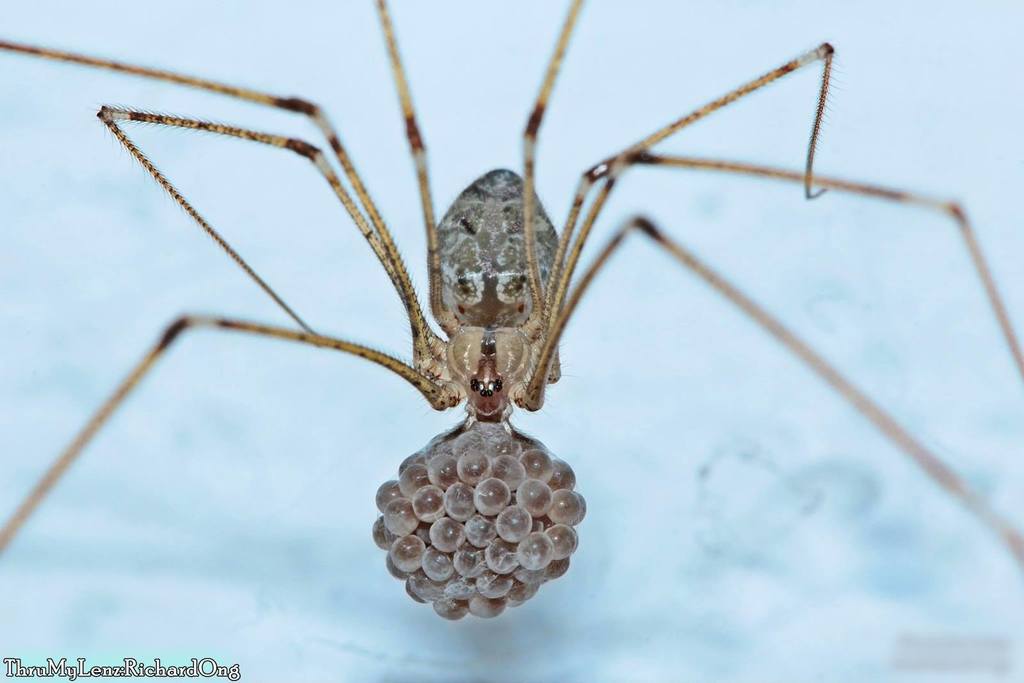
Tailed Cellar Spider
Crossopriza lyoni
Crossopriza lyoni is a widespread species of cellar spiders that prefer to live in or around human structures. They are commonly known as tailed cellar spiders, tailed daddy longlegs spiders, and sometimes box spiders. They all possess extremely long fragile legs that can reach up to 6 cm (2.4 in) long and a body length of that ranges from 2.5 to 7 mm (0.098 to 0.276 in). Their abdomens are distinctly squarish when viewed from the side and their carapace is more or less circular when viewed from above. They also possess two kinds of sound-producing organs and have six eyes.
The original range of C. lyoni is unknown. They have been introduced into other parts of the world accidentally and are now pantropical in distribution. They are a regulated species in some countries and are often regarded as pests due to the large amounts of unsightly webs they construct inside human homes. Some people, however, regard them as beneficial, as they are efficient predators of mosquitoes and other arthropods. They are harmless to humans.
From the article Crossopriza lyoni on Wikipedia (CC BY-SA), quoted section by section
Description
C. lyoni are sexually dimorphic. Females of C. lyoni are about 3 to 7 mm (0.12 to 0.28 in) in length. Males are slightly smaller, at about 2.5 to 6 mm (0.098 to 0.236 in) in length, and have prominent pedipalps. Both sexes possess extremely long fragile legs. Males have slightly longer legs than females. The first pair of legs in larger male individuals can reach up to 6 centimetres (2.4 in) in length. The legs are gray to amber in color and covered with numerous small longitudinal brown spots. The 'knee joints' are brown, and the ends of the femur and tibiae are girdled with white. Males also possess a series of 20 to 25 spines (macrosetae) on their femur. Their leg formula is I, II, IV, III - the front pair of legs being the longest and the third pair being the shortest. The cephalothorax is wider than it is long, greyish-white to pale amber in color. The carapace is subcircular. In the middle of the upper surface is a deep depression (called the thoracic fovea) and a darker longitudinal band of color. C. lyoni, like most other cellar spiders, has eight eyes. They are pearly-white in color and located at the tip of the cephalothorax in two lines. The abdomen (the opisthosoma) is gray with white lateral stripes and various dark and light patches on the sides and the upper surface. An irregular darker stripe runs lengthwise at the bottom surface. …
Range & habitat
C. lyoni are synanthropic, preferring to live inside or near human-made structures. They usually build large irregular webs in corners of rooms, basements, cellars, and beneath ceilings. They are readily transported by human activity, especially as hitchikers in ships. As a result, C.lyoni has been introduced to most of the world, including Australia, Asia, Africa, Europe, North and South America, and some Pacific islands. Their place of origin is unknown but have been variously posited to be Africa (where their genus has the highest diversity) or somewhere in Asia.
Wikipedia: “Distribution and habitat”
What it does
A single male C. lyoni is able to copulate with several females. Mating is accomplished with the male inserting both his pedipalps into the genital orifice of the female and transferring a previously prepared packet of sperm into her spermathecae. Because of the relative shortness of the male pedipalps in comparison to the sheer length of the legs of both males and females of the species, the spiders have to bring their bodies close together, giving the impression of 'snuggling'. This lasts for about 40 minutes. In rare instances, females may eat the males after copulation.
The eggs are deposited by the females 5–6 days after copulation. After laying the eggs, females will bind them into a ball with tiny amounts of silk. They then clutch the resulting egg sacs with their mouthparts and carry them around (a behavior common among all cellar spiders). Eggs that somehow fall from the loose bundles do not hatch. The females still feed during this period, setting their burdens aside temporarily while they eat, then picking them up again. They also frequently adjust their grip. Instances of females eating some of their own eggs have been recorded. It is assumed that they only consume the infertile ones, as unfertilized eggs occur at high enough rates among C. lyoni. 5 to 54 spiderlings will eventually hatch from the eggs, 11 to 13 days after egg-laying. …
Wikipedia: “Ecology and life cycle”
Where it lives
Recorded sightings
—
geo-referenced records in GBIF, from museums, herbaria and field observers.
Drag the globe to turn it. Dots are where records exist, not a range map; darker means more records.
In the stacks
Searching the stacks…
Every page naming Crossopriza lyoni in the Biodiversity Heritage Library →
This page is assembled live from iNaturalist, GBIF, Wikipedia, the Source Library and the Internet Archive. It is not yet part of the hand-edited codex. iNaturalist taxon 339927.