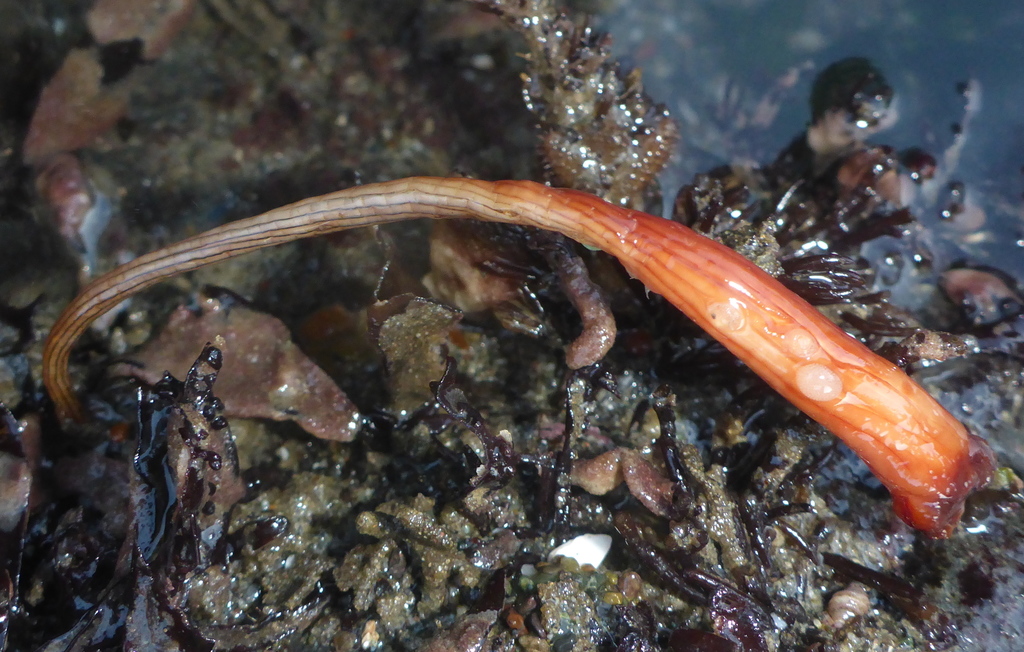
Long-stalked Sea Squirt
Styela montereyensis
Styela montereyensis, also called the stalked tunicate, Monterey stalked tunicate, and the long-stalked sea squirt is a
solitary ascidian tunicate. It has a cylindrical, yellow to dark reddish-brown body and a thin trunk that anchors it to rocks. It is found in subtidal areas of the western coast of North America from Vancouver Island to Baja California.
From the article Styela montereyensis on Wikipedia (CC BY-SA), quoted section by section
Description
Styela montereyensis is yellow to dark red brown in colour. It is a solitary species, growing, often in loose groups. It normally grows to about 8–15 cm (3–6 in) in exposed sites. However, in the more rare, calm habitats, it can grow up to about 25 cm (10 in). The body of Styela montereyensis is elongate and cylindrical, and is attached to a thinner stalk approximately the same length as the body. Its siphons are close together at the distal end, with its oral siphon pointing to the side or downward. The atrial siphon points straight upward. It has a leathery tunic displaying noticeable longitudinal grooves and ridges that extend down the entire length of the body. This species is commonly fouled with foreign matter and small organisms such as algae and hydroids when occurring in harbors, but remains clean in wave-swept habitats. The feeding mechanism of S. montereyensis uses the force generated from underwater current to push water through a feeding apparatus. The flexible stem allows the organism to have its position adjusted passively and the orientation of the siphons optimized by the current, and so foraging is a relatively low-energy activity. Styela montereyensis typically conforms osmotically to their environment due to its limited hyperosmotic capacity, which allows it to adapt to varying salinities in their environment. …
Range & habitat
This species occurs from Vancouver Island and Hope Island south to Baja California.
Wikipedia: “Distribution”
Where it lives
Recorded sightings
—
geo-referenced records in GBIF, from museums, herbaria and field observers.
Drag the globe to turn it. Dots are where records exist, not a range map; darker means more records.
In the stacks
Searching the stacks…
Every page naming Styela montereyensis in the Biodiversity Heritage Library →
This page is assembled live from iNaturalist, GBIF, Wikipedia, the Source Library and the Internet Archive. It is not yet part of the hand-edited codex. iNaturalist taxon 333922.