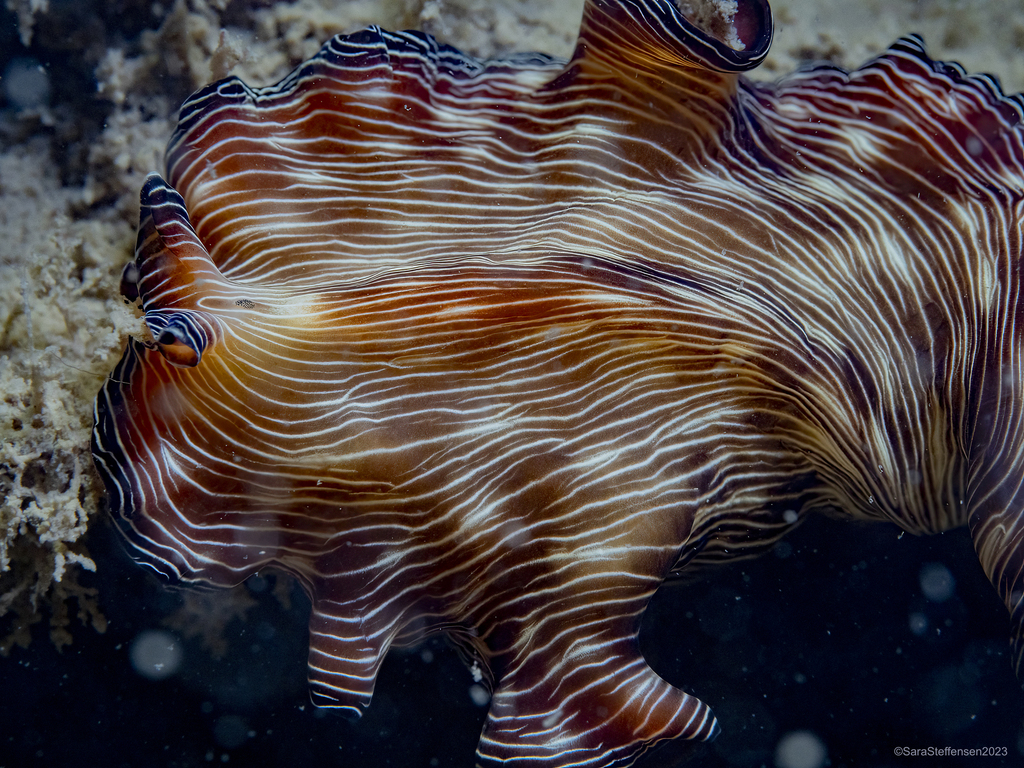
Pseudobiceros fulgor
Pseudobiceros fulgor, also known the lightning worm, is a species of marine flatworm from the family Pseudocerotidae and belongs to the class Turbellaria. These flatworms are commonly found in the tropics of the Indo-Pacific region. They can be found in shallow coral reef environments.
Pseudobiceros fulgor like all flatworms, are triploblastic, meaning 3 germ layers present during development. These organisms are also acoelomate, lacking a body cavity between their gut and body wall. Pseudobiceros fulgor are bilaterally symmetrical, this helps to aid in their movement and navigation in their environment. During embryonic development stages they undergo mostly spiral cleavage. This influences the organization of their cells during development.
From the article Pseudobiceros fulgor on Wikipedia (CC BY-SA), quoted section by section
Range & habitat
Pseudobiceros fulgor are commonly found in the tropic and subtropical oceans of the world. They inhabit shallow coral reefs, internal areas and seagrass beds that can be shared with crustaceans and mollusks. A key feature that helps Pseudobiceros fulgor with survivability in their environment is the ability to regenerate its body when injured. They are drawn towards areas with moderate water flow and high nutrient availability.
Wikipedia: “Habitat”
What it does
Pseudobiceros fulgor are carnivorous and feed on small invertebrates. To do this they use a specialized structure called a proboscis. They have a protrusible pharynx which is a tube like structure that extends out of the mouth. It is lined with tiny teeth that allows for them to grab and break down food. It is an important adaptation and helps to aid in their survivability.
Wikipedia: “Feeding”
Where it lives
Recorded sightings
—
geo-referenced records in GBIF, from museums, herbaria and field observers.
Drag the globe to turn it. Dots are where records exist, not a range map; darker means more records.
In the stacks
Searching the stacks…
Every page naming Pseudobiceros fulgor in the Biodiversity Heritage Library →
This page is assembled live from iNaturalist, GBIF, Wikipedia, the Source Library and the Internet Archive. It is not yet part of the hand-edited codex. iNaturalist taxon 325947.